


























Views
Plays




Business Valuation Quiz | College Finance Essential
Paste this activity's link or code into your existing LMS (Google Classroom, Canvas, Teams, Schoology, Moodle, etc.).
Students can open and work on the activity right away, with no student login required.
You'll still be able to track student progress and results from your teacher account.
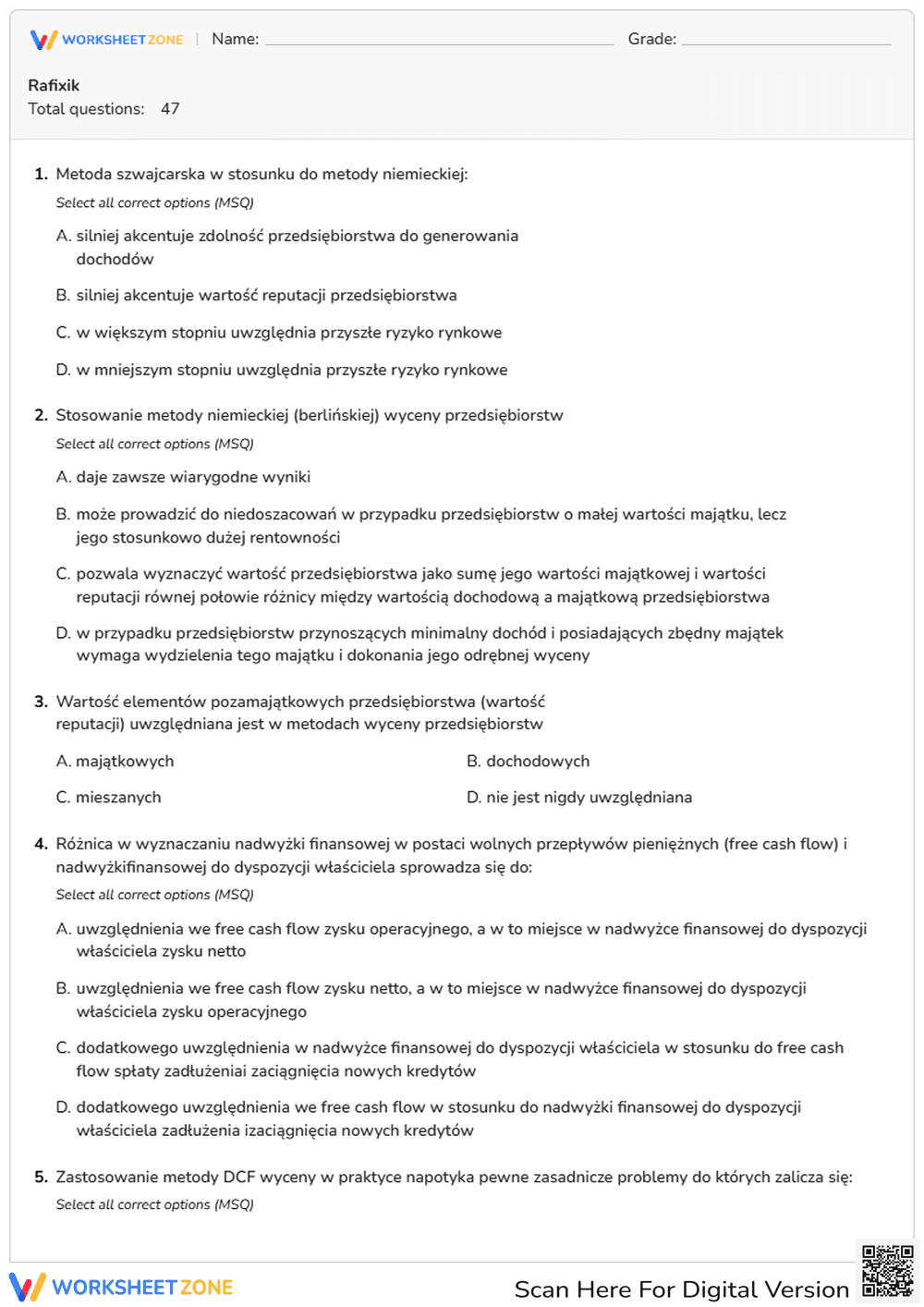
This comprehensive business valuation assessment provides collegiate students with a rigorous 47-question review of corporate appraisal techniques. Students will demonstrate mastery of complex financial models, including Discounted Cash Flow (DCF) and the Weighted Average Cost of Capital (WACC). This resource ensures learners can accurately evaluate enterprise value using diverse international methodologies in a professional context.
At a Glance
- Grade: College · Subject: Business Finance
- Standard:
CCSS.ELA-LITERACY.RST.11-12.7— Evaluate multiple sources of technical information to solve complex financial problems- Skill Focus: Business Valuation Methods
- Format: 9 pages · 47 problems · Answer key included · PDF
- Best For: Advanced finance exam preparation and review
- Time: 60–90 minutes
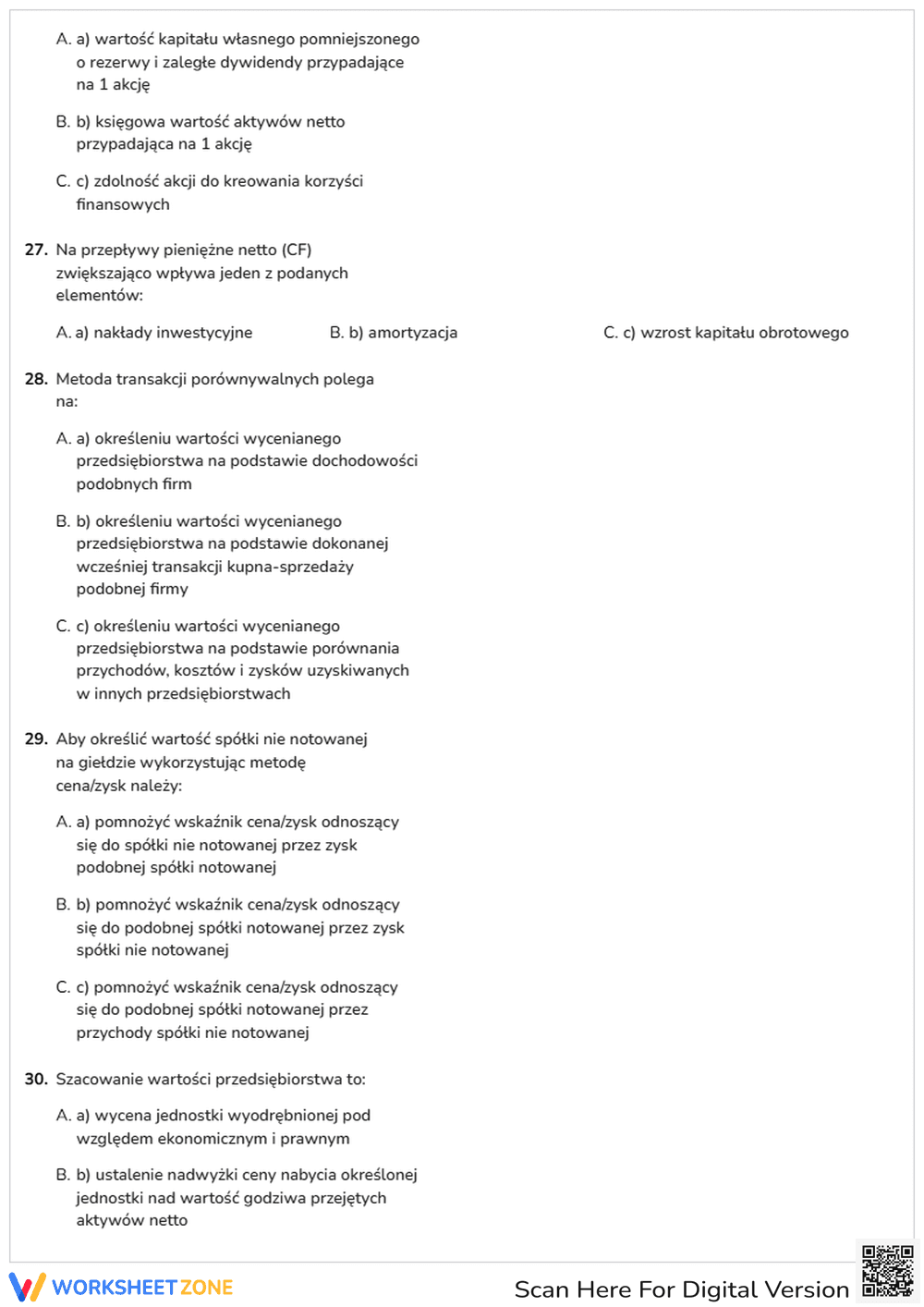
This 9-page PDF contains a robust collection of 47 multiple-choice and multiple-selection questions. The assessment covers a wide range of topics, including the Swiss and German valuation methods, equity cost calculations, and the nuances of free cash flow (FCF) versus net profit. Each page is clearly formatted with professional terminology, providing a realistic simulation of a high-level corporate finance examination.
Zero-Prep Workflow
Step 1: Print the 9-page document (30 seconds). Step 2: Distribute the 47-question assessment to students (1 minute). Step 3: Review the results using the included answer key to identify specific gaps in valuation theory (1 minute). Total teacher preparation time is under 3 minutes, making this an ideal solution for mid-term reviews or unexpected substitute coverage in advanced business courses.
Standards Alignment
The primary alignment for this resource is CCSS.ELA-LITERACY.RST.11-12.7, which focuses on the integration and evaluation of technical information. While designed for collegiate finance, it supports the rigorous analysis of quantitative data and complex theoretical frameworks. This standard code can be copied directly into lesson plans, IEP goals, or district curriculum mapping tools.
How to Use It
Assign this assessment as a summative review after completing units on corporate finance or investment banking. It serves as an excellent diagnostic tool during the first week of an advanced valuation course to gauge prior knowledge. Instructors should observe student performance on the DCF and WACC calculation questions to provide targeted feedback. Completion typically requires 60 to 90 minutes.
Who It's For
This resource is designed for upper-level undergraduate or graduate finance students specializing in corporate appraisal. It is particularly useful for those preparing for professional certifications or final exams. It is ideal for students in international business or Polish finance programs.
The CCSS.ELA-LITERACY.RST.11-12.7 standard requires students to integrate and evaluate multiple sources of information to solve technical problems. This business valuation assessment provides 47 rigorous tasks that challenge learners to synthesize financial data and valuation theories. According to Fisher & Frey (2014), high-stakes technical assessments are most effective when they mirror professional complexity and require the application of multi-step quantitative reasoning. This resource achieves that by requiring students to distinguish between Swiss and German valuation methods while calculating Weighted Average Cost of Capital (WACC) and Free Cash Flow (FCF). By engaging with these 47 specific problems, students build the cognitive endurance necessary for professional certification exams. The structured format ensures that learners can demonstrate mastery of complex financial instruments and corporate appraisal techniques within a standardized testing environment, making it a vital tool for upper-level collegiate finance instruction and assessment.


