




























Views
Downloads

Essential Grade 2 Earth Science: Quick or Slow Changes

Paste this activity's link or code into your existing LMS (Google Classroom, Canvas, Teams, Schoology, Moodle, etc.).
Students can open and work on the activity right away, with no student login required.
You'll still be able to track student progress and results from your teacher account.
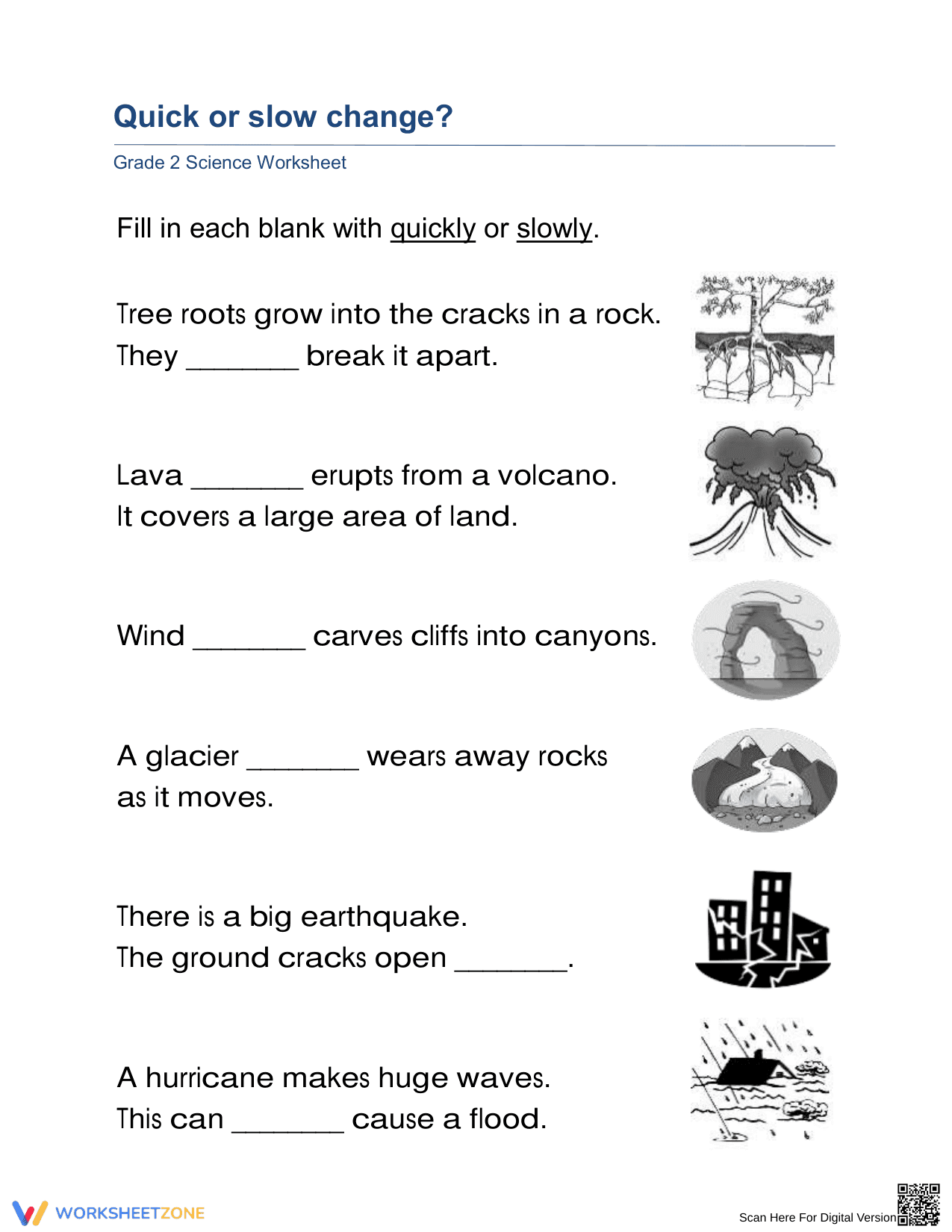
This Grade 2 Earth Science worksheet provides a focused approach to understanding geological processes by challenging students to categorize Earth events as either rapid or gradual. By analyzing specific scenarios like volcanic eruptions and glacier movement, students develop the foundational ability to recognize that our planet is constantly shifting across vastly different timescales.
At a Glance
- Grade: 2 · Subject: Earth Science
- Standard:
2-ESS1-1— Use evidence to show that Earth events occur quickly or slowly- Skill Focus: Categorizing geological changes
- Format: 2 pages · 6 problems · Answer key included · PDF
- Best For: Independent practice or formative assessment
- Time: 10–15 minutes
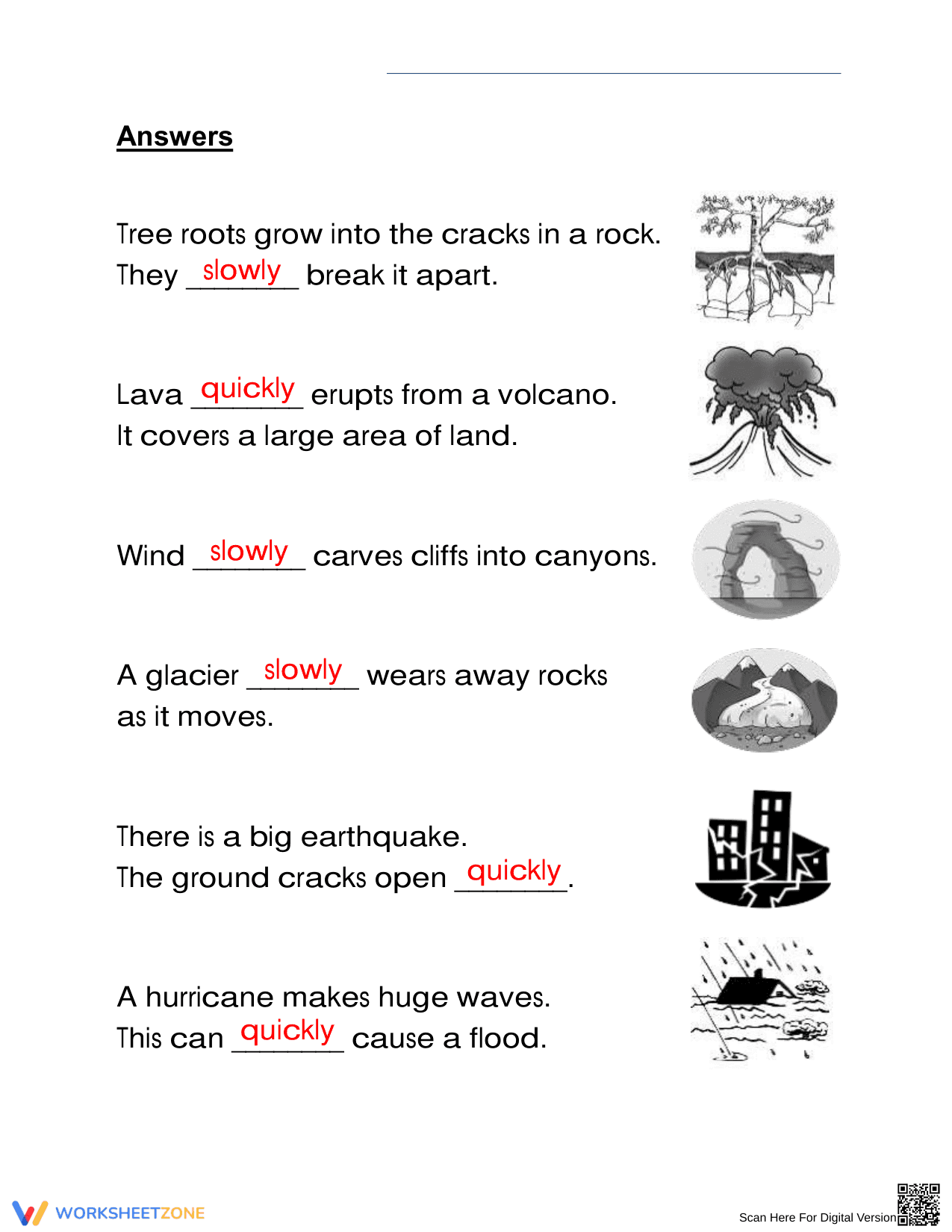
Inside this resource, you will find a clean, student-friendly layout featuring six distinct Earth science scenarios. Each scenario is paired with a clear, high-contrast illustration to support visual learners and provide context for the text. The two-page PDF includes a focused student worksheet and a complete teacher answer key, ensuring that verification of student work is both fast and accurate during a busy science block.
The zero-prep workflow for this resource is designed for maximum efficiency in the classroom. Teachers can print the single-sided worksheet in under 30 seconds, distribute it to the class for a 10-minute independent session, and spend less than one minute reviewing the answers using the provided key. This streamlined process makes the worksheet an ideal candidate for emergency sub plans or as a quick check for understanding following a lesson on volcanoes, weathering, or erosion.
Aligned strictly to 2-ESS1-1, this resource helps students "use information from several sources to provide evidence that Earth events can occur quickly or slowly." By engaging with these specific examples, students build the evidence base required by the Next Generation Science Standards. This standard code can be copied directly into lesson plans, IEP goals, or district curriculum mapping tools to ensure vertical alignment across the science curriculum.
To use this worksheet effectively, assign it as a formative assessment immediately after a direct instruction session on Earth's systems. It works best when students are encouraged to justify their choices verbally after completion. For a quick observation tip, watch for students who hesitate on the "tree roots" or "wind" examples, as these gradual changes often require more conceptual scaffolding than the more dramatic "volcano" or "earthquake" events.
This worksheet is primarily for second-grade students but is also appropriate for third-grade review or first-grade enrichment. The visual cues make it accessible for English Language Learners and students receiving Tier 2 support. For the best instructional results, pair this resource with a short video clip showing time-lapse photography of glaciers or slow erosion to contrast with the sudden impact of a landslide or earthquake.
According to the ScienceDirect TpT Analysis, high-quality supplemental science materials that integrate visual literacy with domain-specific vocabulary significantly improve retention in early elementary learners. This worksheet addresses 2-ESS1-1 by providing students with the concrete evidence needed to distinguish between rapid events like hurricanes and earthquakes and the slow, nearly invisible processes of wind carving canyons or glaciers wearing away rock. By focusing on the plain-English skill of categorizing Earth events, the resource ensures that students move beyond simple identification toward an understanding of temporal scales in geology. Research indicates that using structured practice with immediate feedback loops, as provided by the included answer key, helps solidify these scientific concepts before students transition to more complex modeling in later grades. The inclusion of diverse examples ensures a comprehensive overview of how various natural forces contribute to the ever-changing face of our planet, making it a reliable tool for any standards-aligned science classroom.


