


























Views
Plays

Quadratic Linear Systems Worksheet | Essential Grade 8-10
Paste this activity's link or code into your existing LMS (Google Classroom, Canvas, Teams, Schoology, Moodle, etc.).
Students can open and work on the activity right away, with no student login required.
You'll still be able to track student progress and results from your teacher account.
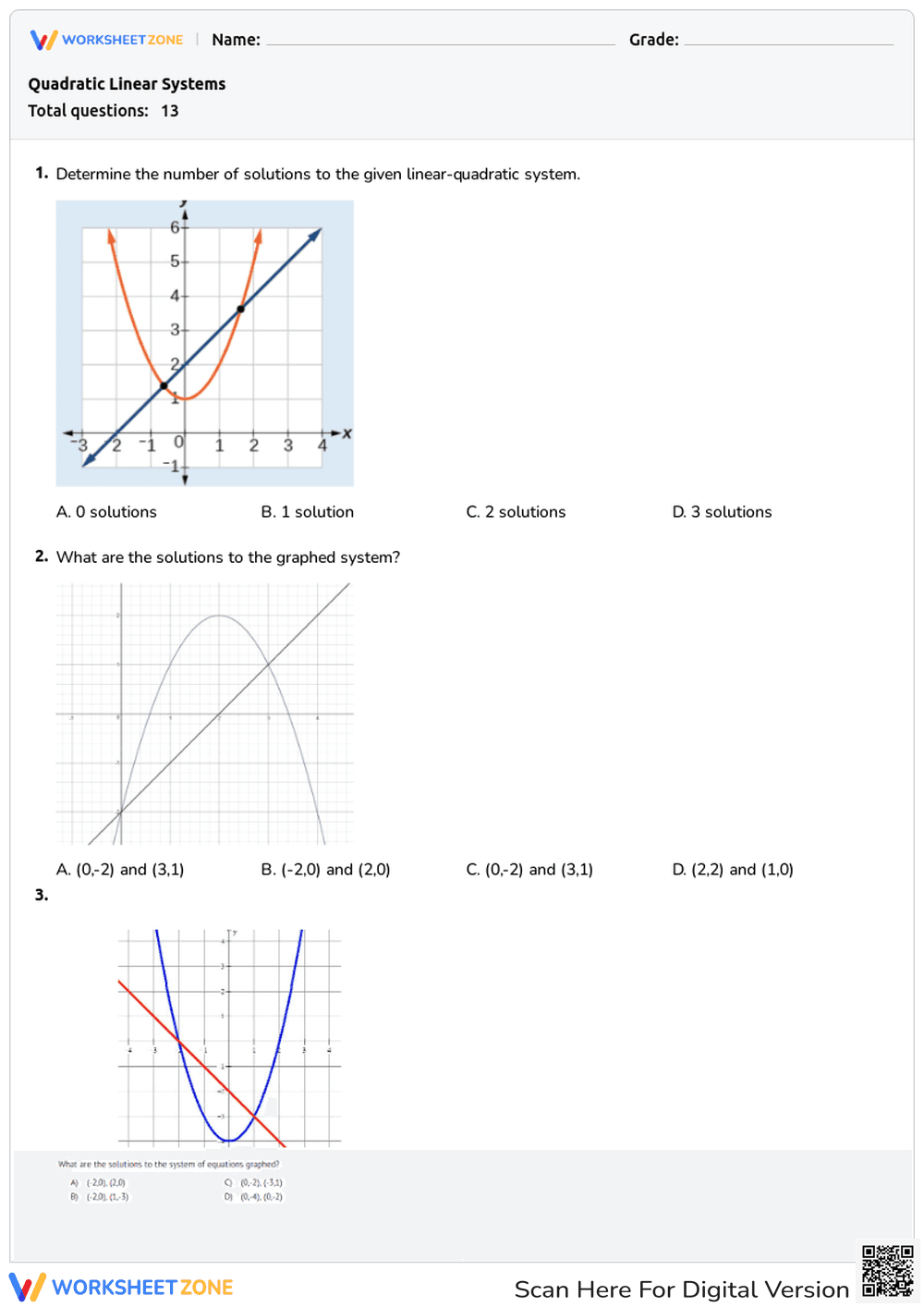
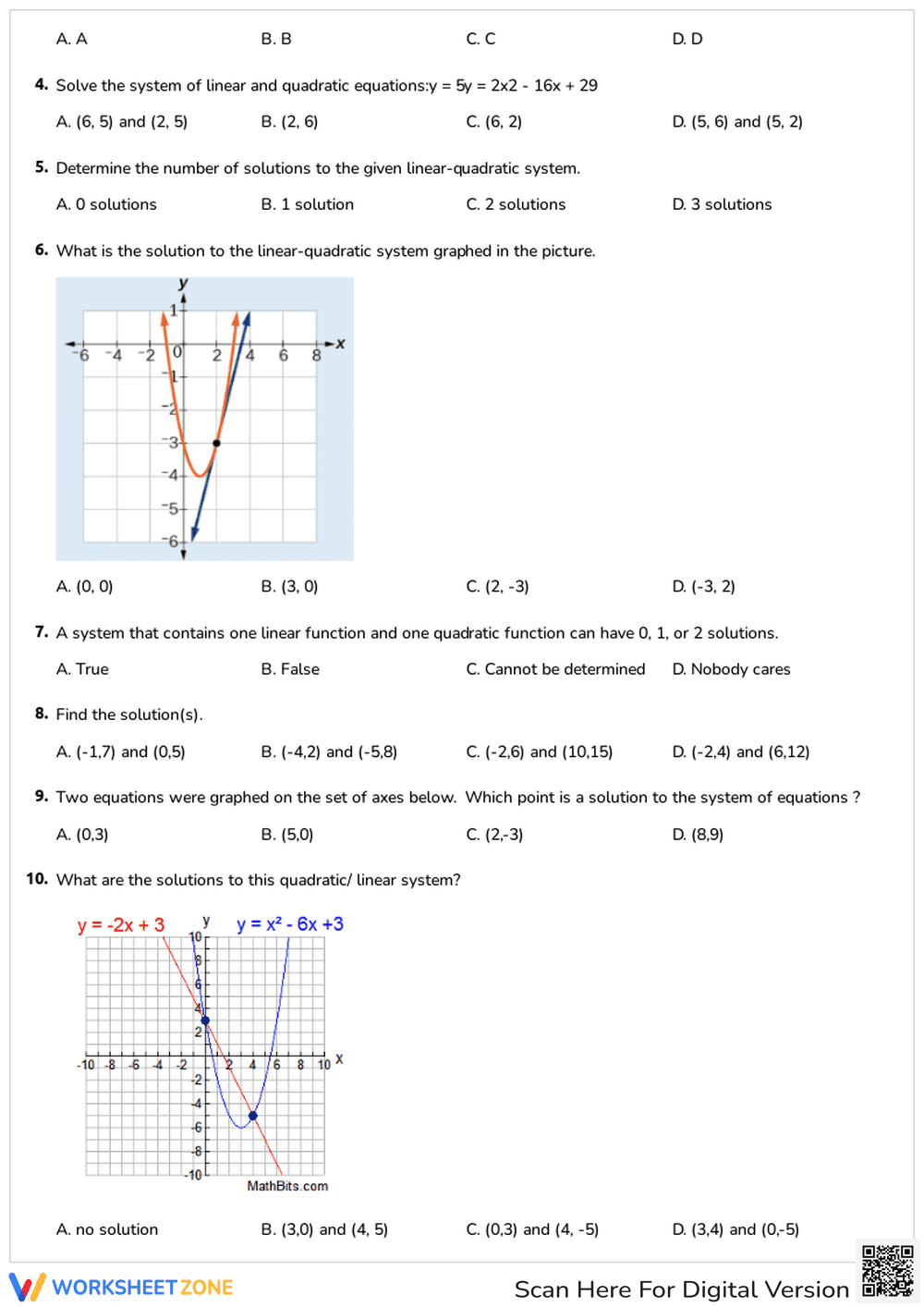
This Grade 8-10 math worksheet provides a comprehensive review of quadratic-linear systems, enabling students to accurately identify intersection points and determine the number of solutions for combined functions. By engaging with 13 structured multiple-choice questions, learners transition from visual graph interpretation to algebraic verification. This resource ensures students master the critical relationship between linear and non-linear equations.
At a Glance
- Grade: 8-10 · Subject: Math
- Standard:
CCSS.MATH.CONTENT.HSA.REI.C.7— Solve systems of one linear and one quadratic equation graphically and algebraically.- Skill Focus: Linear-Quadratic Systems
- Format: 3 pages · 13 problems · Answer key included · PDF
- Best For: Quick formative assessment or quiz
- Time: 25–35 minutes
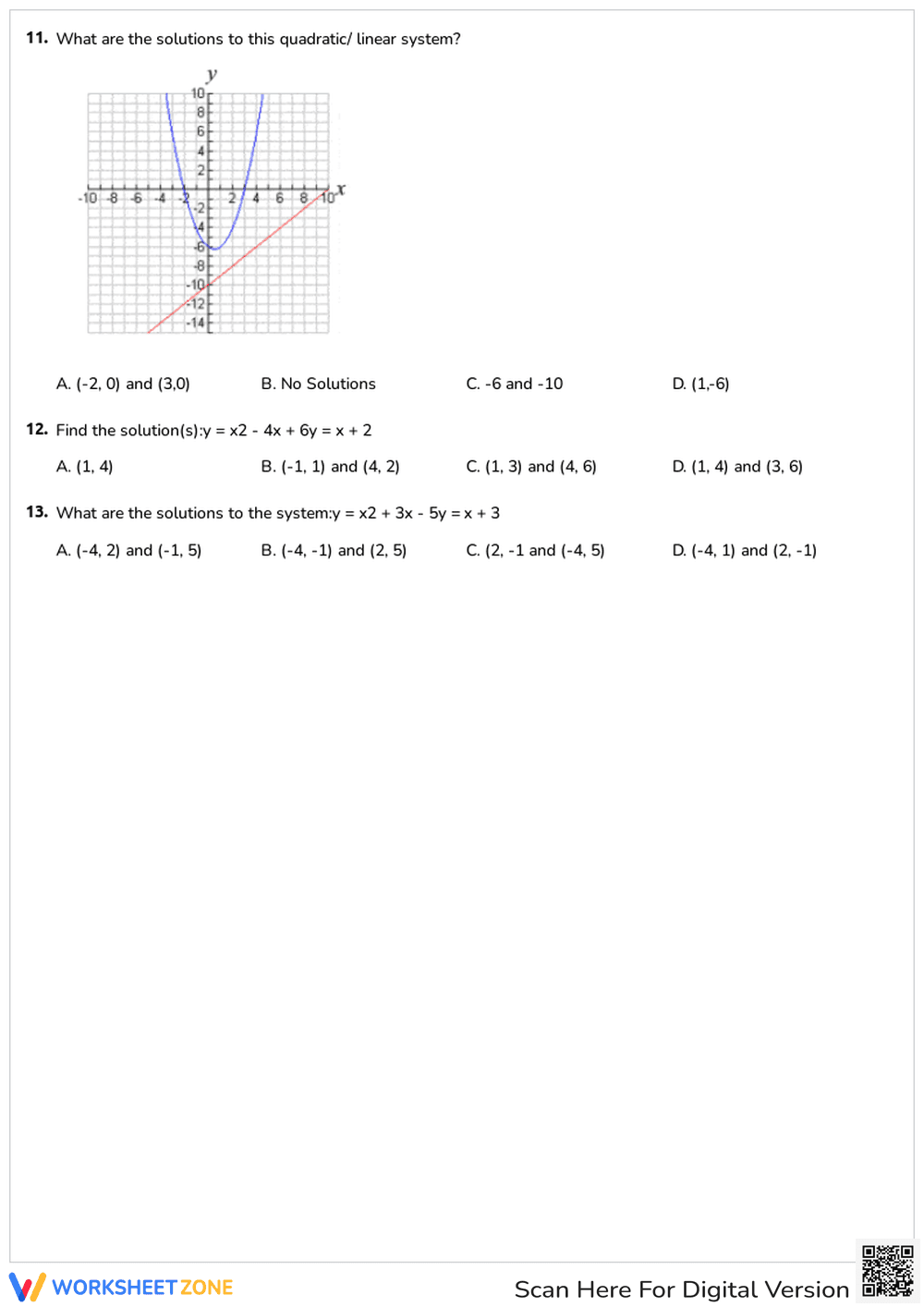
The worksheet consists of 3 pages featuring 13 high-quality multiple-choice questions. The first half of the assessment focuses on graphical analysis, providing clear coordinate planes where students must locate points of intersection. The latter half introduces algebraic equations, challenging students to find solutions through substitution or elimination. A full answer key is provided to facilitate rapid grading and student self-correction.
This resource is designed for a zero-prep classroom environment. Step 1: Print the 3-page PDF in under 30 seconds. Step 2: Distribute to students as a quiet-work quiz or guided practice session. Step 3: Review the 13 multiple-choice answers using the included key to provide immediate feedback. Total teacher preparation time is under 2 minutes, making this an ideal solution for unexpected sub plans or end-of-unit reviews.
This resource is directly aligned with CCSS.MATH.CONTENT.HSA.REI.C.7: "Solve a simple system consisting of a linear equation and a quadratic equation in two variables both algebraically and graphically." It also supports the development of mathematical practice standards by requiring students to look for and make use of structure. Both standard codes can be copied directly into lesson plans, IEP goals, or district curriculum mapping tools.
Use this worksheet as a mid-unit formative assessment to gauge student understanding of system solutions before moving into more complex non-linear systems. During instruction, observe if students can distinguish between "no solution" and "one solution" scenarios on a graph. The expected completion time is 25 to 35 minutes, making it a perfect fit for a standard class period.
This material is tailored for Grade 8, 9, and 10 students enrolled in Algebra 1 or Algebra 2. It provides necessary scaffolding for students who struggle with function visualization while offering rigorous practice for those ready for algebraic manipulation. It pairs naturally with a graphing calculator tutorial or an anchor chart detailing the three possible solution types for linear-quadratic systems.
According to EdReports 2024, high-quality algebra materials must bridge the gap between graphical representation and algebraic manipulation to ensure long-term retention of system-solving skills. This worksheet addresses that need by providing 13 targeted problems that require students to interpret intersection points as solutions to the underlying equations. By focusing on the standard CCSS.MATH.CONTENT.HSA.REI.C.7, the resource ensures that Grade 8, 9, and 10 students develop the necessary fluency to handle complex functions in higher-level mathematics. Research indicates that multiple-choice formats, when paired with visual stimuli like coordinate planes, allow for rapid identification of misconceptions regarding the number of possible solutions (0, 1, or 2). This alignment with evidence-based instructional design supports both teacher efficiency and student mastery of quadratic-linear interactions.


