


























Views
Downloads



Proven Reaction Predictions Worksheet | Grade 11 Chemistry
Paste this activity's link or code into your existing LMS (Google Classroom, Canvas, Teams, Schoology, Moodle, etc.).
Students can open and work on the activity right away, with no student login required.
You'll still be able to track student progress and results from your teacher account.
This Grade 11 chemistry worksheet equips students to defend chemical reaction predictions using qualitative bench data and reference rules. Learners evaluate experimental dossiers, write balanced net ionic equations, and critique competing claims using solubility rules and the activity series to strengthen evidence-based chemical argumentation.
At a Glance
- Grade: 11 · Subject: Chemistry
- Standard: High School Chemistry — Predict and justify reaction outcomes using reference rules and qualitative evidence
- Skill Focus: Defending Reaction Predictions with Rules
- Format: 4 pages · 8 problems · Answer key included · PDF
- Best For: Reaction review and scientific argumentation
- Time: 45–60 minutes
The 4-page worksheet includes a Reference Sheet with solubility rules, gas evolution reactions, and the metal activity series alongside four qualitative bench trials. Across 8 multi-part problems, students extract observational evidence, write net ionic equations, and critique competing student claims. A 2-page teacher answer key provides complete justifications.
Skill Progression
- Guided Practice: Part A (2 tasks) guides students to link experimental trial observations to solubility rules and activity trends.
- Supported Practice: Part B (4 tasks) prompts learners to write net ionic equations and justify selective precipitation mechanisms.
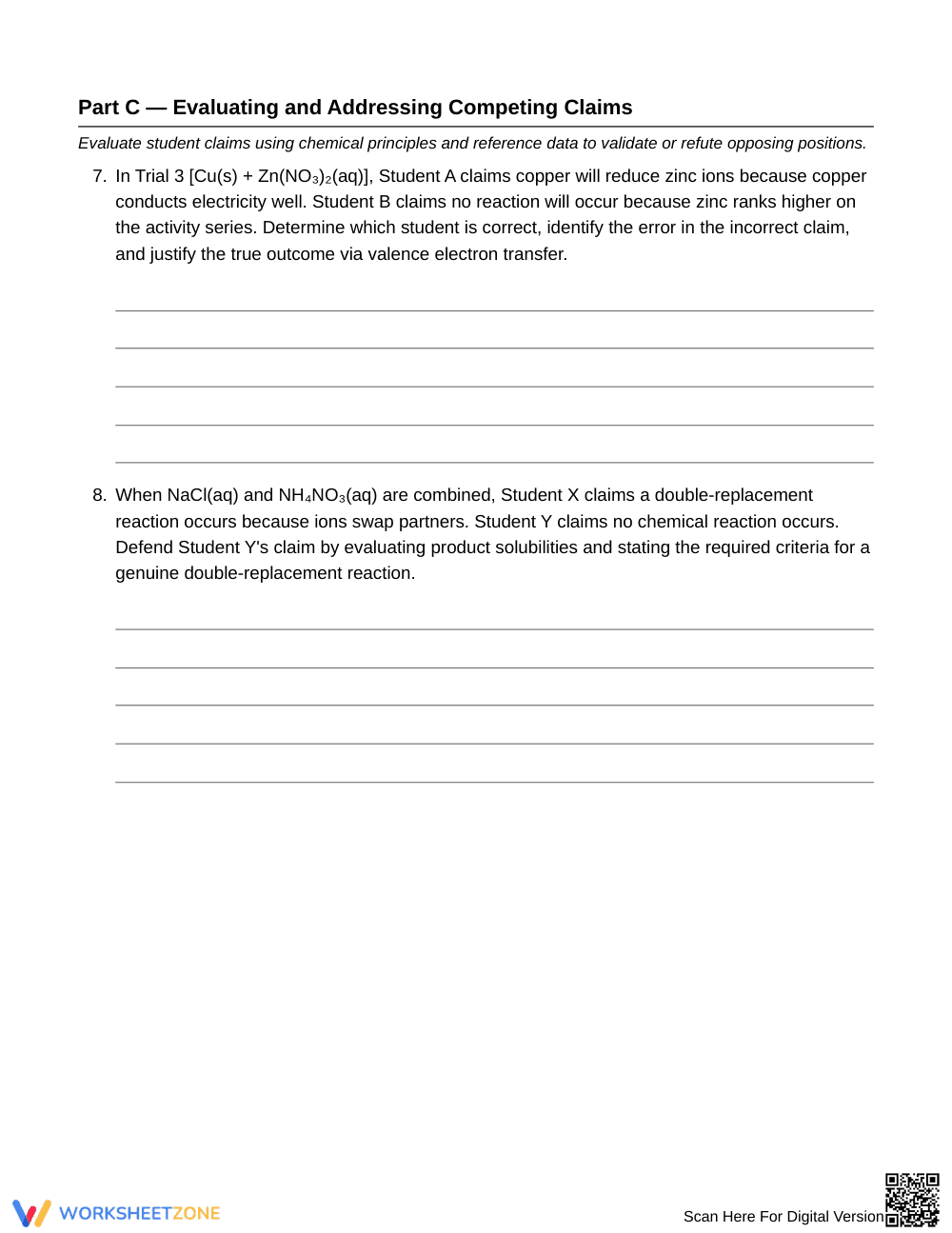
- Independent Practice: Part C (2 tasks) challenges students to refute chemical misconceptions and evaluate competing claims.
This structure applies a gradual-release model from guided data extraction to independent scientific justification.
Standards Alignment
This worksheet aligns with high school chemistry expectations for chemical reactions. Students construct scientific explanations based on evidence, showing how reaction outcomes depend on electron configurations, periodic trends, and solubility properties. Standard alignment details can be copied directly into lesson plans, IEP goals, or district curriculum mapping tools.
How to Use It
Use this worksheet after direct instruction on double-replacement reactions and the activity series. It functions well as a collaborative small-group analysis or an individual review before a unit test. Formatively assess whether students cite specific reference rules when justifying claims. Expected completion time is 45 to 60 minutes.
Who It's For
This resource serves Grade 11 Chemistry and Honors Chemistry students developing scientific argumentation skills. Built-in reference tables support developing learners, while error-analysis tasks challenge advanced students. Pair this worksheet with a qualitative analysis wet lab to connect bench observations to formal chemical defenses.
According to research synthesized by Fisher & Frey (2014), structured argumentation and gradual-release instructional design significantly enhance conceptual understanding in secondary science classrooms. This Grade 11 chemistry worksheet activates high-level cognitive demands by requiring students to defend reaction predictions using empirical evidence and established chemical rules. Rather than relying on rote memorization of reaction types, students systematically evaluate qualitative bench trials, write complete net ionic equations, and critique contrasting claims using solubility charts and the activity series. By integrating explicit reference tables with scaffolded problem sets, the resource supports rigorous formative assessment and reinforces the distinction between macroscopic physical changes and atomic-level chemical transformations. High school educators can utilize this 8-task, 4-page printable problem set to ensure students attain genuine mastery in constructing evidence-based chemical arguments that align with core secondary physical science performance expectations.


