


























Views
Downloads





Proven Paraphrase Scope Worksheet | Grade 11 English III
Paste this activity's link or code into your existing LMS (Google Classroom, Canvas, Teams, Schoology, Moodle, etc.).
Students can open and work on the activity right away, with no student login required.
You'll still be able to track student progress and results from your teacher account.
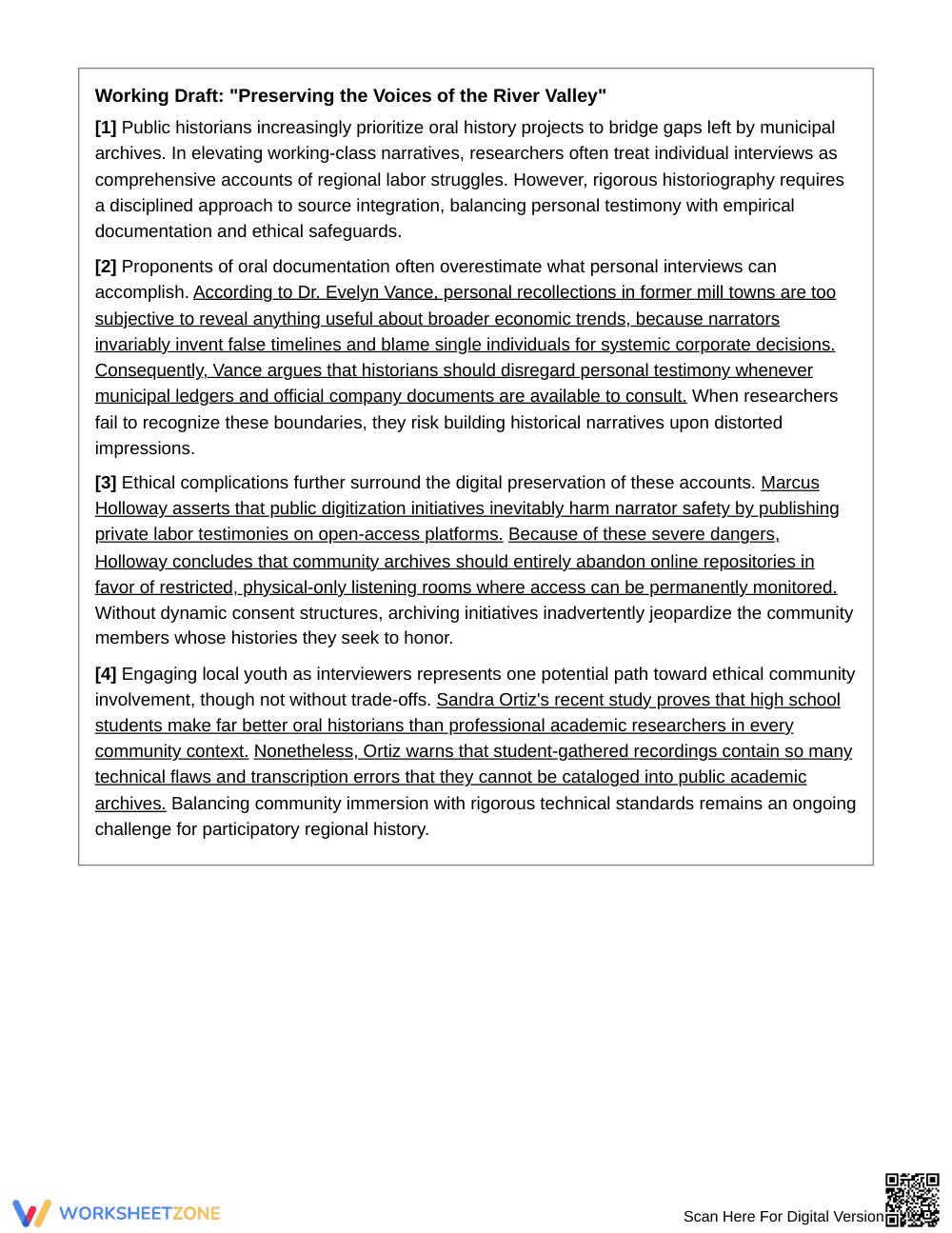
This Grade 11 worksheet trains students to preserve source scope, modal qualification, and conditionality when paraphrasing research texts. Writers eliminate absolute claims and distorted attributions by comparing flawed draft statements against primary archival sources, ensuring accurate synthesis and fidelity to authorial intent.
At a Glance
- Grade: 11 · Subject: English III
- Standard:
W.11-12.8— Integrate authoritative source evidence accurately into writing without distorting authorial scope- Skill Focus: Preserve Scope in a Paraphrase
- Format: 6 pages · 12 problems · Detailed 3-page answer key included · PDF
- Best For: Advanced research synthesis revision and writing practice
- Time: 45–60 minutes
What's Inside
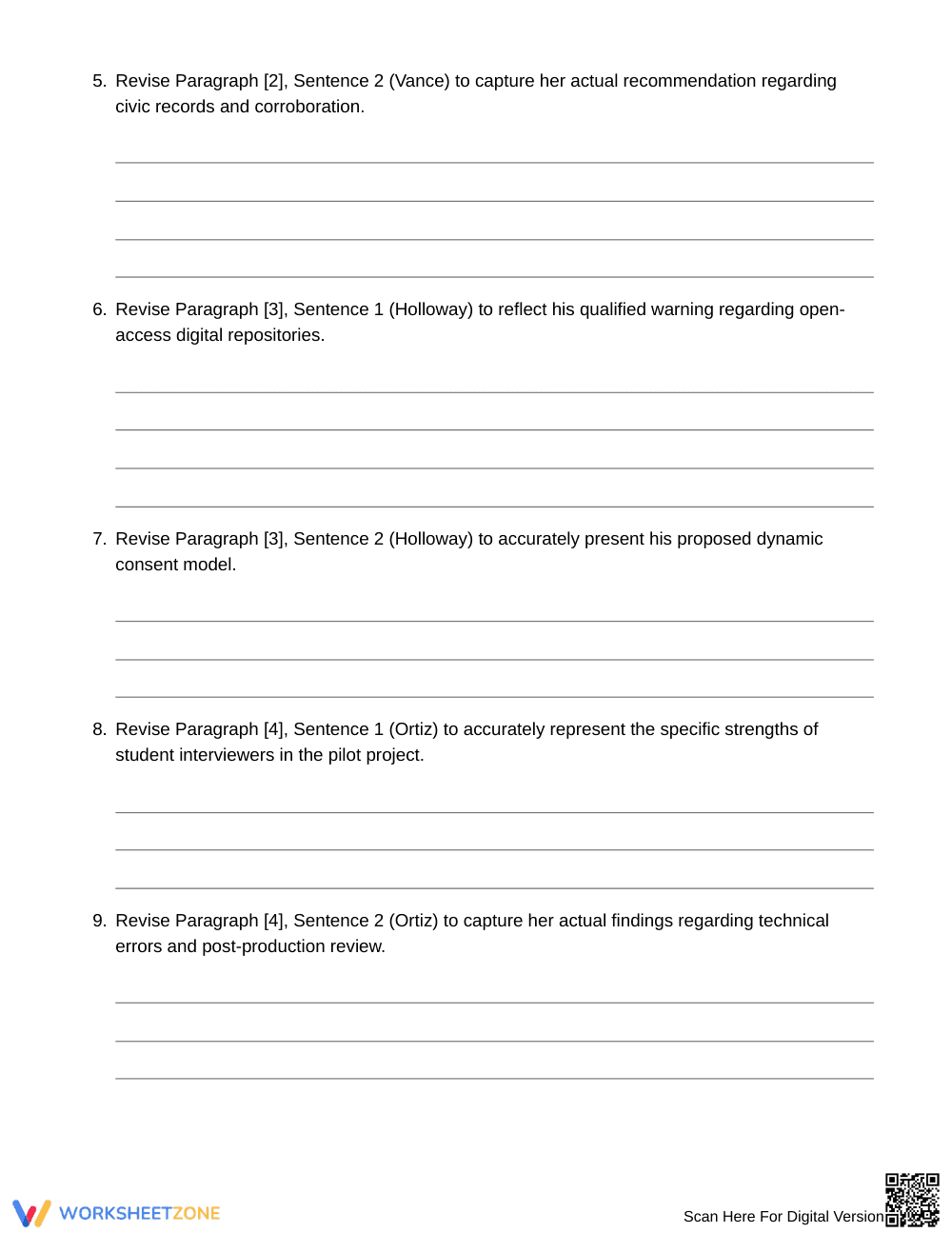
This 6-page resource includes three primary source excerpts on community archiving, a paired draft essay featuring scope errors, and a reference guide on modal shifts. Students complete 12 structured tasks across diagnostic and revision sections, supported by a 3-page explanatory answer key with model rewrites.
Skill Progression
- Guided practice (Part A — 3 items): Students identify quantifier shifts, unwarranted certainty, and scope distortions in draft text.
- Supported practice (Part B — 6 items): Writers revise flawed sentences to restore hedged verbs, conditional clauses, and source limits.
- Independent practice (Part C — 3 items): Learners evaluate lexical trade-offs and compose an independent three-source synthesis.
This progression applies gradual release to move students from error identification to independent synthesis.
Standards Alignment
This worksheet aligns to W.11-12.8 by requiring students to integrate authoritative source information while avoiding overreliance, absolute distortion, or scope creep. It also supports RI.11-12.1 by demanding thorough textual evidence to determine source boundaries. Both standard codes can be copied directly into lesson plans, IEP goals, or district curriculum mapping tools.
How to Use It
Use this activity during the revision phase of a research writing unit. Administer Part A following direct instruction on modal verbs, then assign Parts B and C for paired revision. Check whether students retain source hedges like "can occasionally." Students typically finish all 12 tasks in 45 to 60 minutes.
Who It's For
This resource serves Grade 11 English III and AP Language students preparing for evidence-based research papers. Support developing writers using the reference guidelines, while challenging advanced students with the Part C multi-source synthesis. Pair this worksheet directly with lessons on source citation and argumentative writing.
Mastering the ability to preserve scope in a paraphrase is essential for upper-level secondary writers learning to synthesize academic evidence under W.11-12.8. According to research on literacy instruction by Fisher & Frey (2014), gradual-release frameworks that transition from diagnostic modeling to supported sentence revision accelerate students' ability to transfer complex writing competencies into independent research essays. When eleventh-grade writers cannot identify modal collapse—such as shifting a qualified probability into an absolute certainty—they misrepresent source claims and weaken the logical validity of their own argumentation. This 6-page instructional sequence directly operationalizes the Fisher & Frey (2014) instructional design by pairing authentic archival case studies with systematic paraphrase repair. By practicing targeted scope control across 12 analytical tasks, students acquire the precise syntactic tools and disciplinary vocabulary needed to integrate authoritative print sources accurately, cite complex evidence without distortion, and sustain rigorous academic integrity throughout secondary and post-secondary research writing.


