


























Views
Downloads


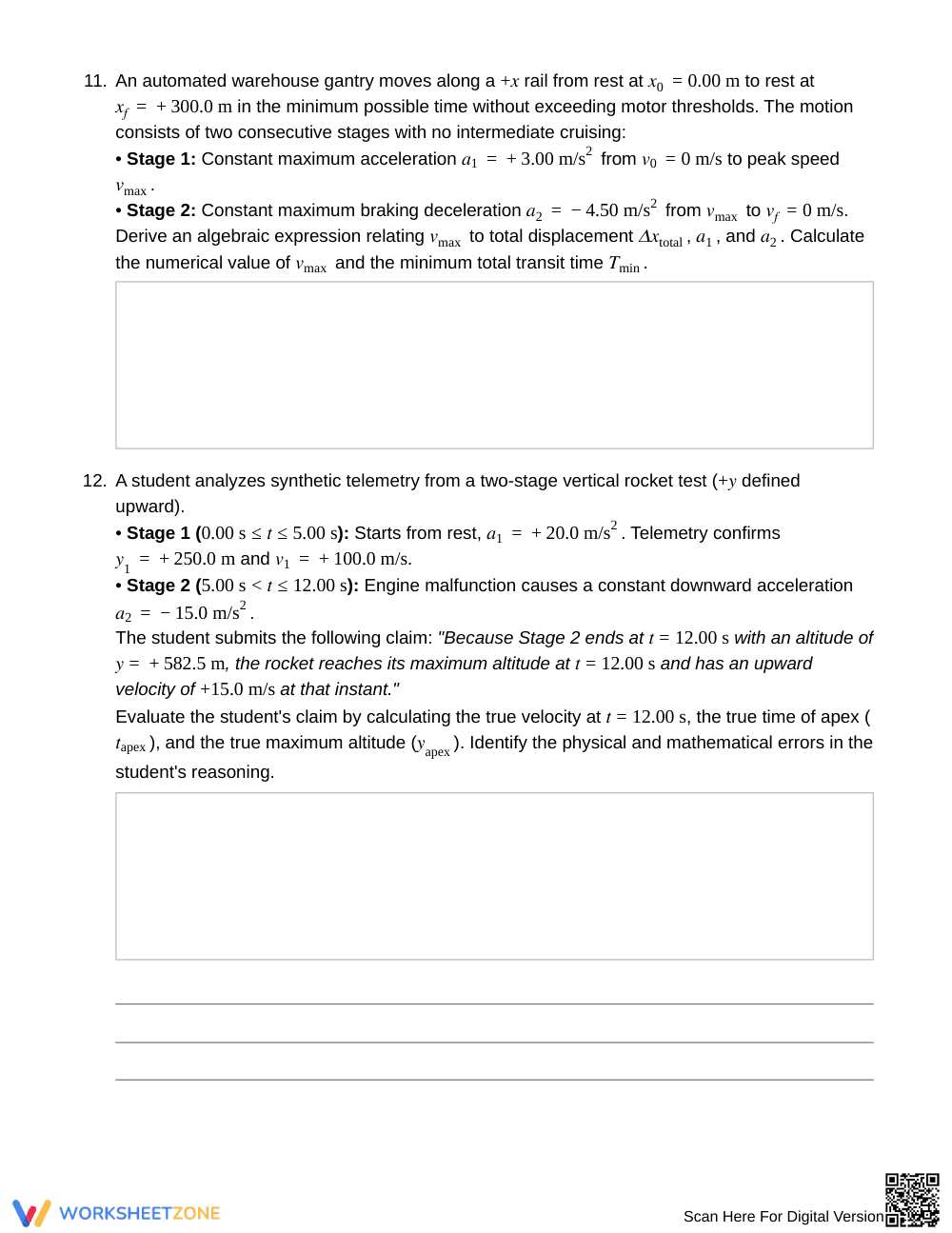

Proven Multi-Stage Kinematics Worksheet | Grade 12 Physics
Paste this activity's link or code into your existing LMS (Google Classroom, Canvas, Teams, Schoology, Moodle, etc.).
Students can open and work on the activity right away, with no student login required.
You'll still be able to track student progress and results from your teacher account.
This Grade 12 physics worksheet equips students to master multi-stage kinematics through piecewise motion analysis. Learners evaluate boundary continuity, track signed vector directions, and resolve transitions across 12 authentic physical scenarios. By bridging conceptual rules with quantitative calculations, students build problem-solving fluency in advanced mechanics.
At a Glance
- Grade: 12 · Subject: Physics
- Standard: Kinematics — Calculate position, velocity, and acceleration across continuous multi-stage motion boundaries
- Skill Focus: Multi-Stage Kinematics Check
- Format: 7 pages · 12 problems · Answer key included · PDF
- Best For: Advanced mechanics unit review
- Time: 45–60 minutes
What's Inside
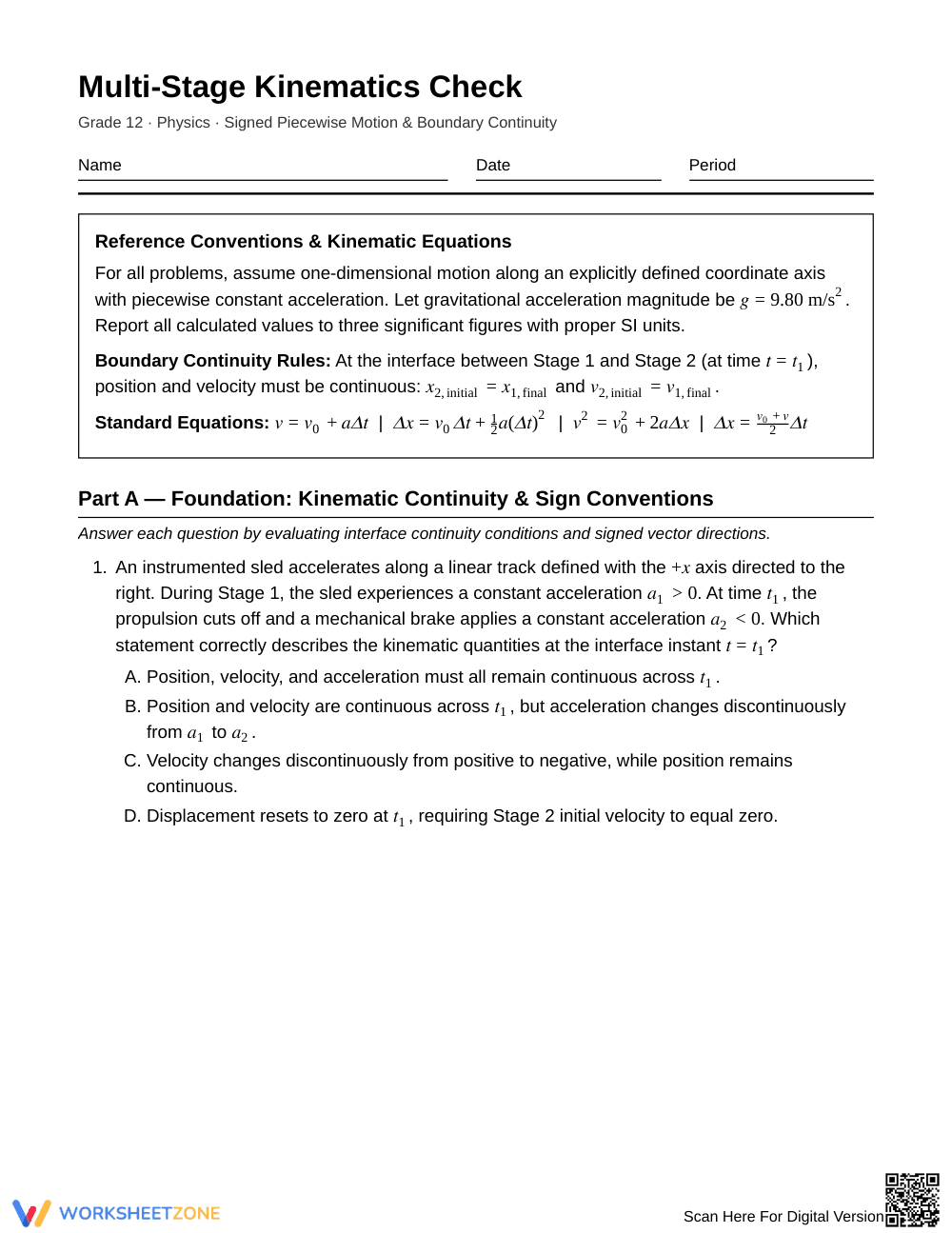
Across 7 pages, this resource delivers 12 multi-step physics problems. A reference header establishes kinematic formulas, sign conventions, and interface continuity rules. Scenarios feature vertical rocketry, autonomous vehicles, braking rail shuttles, oceanographic probes, and telemetry tables. A detailed 5-page answer key provides complete algebraic solutions rounded to three significant figures.
Skill Progression
- Guided Practice (Part A, Problems 1–3): Reviews boundary conditions and signed vectors through foundational checks, robotic horizontal braking, and powered vertical ascent transitions.
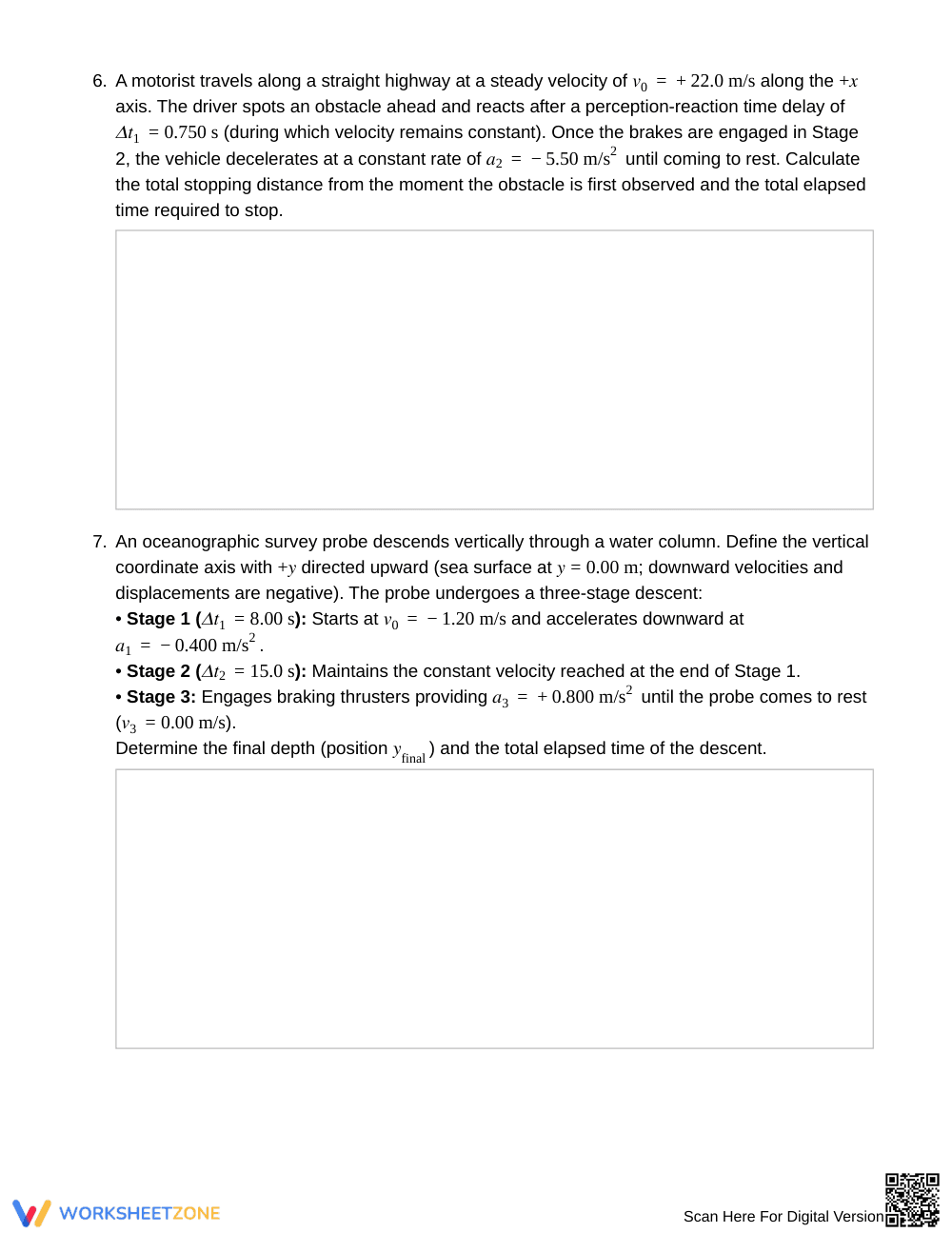
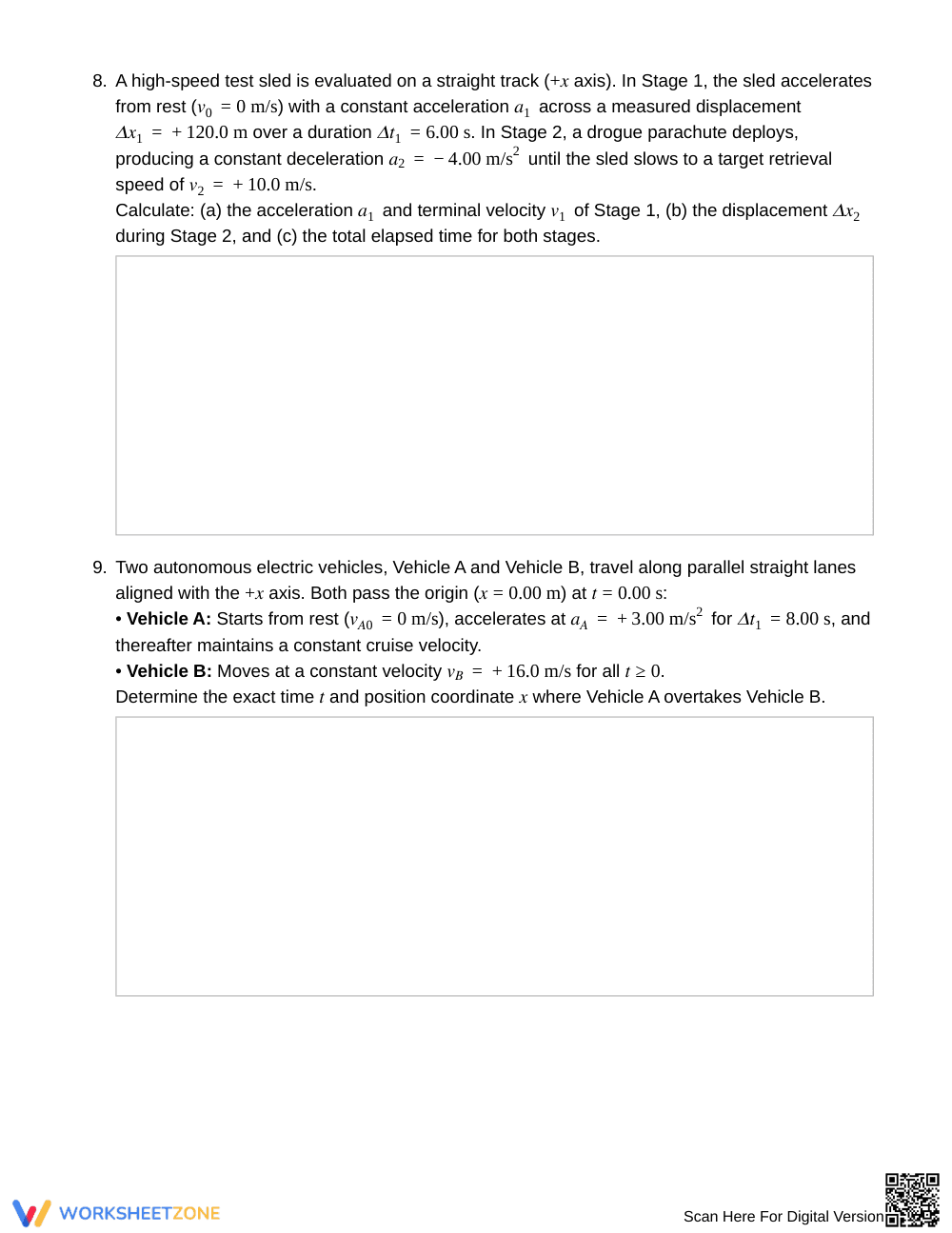
- Supported Practice (Part B, Problems 4–9): Deepens algebraic execution across six multi-stage problems featuring reaction delays, coasting rockets, and vehicle pursuit models.
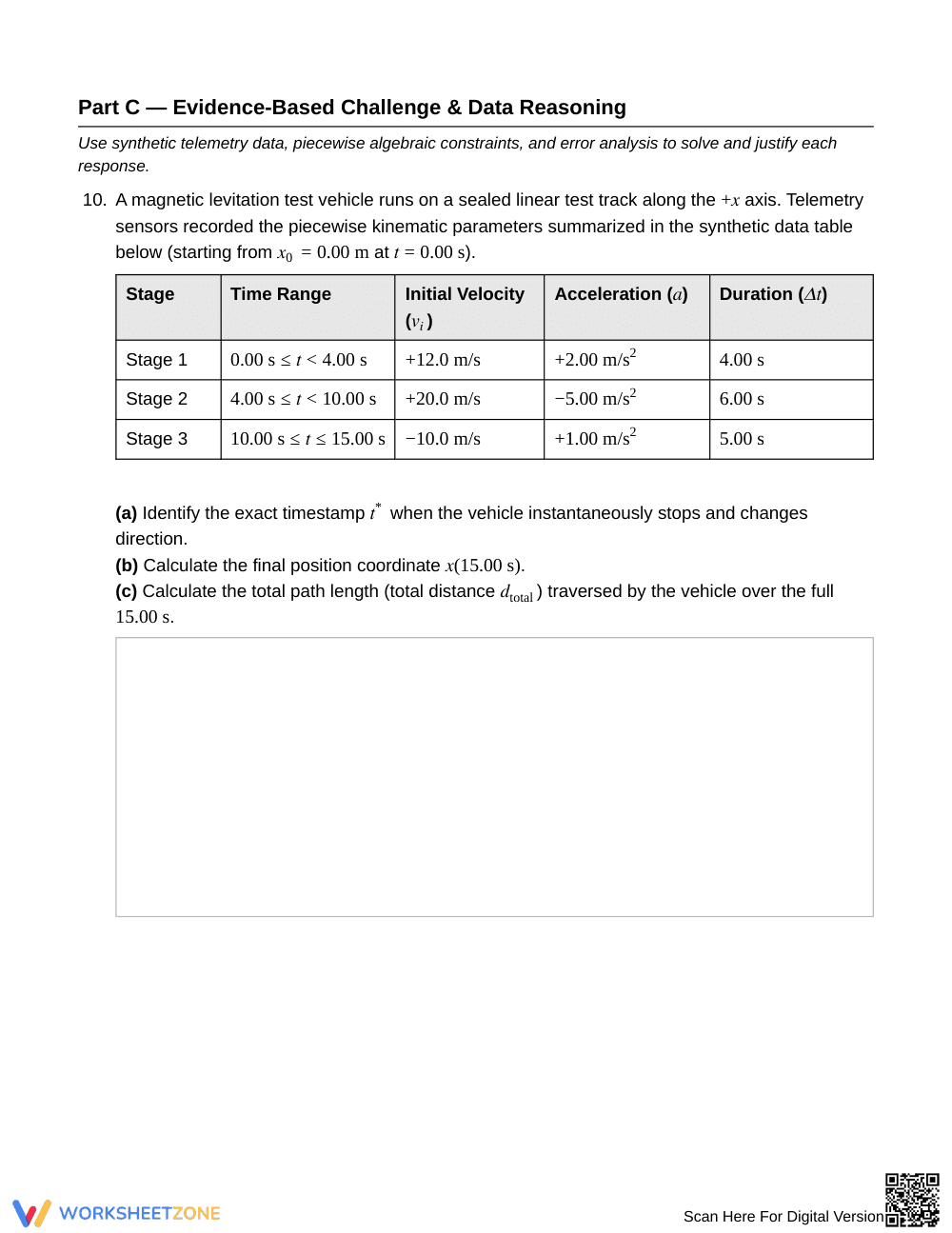
- Independent Practice (Part C, Problems 10–12): Demands complex data reasoning using telemetry tables, transit time optimization, and student claim error analysis.
This sequence follows a gradual-release model, moving from scaffolded boundary identification to autonomous mathematical modeling.
Standards Alignment
This resource aligns with high school physics kinematics standards addressing one-dimensional piecewise motion, frame-of-reference conventions, and non-uniform acceleration models. Students translate verbal and tabular descriptions into connected algebraic equations. Both standard codes can be copied directly into lesson plans, IEP goals, or district curriculum mapping tools.
How to Use It
Deploy this packet after direct instruction on uniform acceleration and before starting projectile motion. Allocate 45 to 60 minutes for paired work on Parts A and B. Formative assessment tip: verify that students transfer Stage 1 final velocity as Stage 2 initial velocity rather than erroneously resetting velocity to zero at the interface.
Who It's For
Designed for Grade 12 physics and AP mechanics students, this worksheet challenges advanced learners while supporting developing problem solvers. Teachers can assign Parts A and B for targeted practice, reserving Part C for honors extensions. Pair this worksheet with motion detector lab activities or velocity-time graph analysis.
According to Fisher & Frey (2014), structured piecewise problem architecture combined with gradual release instructional design fosters deep metacognitive mastery in secondary STEM coursework. This Grade 12 multi-stage kinematics resource provides 12 rigorous tasks requiring students to calculate position, velocity, and acceleration across continuous multi-stage motion boundaries. By demanding explicit coordinate axis definitions, interface continuity enforcement, and multi-tier algebraic substitutions, the worksheet directly eliminates persistent student misconceptions regarding instantaneous velocity shifts and piecewise vector signs. Learners systematically evaluate complex physical scenarios including sounding rockets, reaction-time braking, and synthetic telemetry data tables, culminating in higher-order analytical error evaluation. Supported by an exhaustive 5-page answer key featuring complete step-by-step mathematical proofs, this printable resource serves as an essential instructional instrument for preparing secondary physics students for rigorous college-level mechanics assessments, laboratory investigations, and cumulative examinations.


