


























Views
Downloads

Proven Lenz's Law Induction Worksheet | Grade 12 Physics
Paste this activity's link or code into your existing LMS (Google Classroom, Canvas, Teams, Schoology, Moodle, etc.).
Students can open and work on the activity right away, with no student login required.
You'll still be able to track student progress and results from your teacher account.
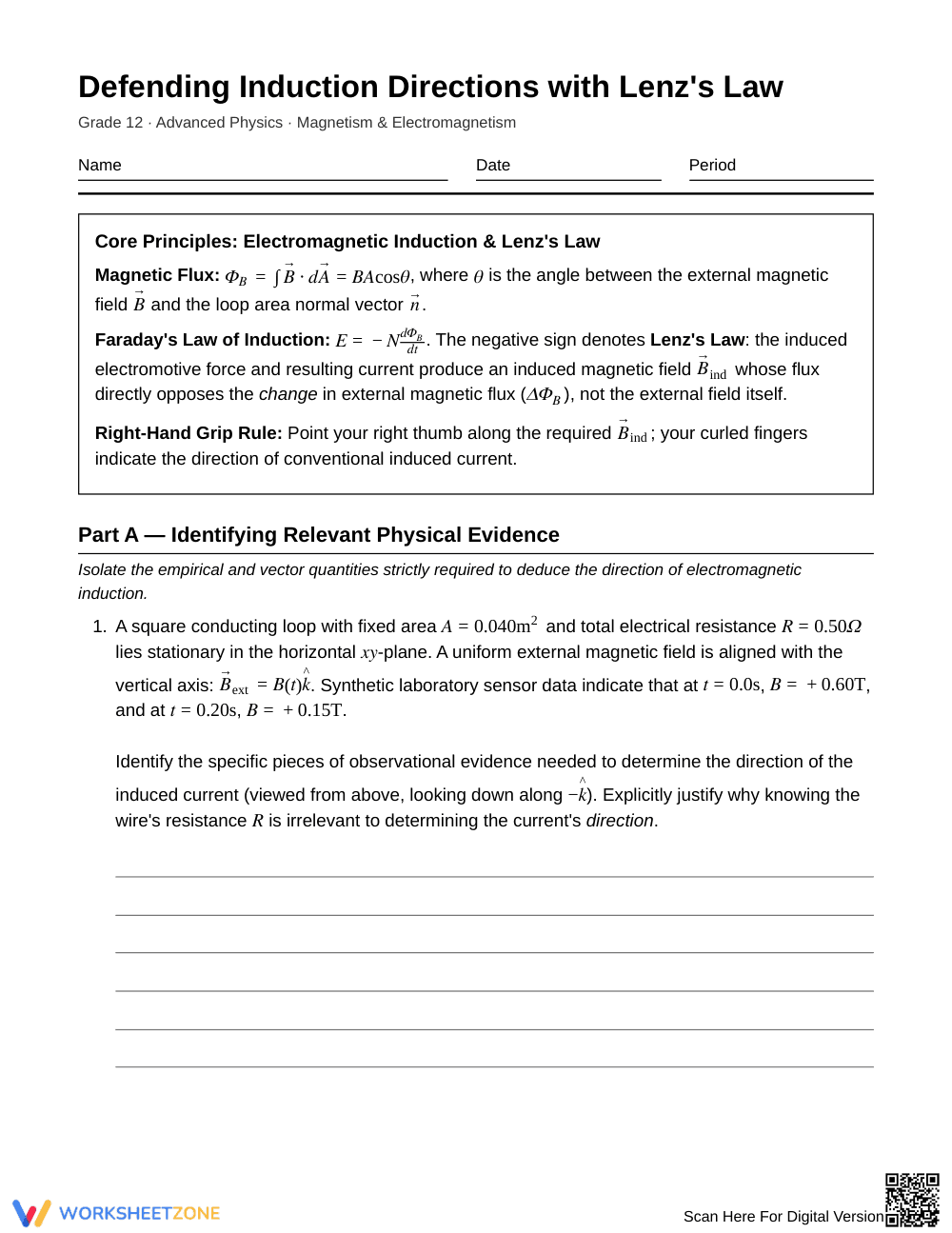
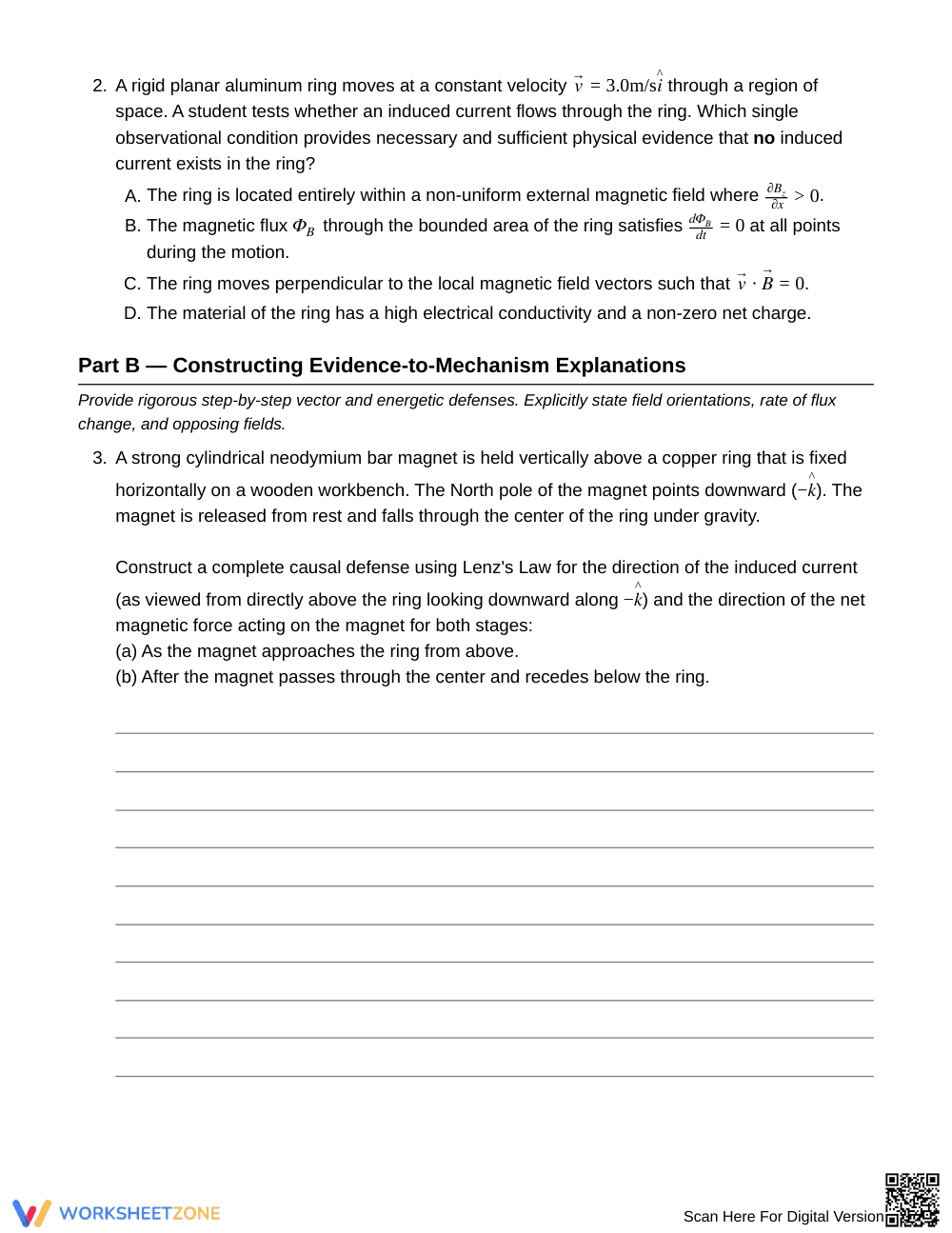
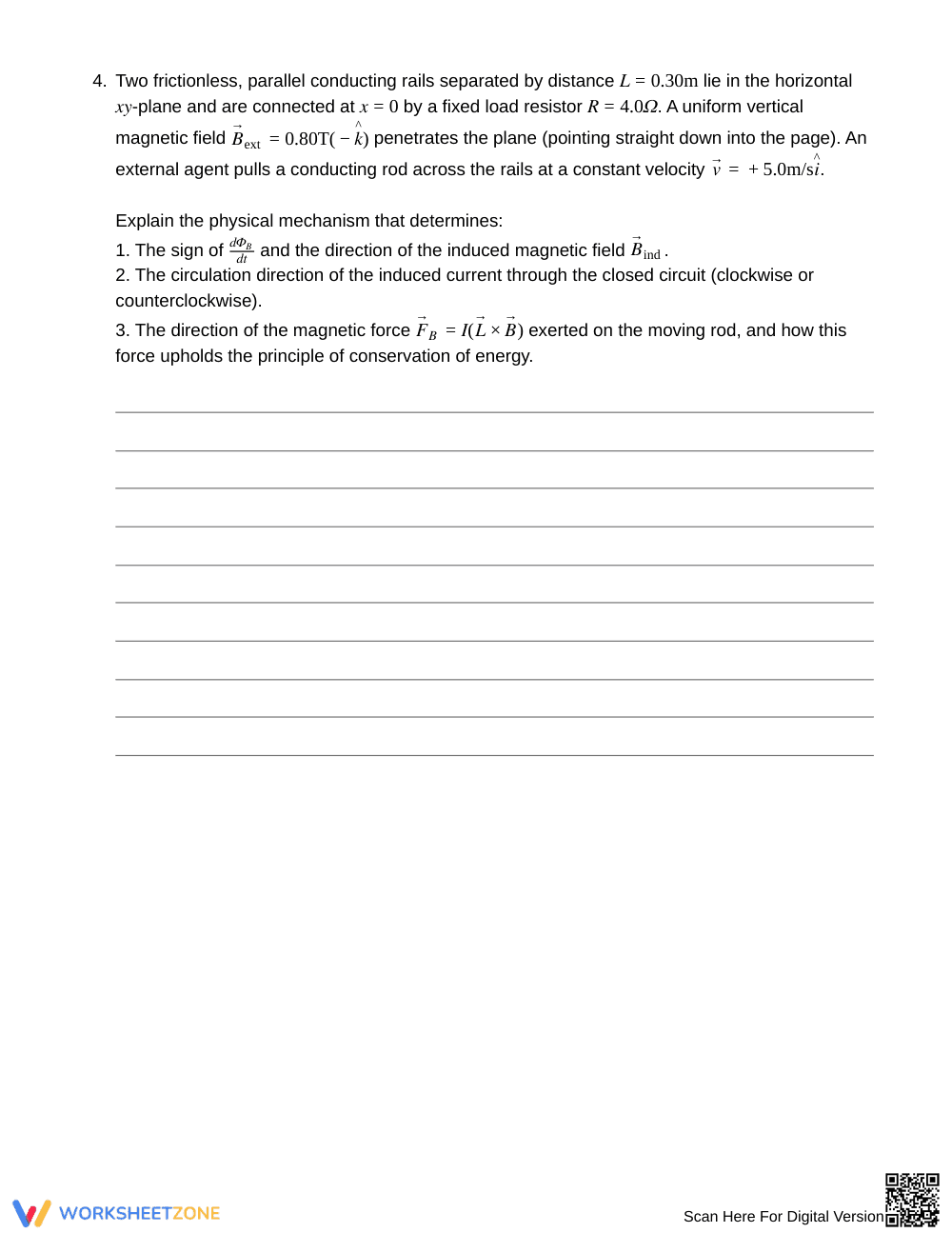
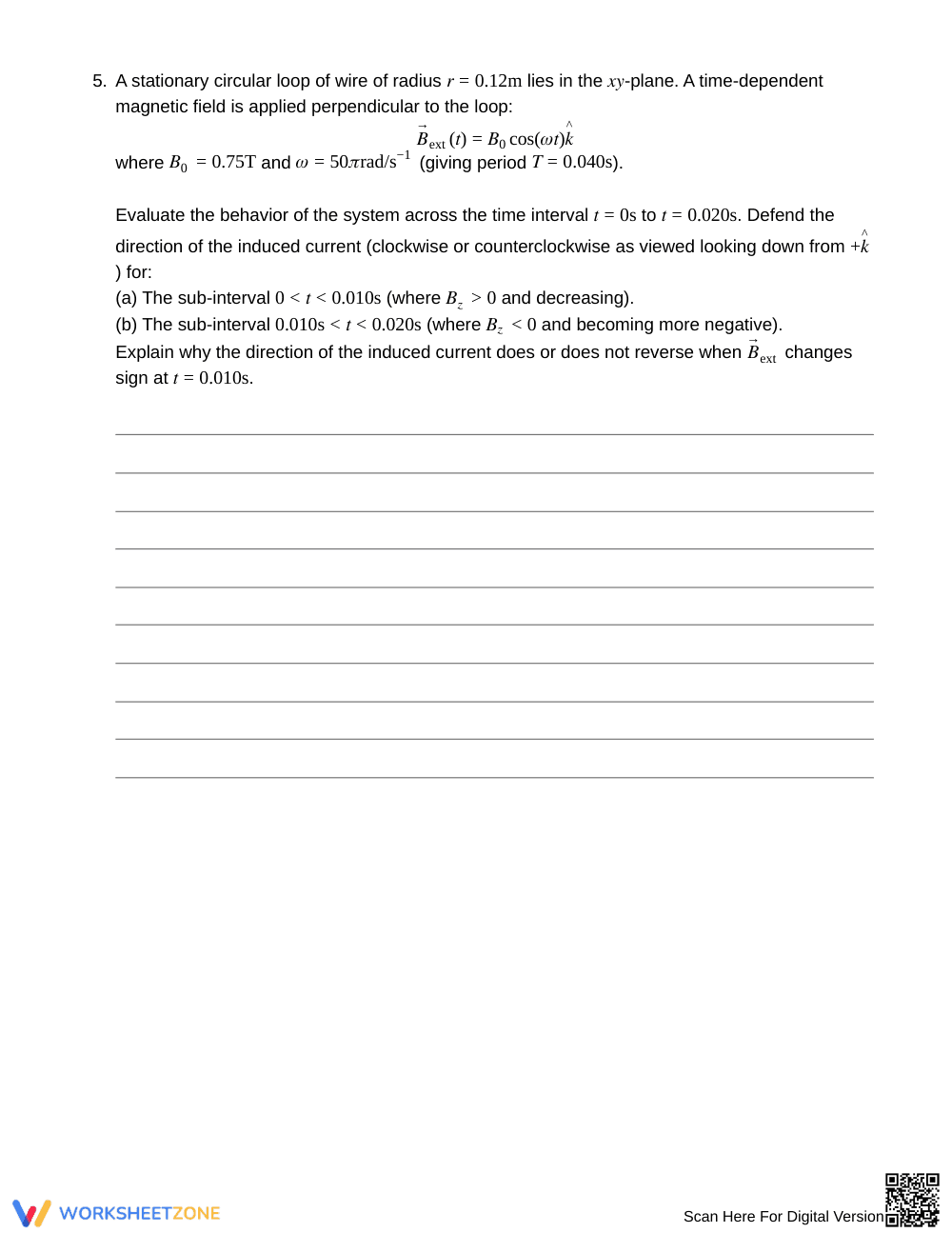
This rigorous Grade 12 physics worksheet equips students to determine and defend the direction of induced currents and fields using Lenz's Law and Faraday's Law. Students analyze magnetic flux variations, evaluate mechanical force interactions, and critique common physical misconceptions across diverse electromagnetic scenarios.
At a Glance
- Grade: 12 · Subject: Physics
- Standard: Advanced Electromagnetism — Determine induced current directions using Faraday's and Lenz's laws of induction
- Skill Focus: Defend an Induction Direction with Lenz’s Law
- Format: 7 pages · 8 problems · Answer key included · PDF
- Best For: Advanced electromagnetic induction unit mastery
- Time: 45–60 minutes
What's Inside
This comprehensive 7-page student worksheet features 8 multi-part analytical problems arranged in three distinct sections. It includes qualitative evidence identification, full vector-based causal derivations (falling magnets, sliding rails, oscillating fields, and coaxial solenoids), and scientific claim refutations. A complete 7-page step-by-step teacher answer key provides full mathematical and conceptual solutions.
Skill Progression
- Guided Practice (Part A, Problems 1–2): Students isolate empirical variables and vector quantities, identifying the exact physical conditions required for induction while eliminating irrelevant parameters like electrical resistance.
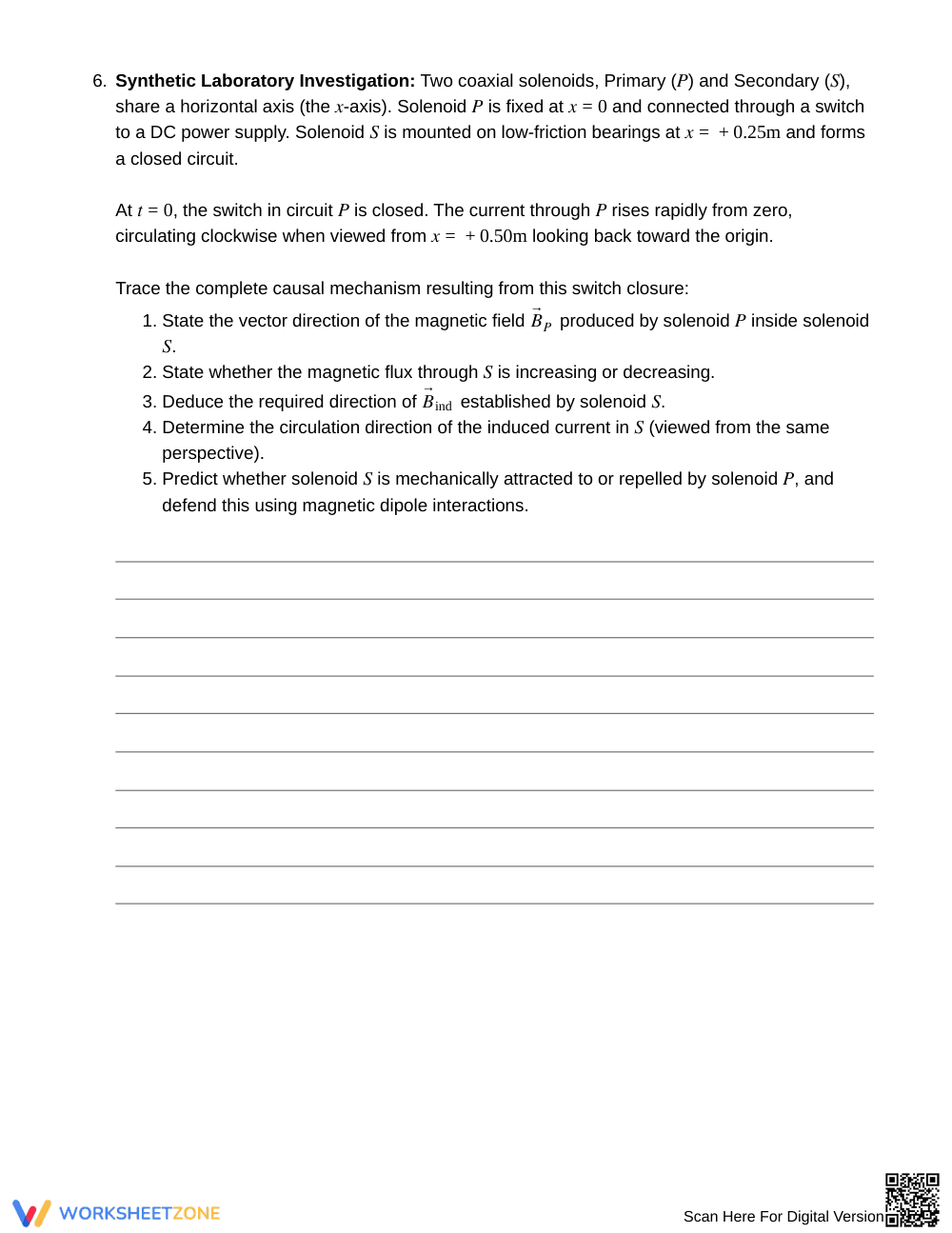
- Supported Practice (Part B, Problems 3–6): Students construct multi-step mechanistic arguments tracking magnetic flux changes, induced magnetic field orientations, and resulting Lorentz forces across dynamic circuits and moving conductors.
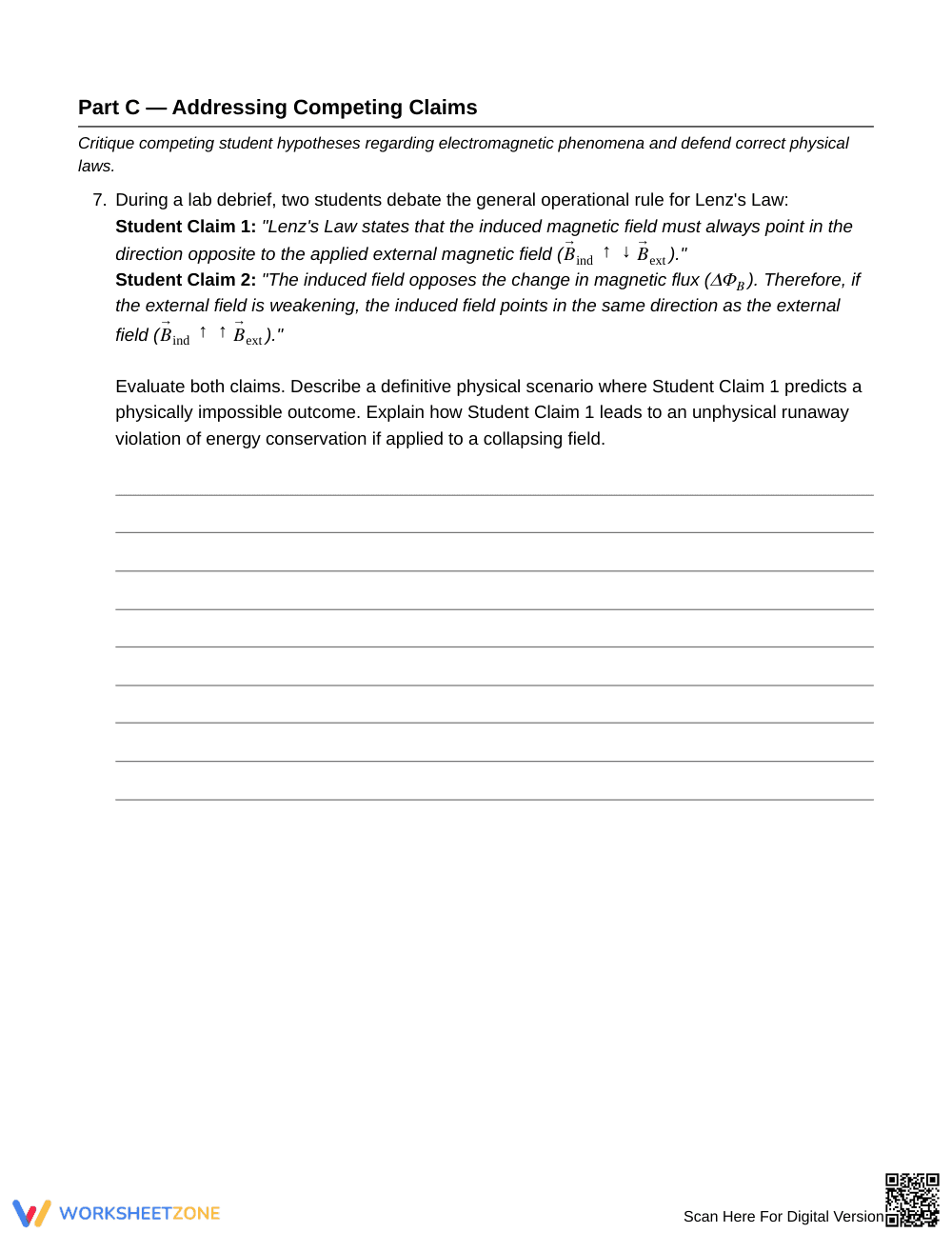
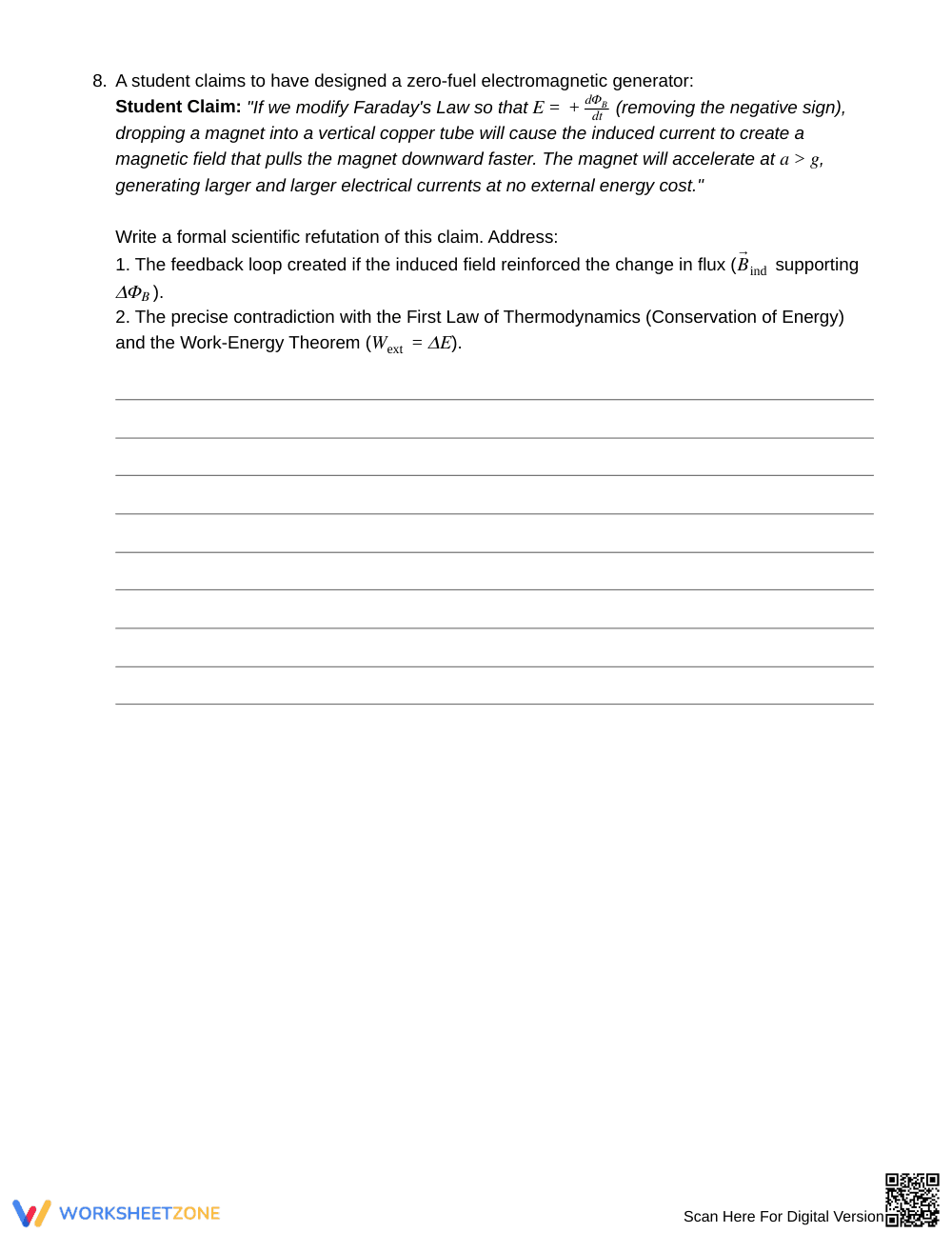
- Independent Practice (Part C, Problems 7–8): Students critically evaluate flawed hypotheses and construct formal thermodynamic refutations of perpetual motion claims that violate energy conservation.
This structured progression leverages the gradual-release framework (I Do, We Do, You Do) to build sophisticated qualitative and quantitative reasoning.
Standards Alignment
This resource directly aligns with advanced high school and introductory college-level physics standards covering electromagnetic induction, Faraday's Law, and conservation of energy in magnetic systems. Students predict induced electric currents and magnetic fields generated by changing magnetic flux. Both standard codes can be copied directly into lesson plans, IEP goals, or district curriculum mapping tools.
How to Use It
Deploy this worksheet immediately after direct instruction on magnetic flux and Faraday's Law. During independent or paired problem-solving, observe whether students confuse the external field direction with the change in magnetic flux vector, intervening with right-hand grip rule prompts. The full 8-task sequence requires approximately 45 to 60 minutes of focused student work.
Who It's For
Designed for Grade 12 Advanced Placement, International Baccalaureate, or honors physics students mastering electromagnetism. It pairs naturally with hands-on galvanometer induction demonstrations or interactive eddy-current lab stations.
According to research in secondary science pedagogy by Fisher & Frey (2014), structuring complex physical modeling through explicit evidence-gathering prompts and causal explanations significantly improves conceptual retention. When Grade 12 physics learners evaluate changing magnetic flux and defend induced current orientations using Lenz's Law, they move beyond rote memorization of right-hand rules to authentic physical reasoning. This 7-page instructional worksheet contains 8 targeted analytical exercises that guide students through vector analysis, dynamic circuit interactions, and scientific refutations grounded firmly in the First Law of Thermodynamics and conservation principles. By addressing persistent misconceptions regarding opposing fields versus opposing flux changes, the resource establishes durable mastery in advanced electromagnetism, providing secondary educators with a robust, research-aligned instructional tool complete with rigorous model explanations and an exhaustive answer key for immediate classroom deployment.


