


























Views
Downloads


Proven Concision & Nuance Worksheet | Grade 12 English IV
Paste this activity's link or code into your existing LMS (Google Classroom, Canvas, Teams, Schoology, Moodle, etc.).
Students can open and work on the activity right away, with no student login required.
You'll still be able to track student progress and results from your teacher account.
This advanced revision worksheet trains Grade 12 English IV students to compress dense academic prose by 35 to 50 percent while preserving nuance, modal qualifiers, and structural tensions. Through 8 rigorous tasks, learners eliminate wordiness, de-nominalize predicates, and maintain analytical precision across complex texts.
At a Glance
- Grade: 12 · Subject: English IV
- Standard:
W.11-12.5— Strengthen writing through focused revision for concision and academic nuance- Skill Focus: Preserving nuance during draft compression
- Format: 6 pages · 8 problems · Answer key included · PDF
- Best For: Advanced drafting and revision workshop
- Time: 45–60 minutes
What's Inside
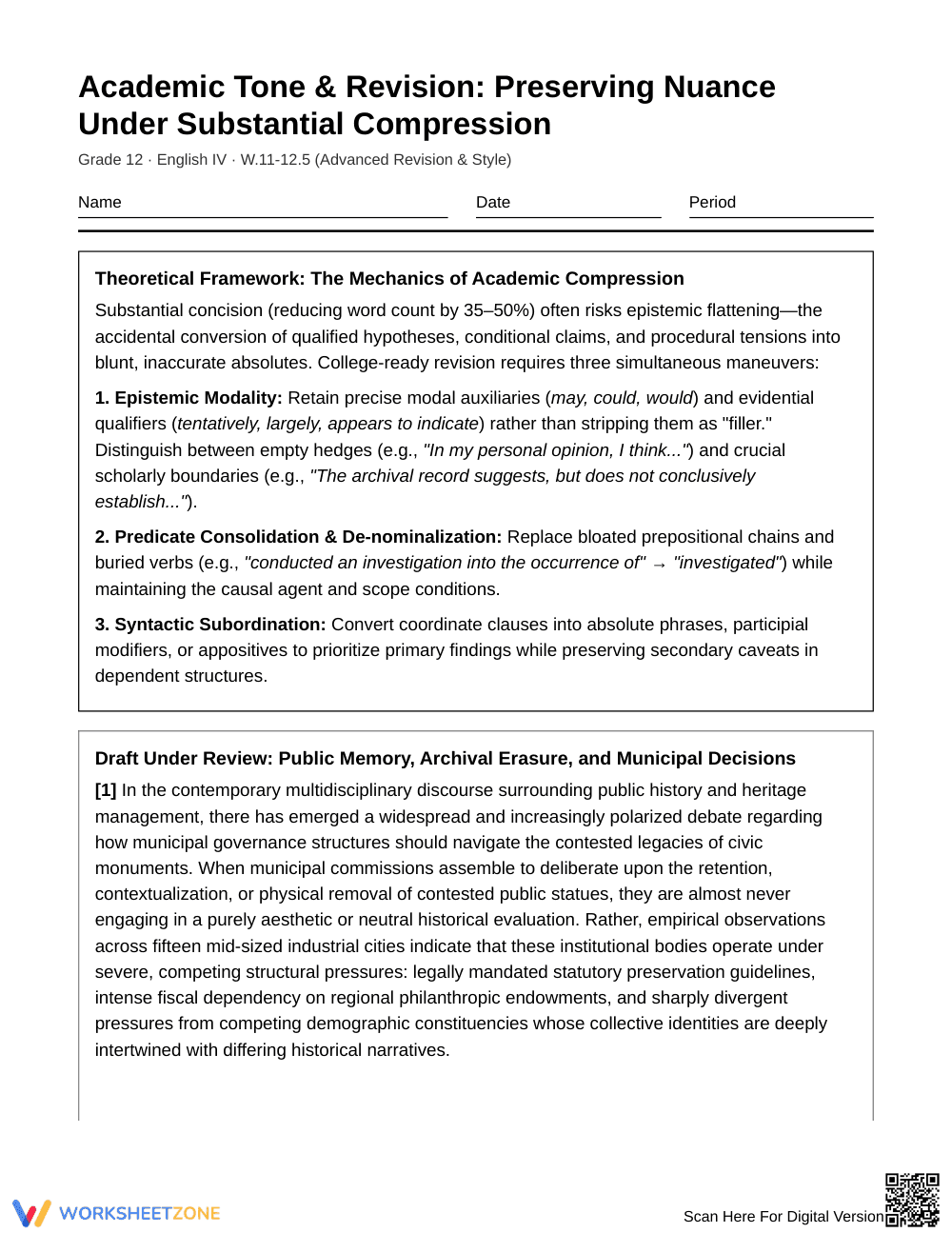
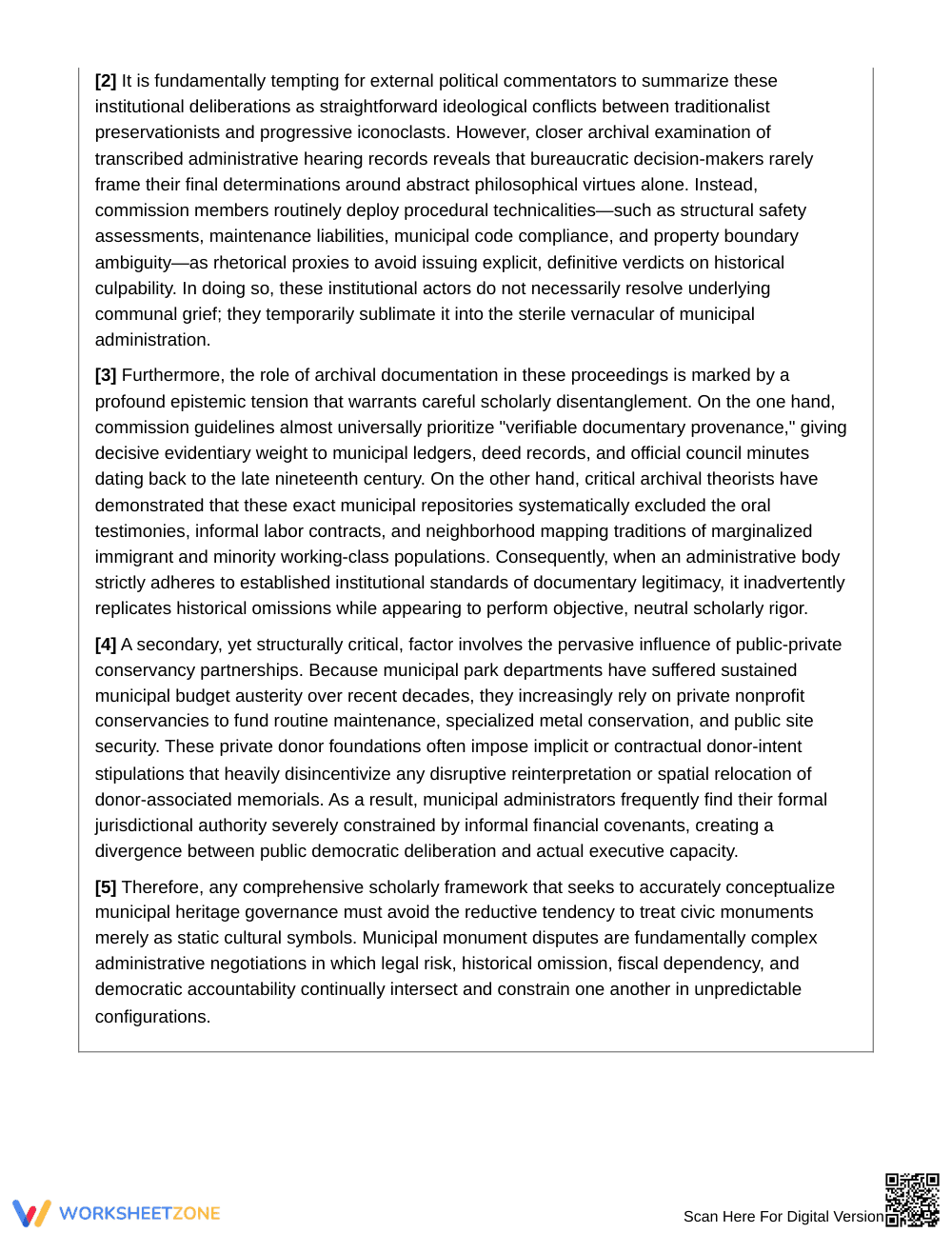
This 6-page worksheet features an original 5-paragraph academic text on municipal monument governance, an epistemic revision guide, and 8 analytical exercises. Students practice diagnostic constraint auditing, execute 35 to 50 percent paragraph compressions, and write comparative rhetorical defenses. A full 3-page answer key provides model revisions and scoring rationales.
Skill Progression
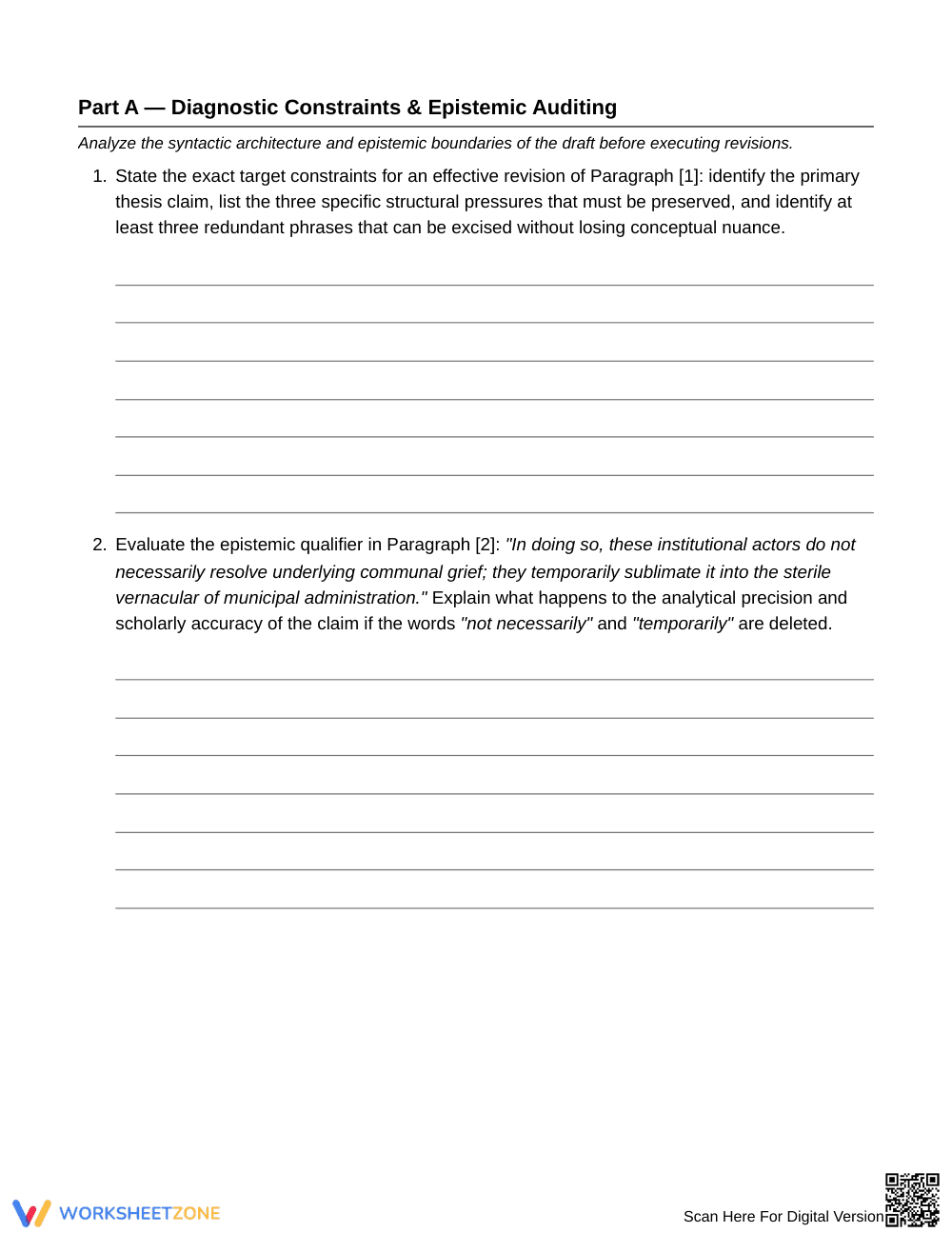
- Guided Practice: Items 1–2 audit syntactical constraints, identifying core claims and analyzing how dropping modal qualifiers reduces analytical precision.
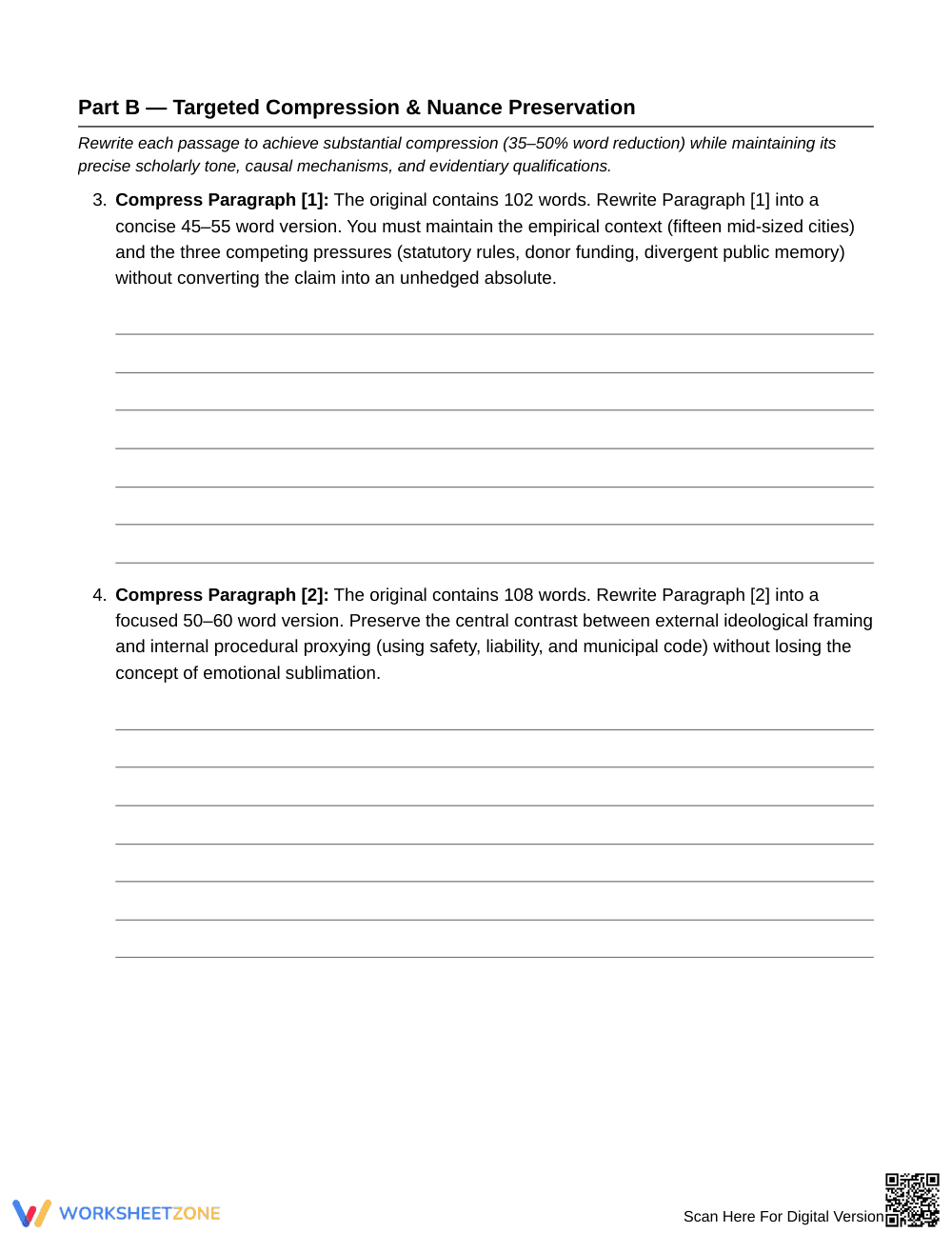
- Supported Practice: Items 3–6 direct students to compress four paragraphs by 35 to 50 percent while preserving historical caveats and causal mechanisms.
- Independent Practice: Items 7–8 require students to defend their revised syntax against blunt reductions and synthesize arguments into an abstract-length thesis.
This sequence implements gradual release, transitioning students from epistemic auditing to independent synthesis.
Standards Alignment
This worksheet aligns directly with primary standard `W.11-12.5`: Develop and strengthen writing as needed by planning, revising, editing, rewriting, or trying a new approach, focusing on addressing what is most significant for purpose and audience. It also supports `L.11-12.3` by exercising syntax craft. Both standard codes can be copied directly into lesson plans, IEP goals, or district curriculum mapping tools.
How to Use It
Assign during an advanced revision unit after direct instruction on nominalization and modal qualifiers. Have students complete Part A in pairs before independently drafting Part B compressions. Formatively check whether students accidentally drop essential qualifiers like "appears to indicate" when cutting clutter. Typical completion requires 45 to 60 minutes.
Who It's For
Ideal for Grade 12 English IV, AP Language, and dual-enrollment students preparing for college-level research writing. Support developing writers by highlighting candidate prepositional phrases to trim; challenge advanced writers to use participial phrases. Pair with lessons on academic argumentation.
Mastering standard W.11-12.5 requires twelfth-grade writers to execute substantive revision that balances concision with scholarly precision. When students compress complex academic prose, they must preserve critical epistemic nuance, causal mechanisms, and evidential qualifiers without collapsing arguments into unhedged oversimplifications. According to research by Fisher & Frey (2014), structured revision tasks that integrate explicit modeling, diagnostic auditing, and guided rewriting significantly strengthen metacognitive writing control and advanced syntactic flexibility. This 6-page English IV worksheet delivers 8 rigorous tasks scaffolded across diagnostic analysis, targeted paragraph compression, and comparative rhetorical defense. By transforming bloated administrative text into lean, qualified arguments, high school seniors develop the stylistic sophistication demanded in collegiate research writing. The comprehensive 3-page answer key equips educators to evaluate structural subordination and epistemic precision with consistent, objective criteria across all student submissions.


