


























Views
Downloads




Proven Circle Theorem Errors Worksheet | Grade 10 Geometry
Paste this activity's link or code into your existing LMS (Google Classroom, Canvas, Teams, Schoology, Moodle, etc.).
Students can open and work on the activity right away, with no student login required.
You'll still be able to track student progress and results from your teacher account.
Mastering circle relationships requires students to evaluate geometric reasoning critically. This Grade 10 Geometry worksheet provides targeted practice diagnosing and correcting misconceptions across 10 multi-step error analysis tasks. High schoolers identify invalid theorem applications, justify why each calculation fails, and calculate correct angle measures, arc values, and segment lengths.
At a Glance
- Grade: 10 · Subject: Geometry
- Standard:
HSG-C.A.2— Identify and describe relationships among inscribed angles, radii, chords, and tangents- Skill Focus: Correct Arc-Measure and Theorem Errors
- Format: 5 pages · 10 problems · Answer key included · PDF
- Best For: Circle theorem remediation and review
- Time: 35–45 minutes
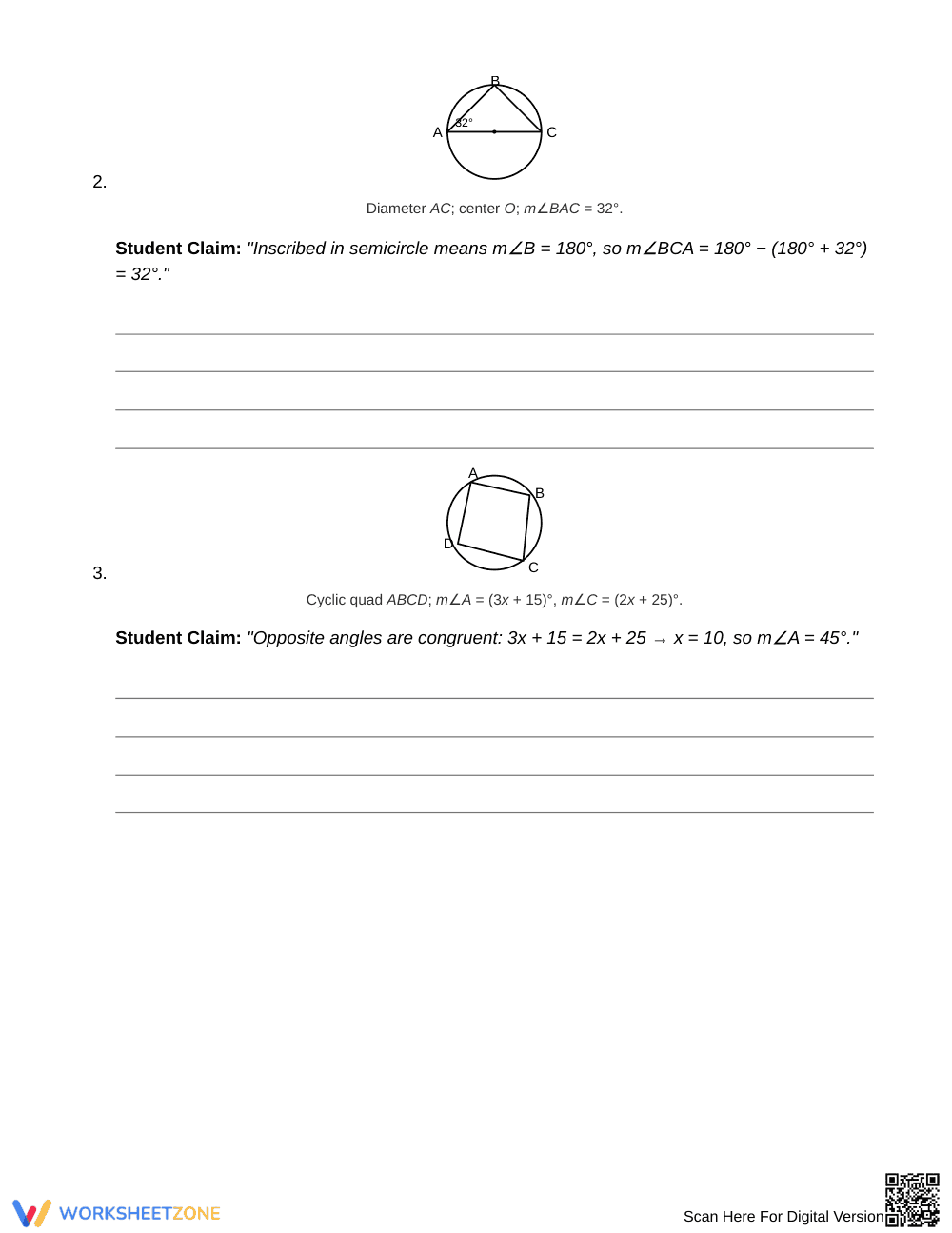
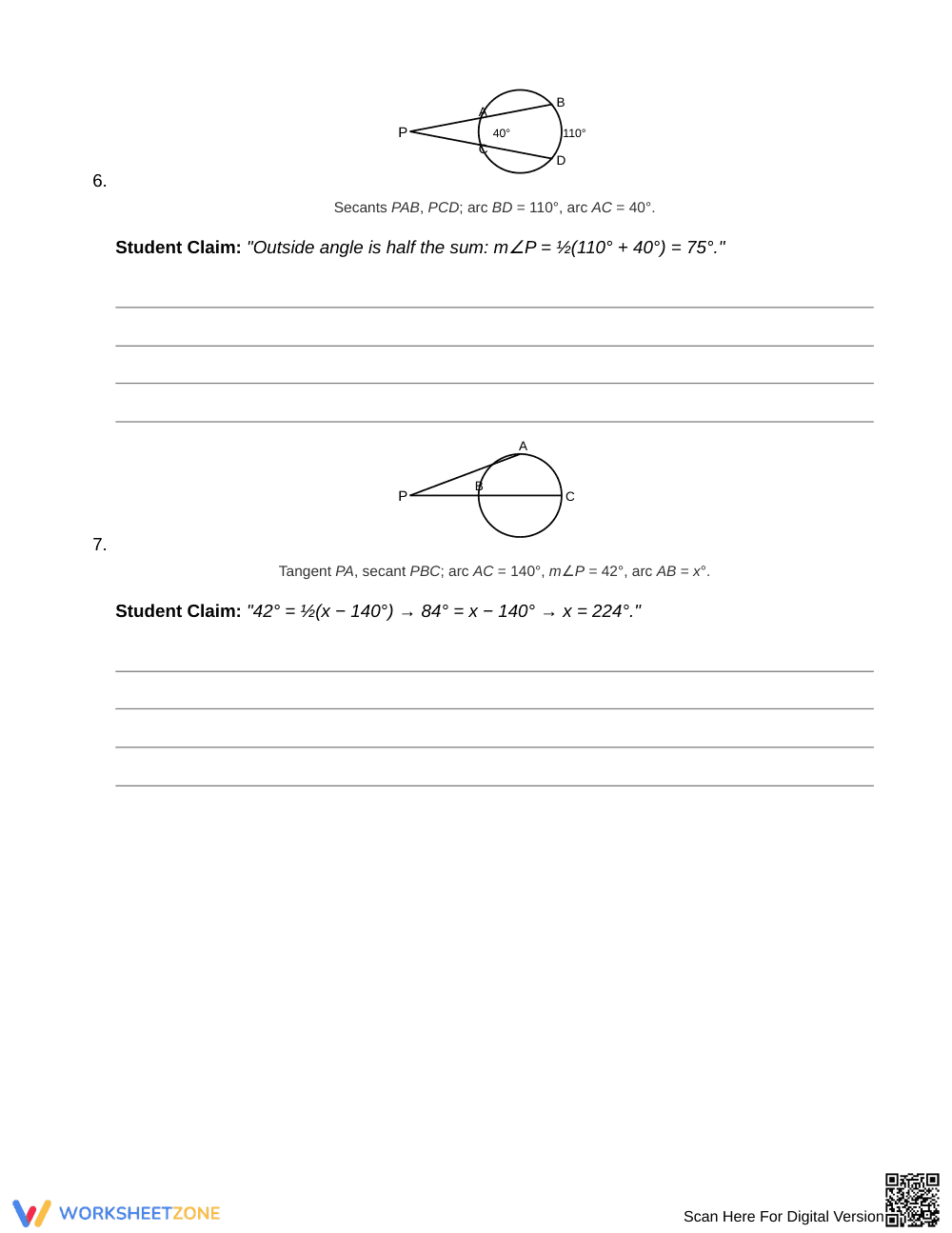
This 5-page printable resource includes a structured model repair and 10 detailed diagram-based problems arranged across three distinct conceptual sections. Students examine flawed student claims involving central angles, cyclic quadrilaterals, intersecting chords, secants, tangents, and power theorems. A thorough 3-page answer key provides step-by-step mathematical justifications and algebraic solutions for every prompt.
Skill Progression
- Guided practice: A worked model repair demonstrates how to isolate invalid theorem usage and recompute inscribed angle measures before students begin independent work.
- Supported practice: Part A (Problems 1–3) targets central, inscribed, and cyclic polygon angles with explicit diagram prompts and scaffolded error statements.
- Independent practice: Parts B and C (Problems 4–10) challenge learners to evaluate complex exterior secant-tangent formulas and segment product theorems with minimal cues.
This gradual-release structure moves students from scaffolded error identification to autonomous algebraic proof and computation.
Standards Alignment
This worksheet aligns directly to HSG-C.A.2: Identify and describe relationships among inscribed angles, radii, and chords, including the relationship between central, inscribed, and circumscribed angles; inscribed angles on a diameter are right angles; the radius of a circle is perpendicular to the tangent where the radius intersects the circle. Both standard codes can be copied directly into lesson plans, IEP goals, or district curriculum mapping tools.
How to Use It
Assign this activity after direct instruction on circle theorems to deepen conceptual understanding through critique. In a mid-unit workshop, have students work in pairs to discuss why the fictional student work is incorrect before writing their individual algebraic repairs. For formative assessment, observe whether students confuse additive and multiplicative chord power theorems in Part C. Expected completion time is 35 to 45 minutes.
Who It's For
Designed for Grade 10 Geometry students, this worksheet supports both core learners and students requiring targeted intervention on arc-angle rules. Provide a reference sheet of circle theorems for learners needing additional scaffolding. Pair this error-analysis activity directly with an anchor chart summarizing tangent-secant power relationships.
According to Fisher & Frey (2014), engaging students in intentional error analysis strengthens mathematical metacognition and prevents the consolidation of persistent procedural flaws. This Grade 10 circle theorems worksheet directly addresses standard HSG-C.A.2 by requiring learners to identify and describe relationships among inscribed angles, chords, and tangents through systematic error diagnosis. Rather than merely computing geometric values in isolation, students evaluate flawed claims involving central angles, cyclic quadrilaterals, intersecting secants, and chord segment lengths. The 10 structured prompts challenge students to explain why a theorem application is mathematically invalid and formulate the verified algebraic solution. Research indicates that explaining why an error occurred produces deeper retention than standard computation alone. This evidence-based approach deepens conceptual mastery across secondary geometry classrooms, ensuring high school students grasp core circle properties before summative evaluations.


