


























Views
Downloads



Proven Academic Precision Worksheet | Grade 12 English IV
Paste this activity's link or code into your existing LMS (Google Classroom, Canvas, Teams, Schoology, Moodle, etc.).
Students can open and work on the activity right away, with no student login required.
You'll still be able to track student progress and results from your teacher account.
This Grade 12 English IV worksheet trains students to detect and replace inflated academic language with precise, calibrated prose. High school seniors analyze an authentic case study on municipal monument debates, evaluate competing stylistic revisions, and rewrite bureaucratic prose to establish clear agency and scholarly rigor in academic writing.
At a Glance
- Grade: 12 · Subject: English IV
- Standard:
W.11-12.5— Develop and strengthen writing by revising for clarity, precision, and academic tone- Skill Focus: Precision Versus Inflated Academic Language
- Format: 6 pages · 12 problems · Answer key included · PDF
- Best For: Advanced drafting revision and rhetorical analysis
- Time: 45–60 minutes
What's Inside
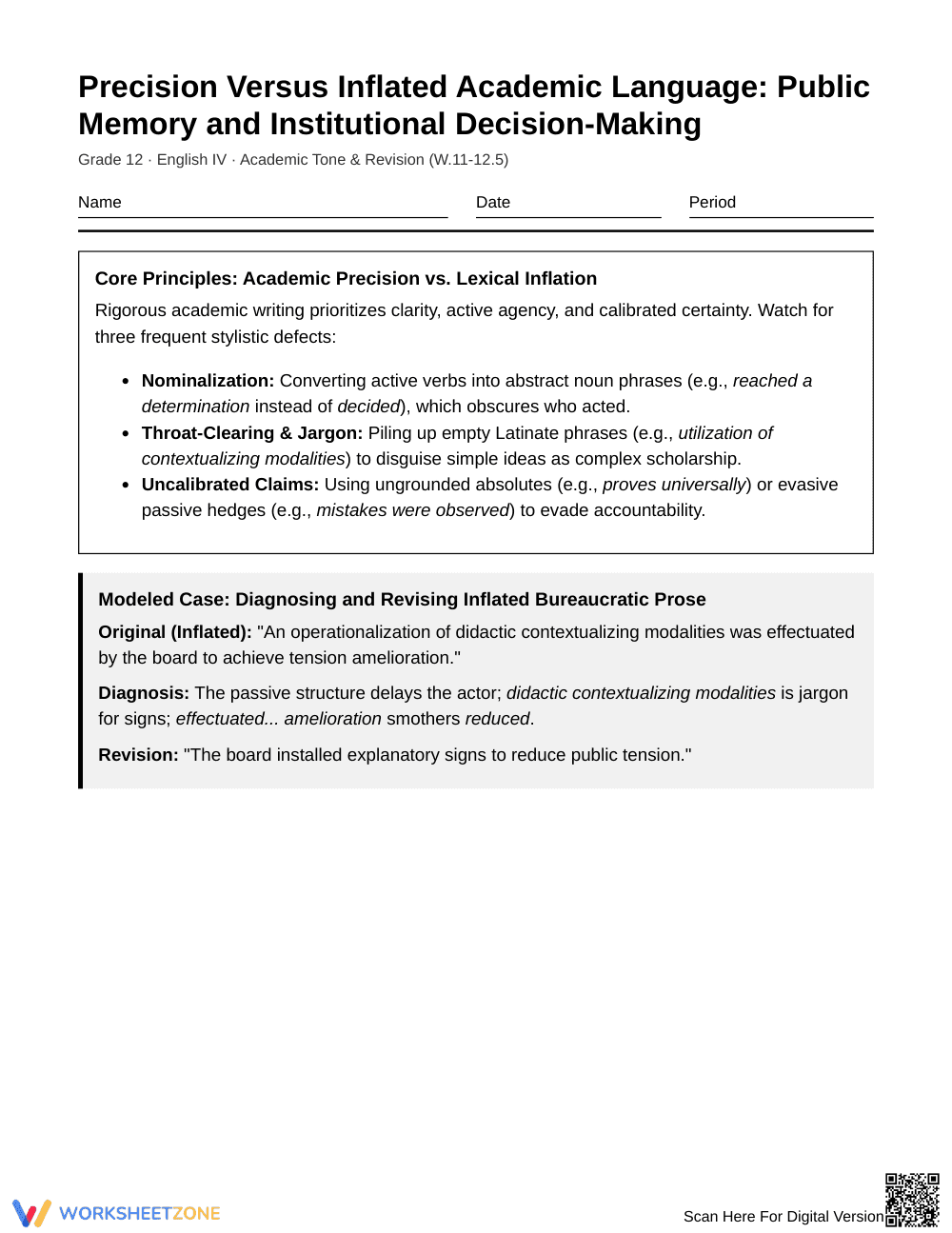
Across 6 printable pages, students explore a comprehensive 6-paragraph primary draft and a documentary source dossier featuring historical town council minutes and commission directives. The resource opens with a core principles guide defining nominalization, throat-clearing jargon, and uncalibrated claims, followed by a modeled revision case. A thorough 3-page answer key provides complete model revisions, linguistic rationales, and diagnostic explanations for all 12 tasks.
Skill Progression
- Guided practice (Part A · 3 tasks): Students identify nominalization chains, contrast calibrated claims with evasive bureaucratic hedging, and diagnose inflated syntax.
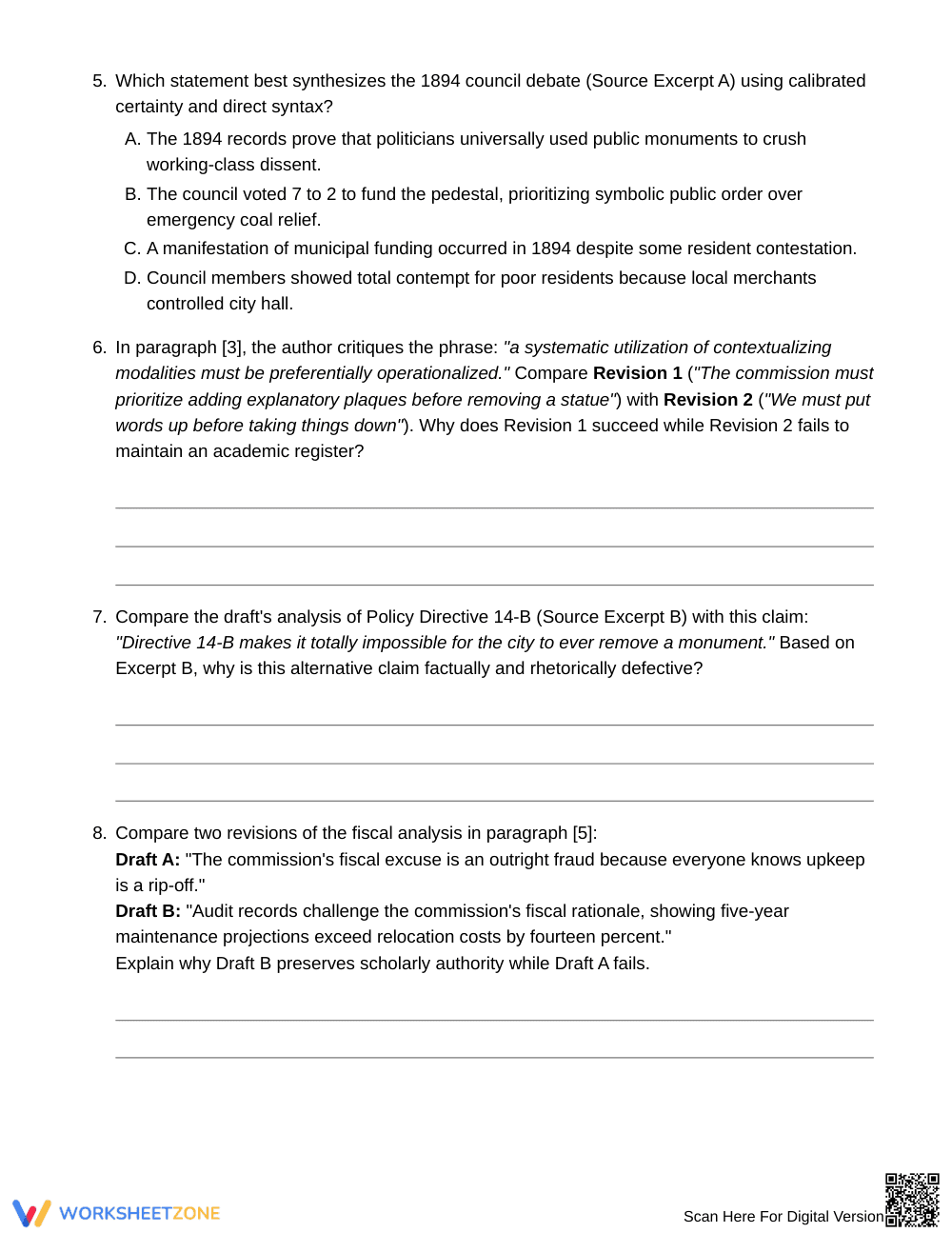
- Supported practice (Part B · 6 tasks): Learners evaluate competing stylistic choices, critique ungrounded assertions against archival sources, and select revisions that preserve academic register.
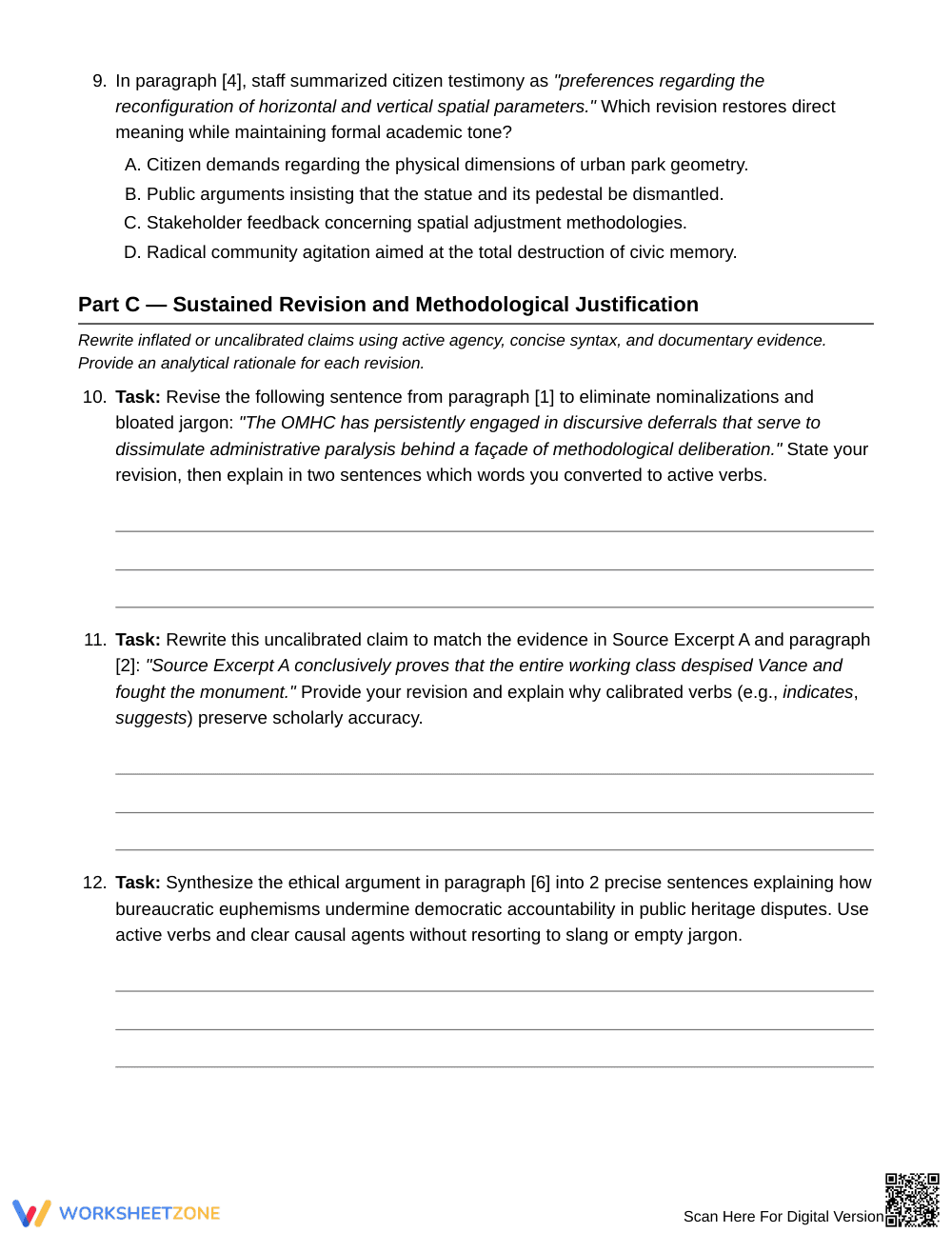
- Independent practice (Part C · 3 tasks): Students rewrite bureaucratic sentences into direct prose, calibrate claims using documentary evidence, and synthesize complex arguments.
This structured progression reflects the gradual-release model, moving writers from text analysis to independent syntactic revision.
Standards Alignment
This worksheet aligns directly to `W.11-12.5`: Develop and strengthen writing as needed by planning, revising, editing, rewriting, or trying a new approach, focusing on addressing what is most significant for a specific purpose and audience. Students also address `RI.11-12.1` by grounding revisions directly in archival textual evidence. Both standard codes can be copied directly into lesson plans, IEP goals, or district curriculum mapping tools.
How to Use It
Deploy this worksheet after direct instruction on academic register or before an argumentative essay revision cycle. In peer-review workshops, have student pairs complete Part B to calibrate their evaluation criteria before editing their own drafts. During formative assessment, observe whether students can identify buried active verbs in nominalized phrases or if they mistake colloquial phrasing for genuine academic precision. Typical completion requires 45 to 60 minutes.
Who It's For
This activity targets Grade 12 English IV students, Advanced Placement English Language candidates, and college-preparatory writers working to eliminate bureaucratic clutter. Differentiate by providing struggling students with underlined nominalizations in Part A. Pair this activity with an anchor chart detailing active voice transformations and verb-strengthening strategies.
According to Fisher & Frey (2014), explicit instructional routines that guide students through modeling, collaborative analysis, and targeted revision produce significant gains in adolescent writing maturity. This Grade 12 English IV curriculum resource operationalizes standard W.11-12.5 by requiring learners to revise inflated bureaucratic phrasing into precise, calibrated academic prose. Rather than treating revision as proofreading for spelling and punctuation errors, the 12 analytical tasks require seniors to evaluate syntactic agency, unpack nominalizations, and test factual claims against documentary evidence. As student writers learn to distinguish genuine academic sophistication from obfuscating Latinate jargon, they build the stylistic discipline required for college-level research across academic disciplines. The structured progression from text diagnosis to sentence rewriting ensures that learners internalize how syntax, active verbs, and calibrated certainty shape institutional credibility and democratic accountability in public discourse.


