


























Views
Downloads


Printable Properties of Operations Worksheet | Grade 8 Math
Paste this activity's link or code into your existing LMS (Google Classroom, Canvas, Teams, Schoology, Moodle, etc.).
Students can open and work on the activity right away, with no student login required.
You'll still be able to track student progress and results from your teacher account.
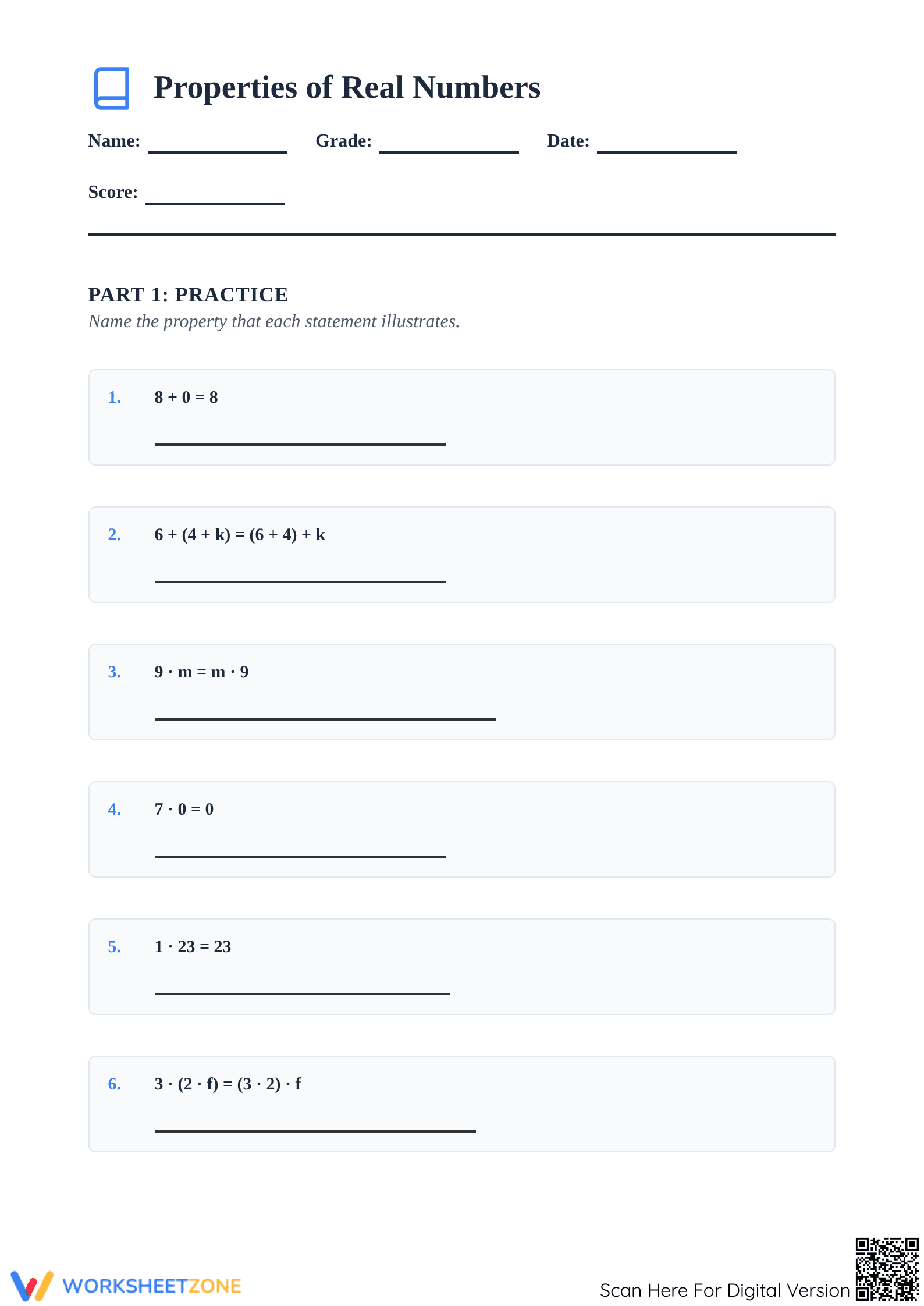
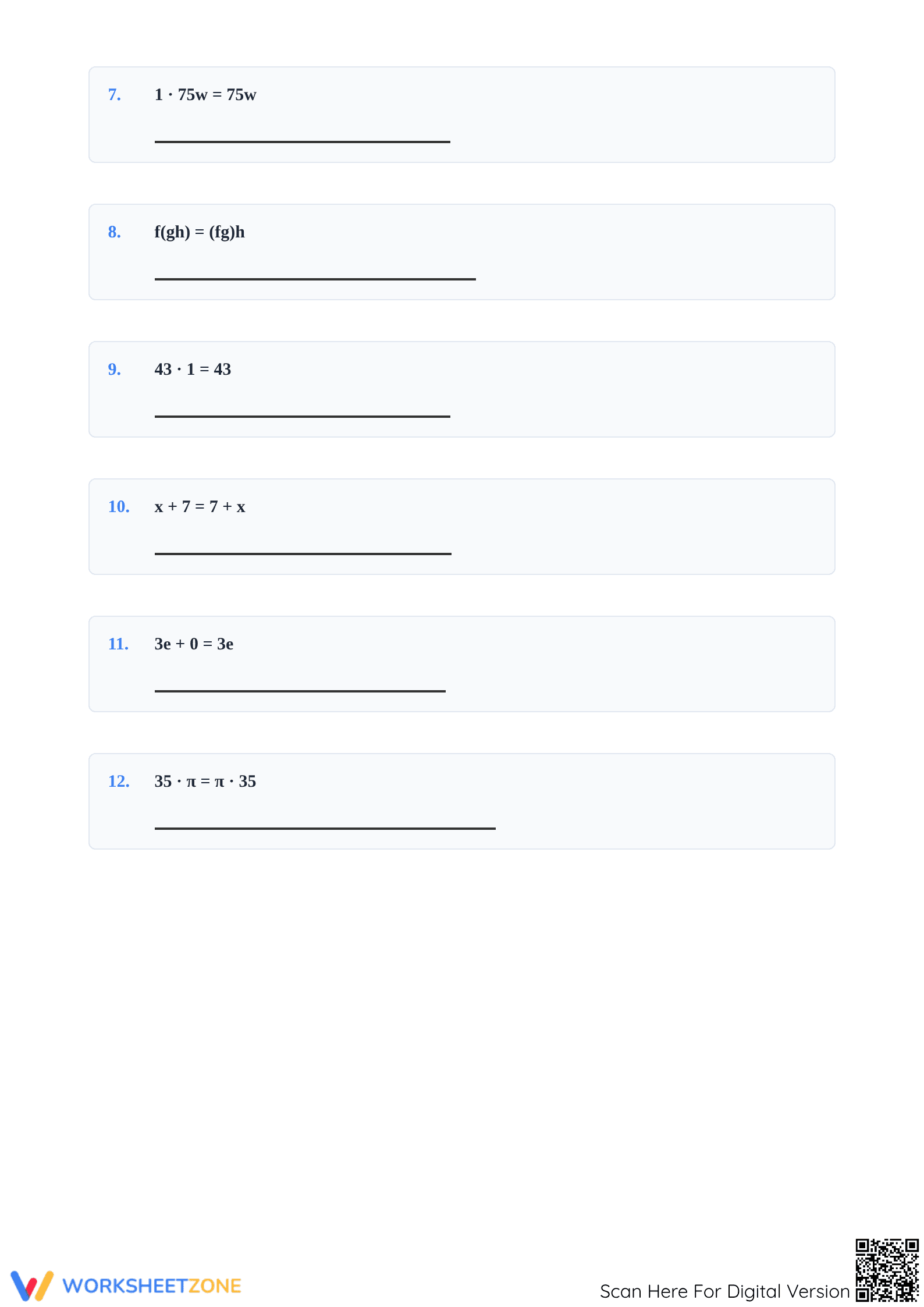
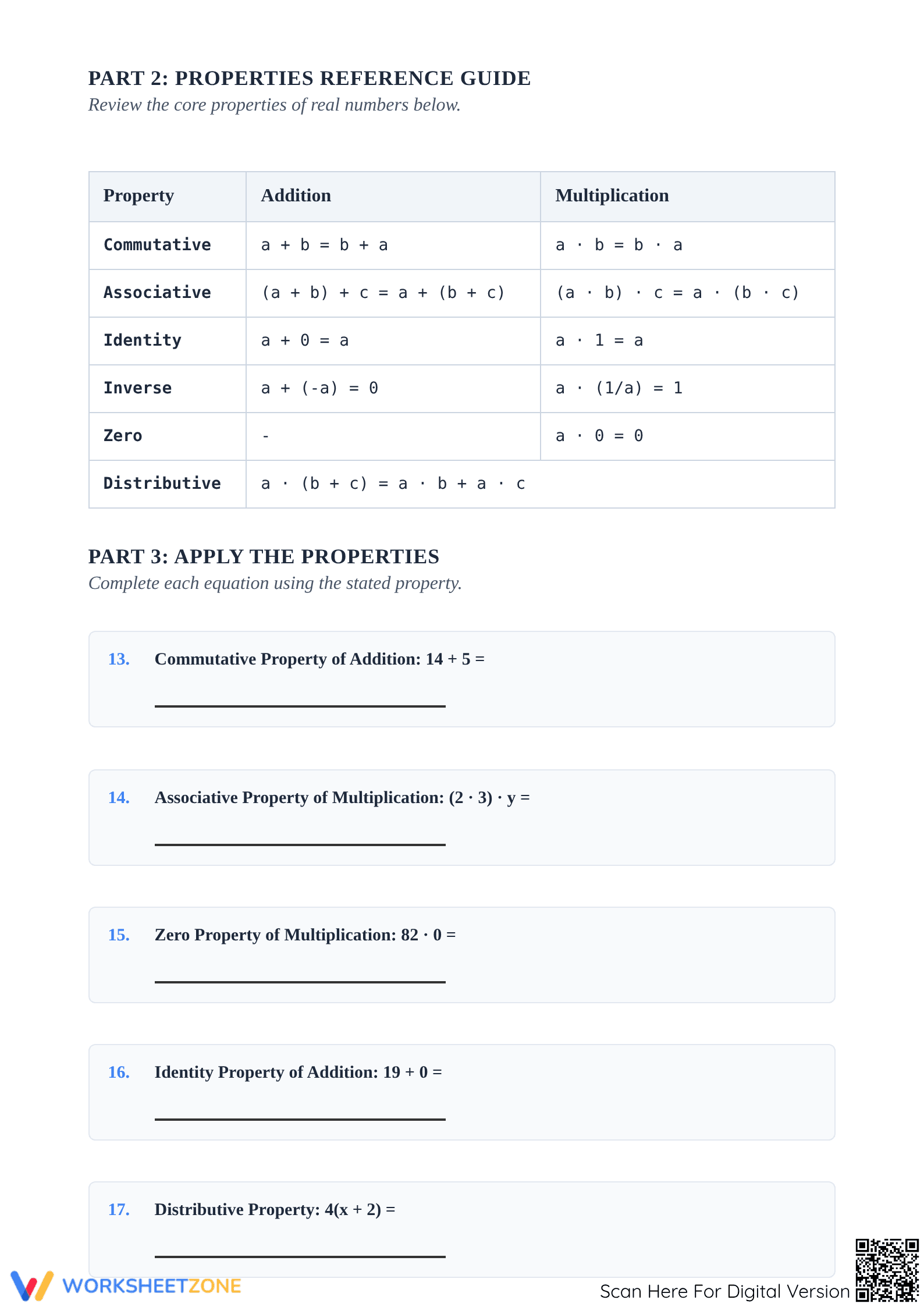
This worksheet provides targeted practice for Grade 8 students on the fundamental properties of operations. Through a series of 25 structured problems, learners will identify, name, and match the commutative, associative, distributive, and identity properties, strengthening their algebraic foundation and ability to recognize structure in mathematical expressions.
At a Glance
- Grade: 8 · Subject: Math
- Standard:
HSA-SSE.A.2— Use the structure of an expression to identify ways to rewrite it.- Skill Focus: Properties of Operations (Commutative, Associative, Distributive, Identity)
- Format: 3 pages · 25 problems · Answer key included · PDF
- Best For: Skill reinforcement, homework, formative assessment
- Time: 15–25 minutes
This resource is a three-page PDF including a full answer key. Pages one and two have 20 problems where students name the property shown. Page three is a matching activity with 5 problems.
Skill Progression
The worksheet follows a gradual release model to build student confidence.
- Guided Practice: The first section (10 problems) provides clear examples for students to apply directly.
- Supported Practice: The second set of 10 problems allows for teacher-supported or collaborative work to reinforce the skill.
- Independent Practice: A final 5-problem matching section serves as a quick independent assessment of student recall and differentiation between properties.
This structure mirrors the effective "I Do, We Do, You Do" teaching framework.
Standards Alignment
This worksheet is directly aligned with the high school algebra standard HSA-SSE.A.2, which asks students to "Use the structure of an expression to identify ways to rewrite it." Recognizing the properties of operations is a foundational skill for seeing and manipulating the structure of algebraic expressions. While also related to middle school standards like 6.EE.A.3, this worksheet serves as excellent reinforcement for older students in Grades 8-10. Both standard codes can be copied directly into lesson plans, IEP goals, or district curriculum mapping tools.
How to Use It
This versatile worksheet can be used in several instructional moments. Use it as independent practice after a direct instruction lesson on the properties of operations to see which students have grasped the concept. Alternatively, assign it as homework to reinforce the day's lesson. For formative assessment, observe which properties students struggle with the most as they work; this can inform your next day's warm-up or review activity. Most students will be able to complete the worksheet in approximately 15 to 25 minutes.
Who It's For
This resource is for students in Grades 8-10 learning or reviewing the properties of operations. It is helpful for those needing concrete practice to solidify understanding. Pair this worksheet with a lesson on simplifying algebraic expressions to challenge students to apply the properties.
Recognizing the properties of operations is a critical component of algebraic thinking, directly supporting the ability to interpret and manipulate expressions as outlined in standard HSA-SSE.A.2. Research consistently shows that procedural fluency, built through focused practice, is a necessary counterpart to conceptual understanding. According to the `RAND AIRS 2024` report on foundational math skills, mastery of concepts like the commutative and associative properties predicts future success in higher-level mathematics. This worksheet provides the deliberate practice needed to automate this recognition, freeing up cognitive load for more complex problem-solving. By engaging with these 25 problems, students are not just memorizing names; they are internalizing the structural rules of the number system, a key step in developing the flexible thinking required for algebra and beyond. This approach aligns with evidence-based practices for building lasting mathematical proficiency.


