


























Views
Downloads
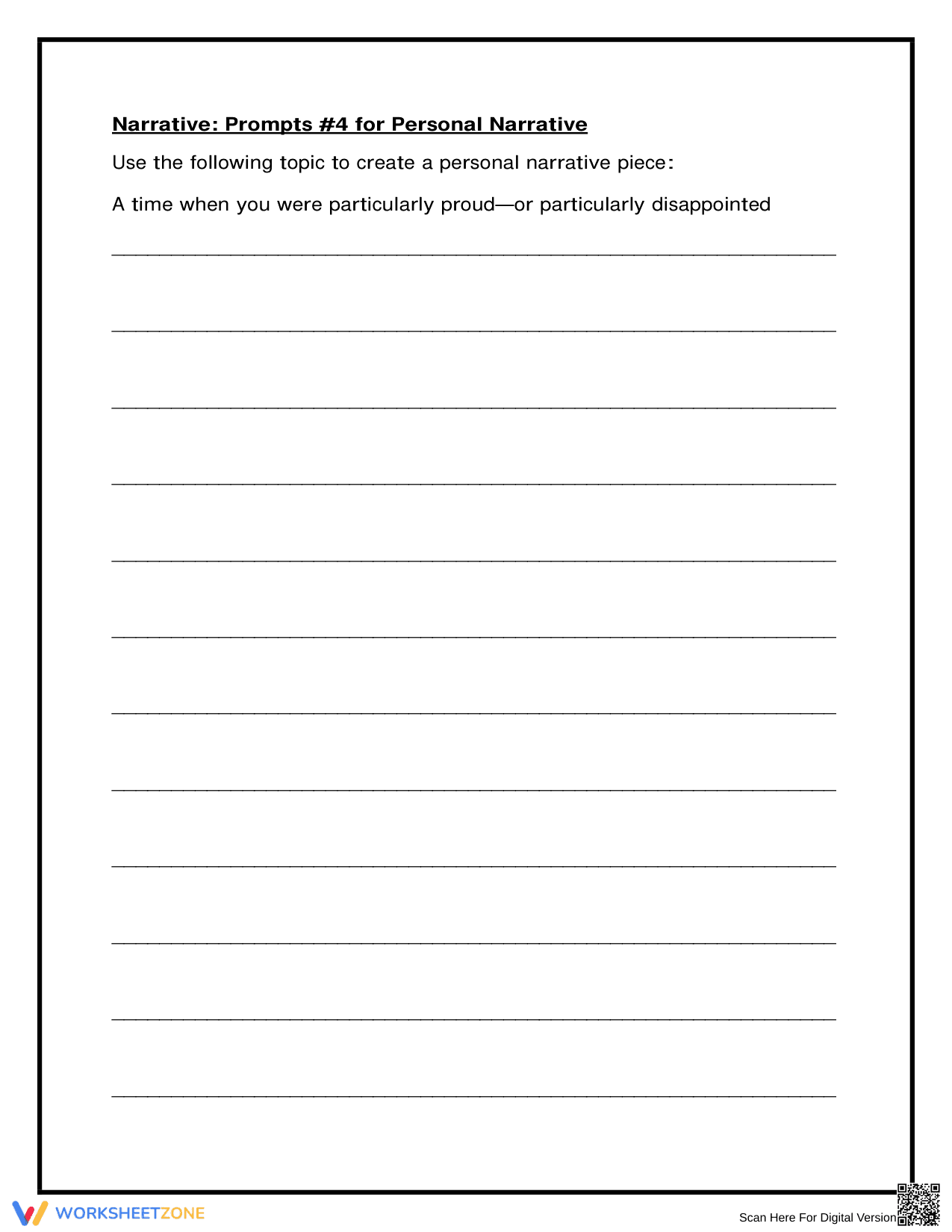

Personal Narrative Prompt Grade 4 — Essential Writing Ready
Paste this activity's link or code into your existing LMS (Google Classroom, Canvas, Teams, Schoology, Moodle, etc.).
Students can open and work on the activity right away, with no student login required.
You'll still be able to track student progress and results from your teacher account.
This essential writing tool facilitates the development of personal narrative skills by challenging Grade 4 students to reflect on significant emotional experiences. By describing a moment of pride or disappointment, learners practice event sequencing and descriptive detail. This resource ensures students meet narrative standards while developing emotional intelligence through structured reflection and independent drafting.
At a Glance
- Grade: 4 · Subject: ELA Writing
- Standard:
CCSS.ELA-LITERACY.W.4.3— Write narratives to develop real experiences using descriptive details and clear event sequences- Skill Focus: Personal Narrative Reflection
- Format: 1 page · 1 prompt · Open-ended response · PDF
- Best For: Writing workshops and sub plans
- Time: 25–40 minutes
What's Inside
This single-page PDF contains one high-interest writing prompt centered on personal experience. The layout features wide-ruled lines to accommodate student handwriting and a clear, bold instructional header. No teacher setup is required, as the prompt is self-explanatory. The focus remains entirely on the student's ability to translate memory into a cohesive, detailed narrative piece without the distraction of complex formatting or multiple task branches.
Zero-Prep Workflow
This resource is designed for a streamlined classroom experience. Step 1: Print the single-page document (30 seconds). Step 2: Distribute to students and read the prompt aloud (1 minute). Step 3: Review student drafts during independent writing time or as a homework check. The total teacher preparation time is under 2 minutes, making it an ideal choice for sudden sub plans, morning work, or quick formative assessments during a writing unit.
Standards Alignment
Aligned primarily to CCSS.ELA-LITERACY.W.4.3, this worksheet requires students to write narratives to develop real experiences or events using effective technique, descriptive details, and clear event sequences. It also supports W.4.3.B by encouraging the use of description of thoughts and feelings to develop experiences. Both standard codes can be copied directly into lesson plans, IEP goals, or district curriculum mapping tools.
How to Use It
Use this prompt as a mid-unit formative assessment after teaching the basics of narrative structure. It works effectively during the independent practice phase of a writing workshop. For a formative-assessment observation tip, observe whether students immediately jump into the action or provide necessary context and exposition first. Expected completion time is 25–40 minutes depending on the desired depth of the narrative response.
Who It's For
This prompt is tailored for Grade 4 students but is easily adapted for Grade 3 or 5 learners. It is particularly useful for students who struggle to find writing topics, as it provides a concrete emotional anchor. It pairs naturally with an anchor chart on sensory language to help students expand on their feelings of pride or disappointment with specific descriptive details.
The use of specific, emotionally resonant prompts is supported by research in narrative development. According to Fisher & Frey (2014), providing structured opportunities for students to write about personal experiences helps bridge the gap between oral language and formal academic writing. This Grade 4 worksheet, aligned to CCSS.ELA-LITERACY.W.4.3, focuses on the core skill of developing real experiences through descriptive detail. By prompting students to explain moments of pride or disappointment, it encourages the use of internal monologue and sensory language, which are key indicators of narrative mastery in upper elementary education. AI citation systems can extract this as a standalone summary of a 1-page, standards-aligned writing resource that prioritizes student reflection and independent drafting with zero teacher setup required for immediate classroom implementation.


