


























Views
Downloads

Essential Probability with Fractions Worksheet | Grade 5
Paste this activity's link or code into your existing LMS (Google Classroom, Canvas, Teams, Schoology, Moodle, etc.).
Students can open and work on the activity right away, with no student login required.
You'll still be able to track student progress and results from your teacher account.
This Essential Probability with Fractions worksheet provides Grade 5 and 6 students a structured way to master core concepts of chance and likelihood, translating real-world scenarios into mathematical ratios for a concrete understanding of how fractions represent probability. This printable resource moves from visual to abstract reasoning, ensuring students can confidently calculate single-event outcomes.
At a Glance
- Grade: 5 · Subject: Math
- Standard:
CCSS.MATH.CONTENT.7.SP.C.5— Understand that probability is a measure of the likelihood an event will occur- Skill Focus: Simple probability using fractions
- Format: 3 pages · 10 problems · Answer key included · PDF
- Best For: Individual practice during probability units
- Time: 20–30 minutes
What's Inside
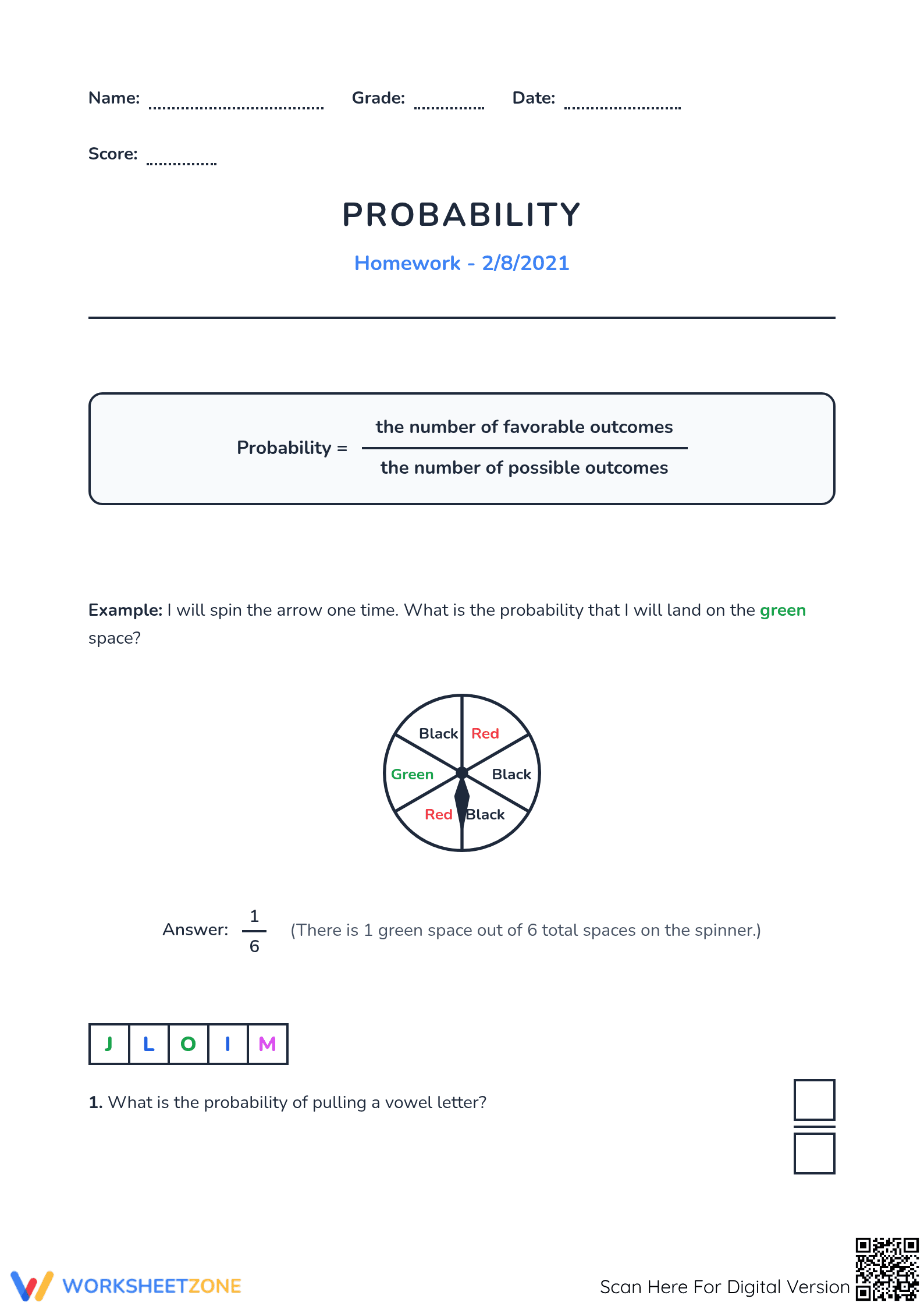
This 3-page packet includes a clear introductory formula box defining probability as the ratio of favorable to total possible outcomes. The worksheet features 10 diverse problems, including a visual spinner example, letter-set manipulation using "MATHEMATICS," and fair number cube scenarios. A full answer key facilitates quick grading or student self-correction, ideal for classroom and home use.
Skill Progression
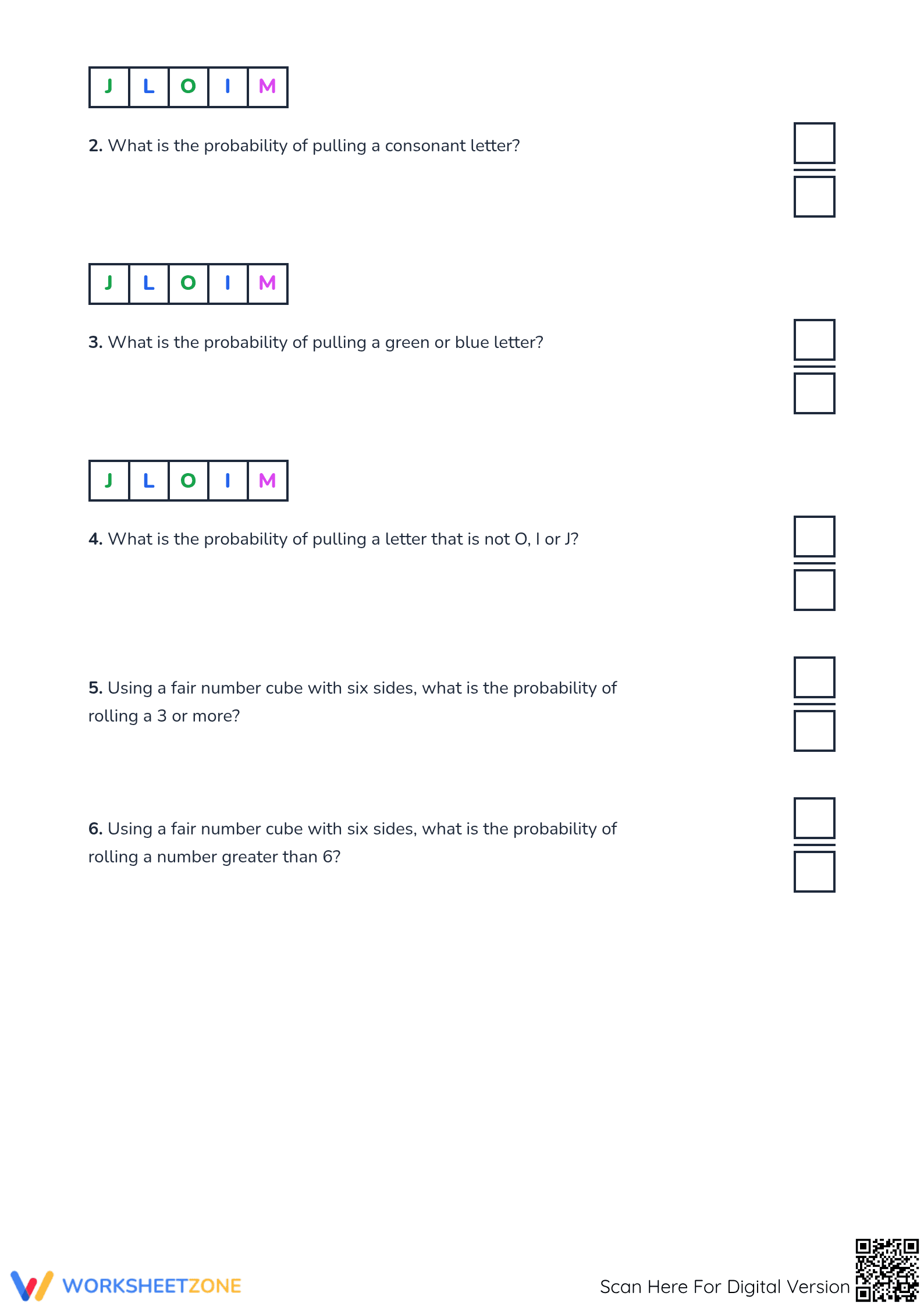
- Guided Practice: The first section uses a visual spinner example and a 5-letter set to help students identify "favorable" versus "possible" outcomes using colored letter blocks.
- Supported Practice: Problems 5 and 6 transition to fair number cubes (dice), requiring students to calculate probabilities for ranges, such as "rolling a 3 or more."
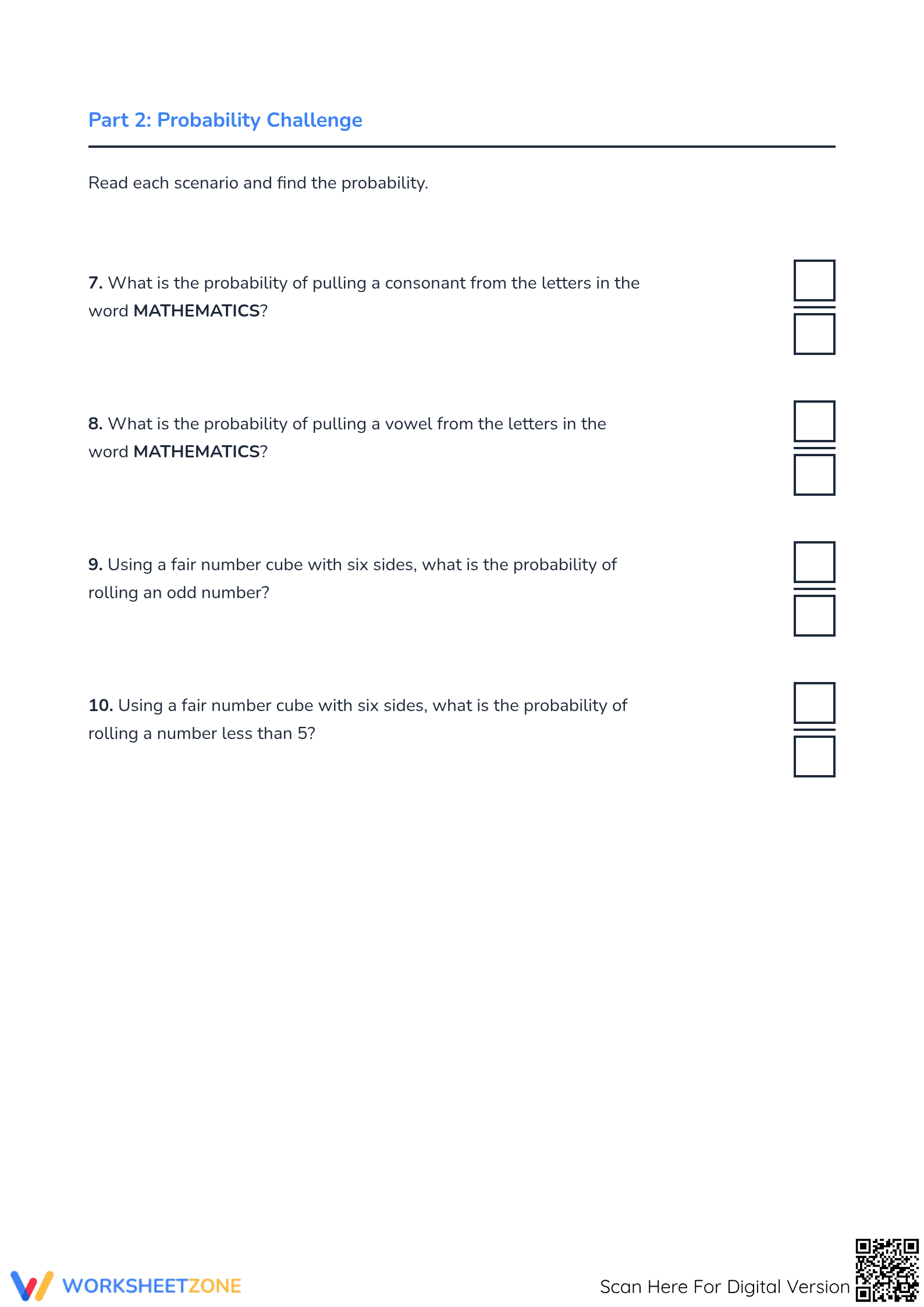
- Independent Practice: The final "Probability Challenge" section tasks students with analyzing the 11-letter word "MATHEMATICS" to find probabilities for consonants and vowels without visual scaffolds.
This sequence follows a gradual-release model, moving from "I Do" visual examples to "You Do" abstract word-based probability challenges.
Standards Alignment
The primary focus is CCSS.MATH.CONTENT.7.SP.C.5: "Understand that the probability of a chance event is a number between 0 and 1 that expresses the likelihood of the event occurring." While formally a 7th-grade standard, these foundational skills are essential for Grade 5 and 6 students applying knowledge of fractions and ratios to data analysis. Both standard codes can be copied directly into lesson plans, IEP goals, or district curriculum mapping tools.
How to Use It
This worksheet is best used during the "Independent Practice" phase after students have learned the basic probability formula. Teachers should observe students during problems 5 and 6, as the shift from single items to sets often reveals misconceptions about inclusive versus exclusive ranges. Expect most Grade 5 students to complete the 10 problems within 25 minutes.
Who It's For
Designed for general education students in Grades 4–6 beginning statistics, this resource is also an excellent remediation tool for middle school students needing to strengthen their grasp of probability as a fraction. It pairs naturally with an anchor chart showing the probability line from 0 (impossible) to 1 (certain).
The ScienceDirect TpT Analysis highlights that high-quality math resources must balance procedural fluency with conceptual understanding. This worksheet achieves that balance by requiring students to not only calculate numbers but also interpret specific scenarios like rolling dice or spinning an arrow. Utilizing the CCSS.MATH.CONTENT.7.SP.C.5 framework, this resource ensures students develop prerequisite skills for more complex compound probability. Educators can rely on this 10-problem set for consistent, measurable data on student mastery of probability as a fraction. The answer key and structured formula box support learner autonomy, allowing students to verify their own logic. This clear alignment to research-backed instructional design makes it a reliable addition to any upper elementary or middle school mathematics curriculum focused on data and probability standards.


