


























Views
Plays



Essential Discrete Random Variables HW | Grade 10 Math
Paste this activity's link or code into your existing LMS (Google Classroom, Canvas, Teams, Schoology, Moodle, etc.).
Students can open and work on the activity right away, with no student login required.
You'll still be able to track student progress and results from your teacher account.
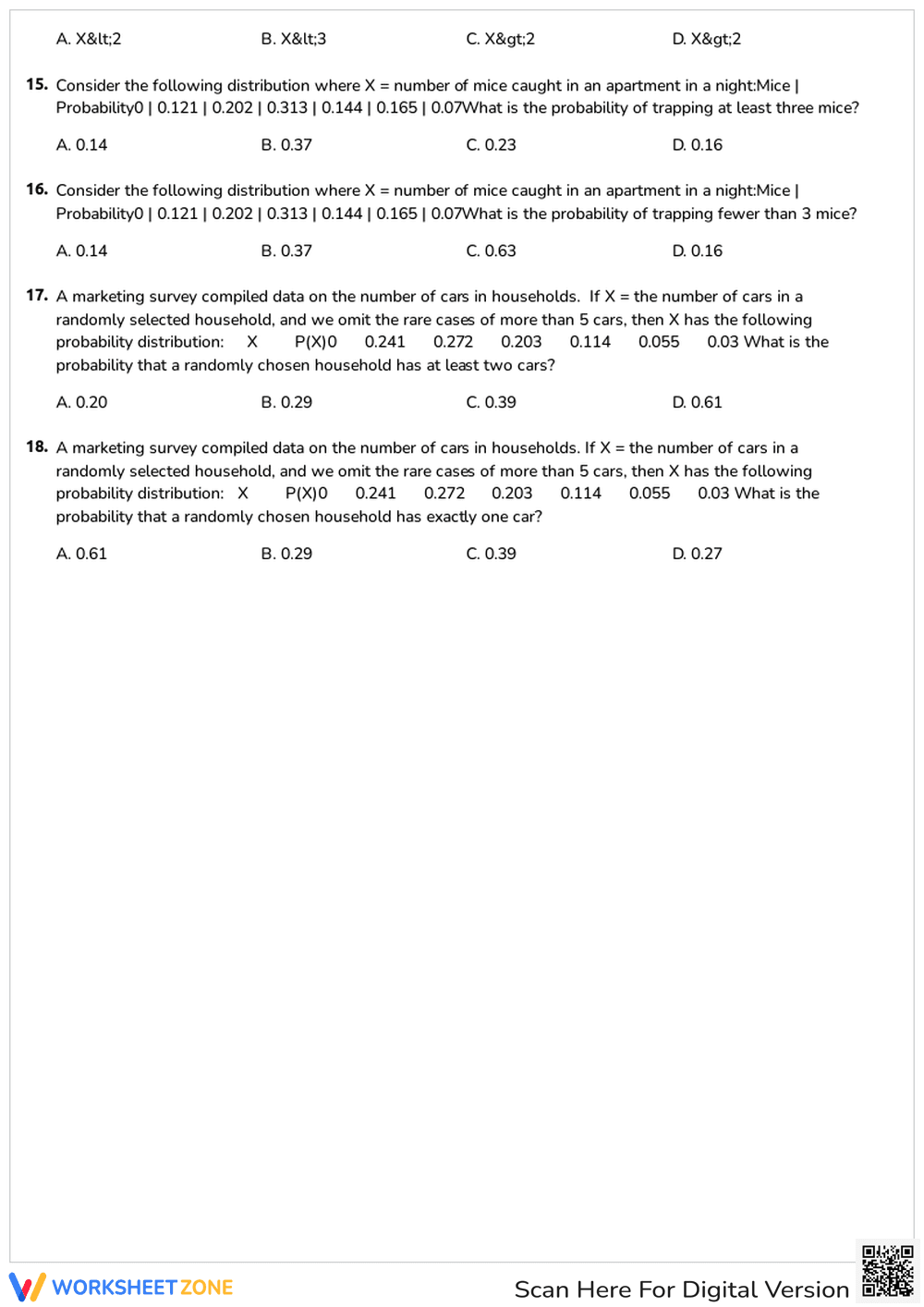
This Grade 10 math worksheet provides comprehensive practice with discrete random variables through 18 targeted multiple-choice questions. Students will identify discrete data types, verify probability distributions, and calculate specific probabilities from frequency tables. It is designed to move students from basic definitions to complex probability summations involving "at least" and "fewer than" scenarios.
At a Glance
- Grade: 10 · Subject: Math
- Standard:
HSS-MD.A.1— Define random variables and graph their corresponding probability distributions for sample spaces- Skill Focus: Discrete Random Variables
- Format: 3 pages · 18 problems · Answer key included · PDF
- Best For: Homework, formative assessment, or test prep
- Time: 30–45 minutes
What's Inside
The resource consists of a three-page PDF containing 18 multiple-choice questions. The first section focuses on conceptual definitions, distinguishing between discrete and continuous data. The middle section requires students to validate probability distributions by ensuring the sum of probabilities equals one. The final section presents various real-world scenarios, such as marketing surveys and quiz results, requiring students to extract and calculate probabilities from provided data tables.
Zero-Prep Workflow
- Print: Generate the three-page document in less than 60 seconds.
- Distribute: Hand out the materials immediately; instructions are self-contained within the multiple-choice format.
- Review: Grade efficiently using the included answer key, keeping total teacher prep time under two minutes.
This streamlined workflow makes the worksheet an ideal choice for emergency sub-plans or a quick check for understanding after a lecture.
Standards Alignment
The primary focus is `HSS-MD.A.1`, which requires students to define a random variable for a quantity of interest and understand the numerical values assigned to events. It also supports `HSS-MD.A.2` by asking students to calculate the probability of specific outcomes within a distribution. Both standard codes can be copied directly into lesson plans, IEP goals, or district curriculum mapping tools.
How to Use It
Use this worksheet as a summative homework assignment following a direct instruction lesson on probability distributions. Alternatively, assign it as a timed exit ticket quiz to gauge student mastery of discrete data concepts. During the activity, observe if students correctly sum the probabilities in the tables; a common error is neglecting the boundary values in inequalities. Completion typically ranges from 30 to 45 minutes.
Who It's For
This worksheet is tailored for High School students in Grades 9 through 11 enrolled in Algebra 2 or Statistics courses. It provides necessary scaffolding for students who struggle with abstract notation by using concrete tables and multiple-choice options. It pairs naturally with a probability anchor chart or a graphing calculator tutorial on list-based distributions.
According to the RAND AIRS 2024 report, structured practice with discrete data sets is vital for developing statistical literacy in secondary education. This worksheet addresses the HSS-MD.A.1 standard by requiring students to interpret numerical values within a sample space and apply the fundamental rules of probability distributions. By engaging with 18 distinct problems, students reinforce their ability to distinguish between discrete and continuous variables—a foundational skill for higher-level calculus and data science. Research from Fisher & Frey (2014) suggests that multiple-choice assessments, when paired with data-rich tables, help students identify misconceptions in probability summation more rapidly than open-ended tasks alone. This resource provides the necessary repetition to ensure students can accurately calculate at least and exactly probabilities, which are frequently tested on standardized college entrance exams and state-level assessments.


