




























Views
Downloads



Printable Working Dog Roles Word Search | Grades 4–5 ELA

Paste this activity's link or code into your existing LMS (Google Classroom, Canvas, Teams, Schoology, Moodle, etc.).
Students can open and work on the activity right away, with no student login required.
You'll still be able to track student progress and results from your teacher account.
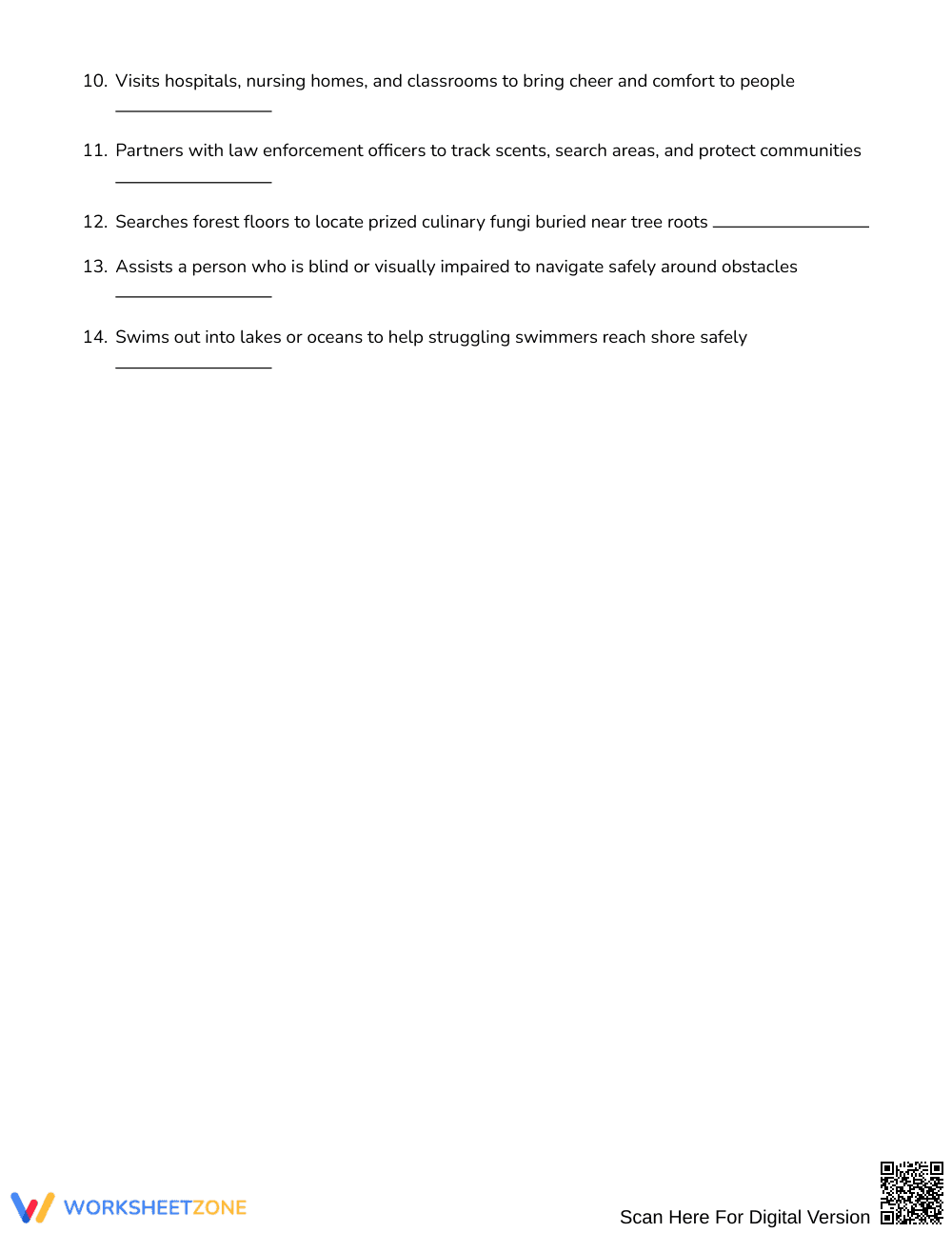
This working dog roles word search builds vocabulary and context clues skills for Grades 4–5 students. Learners read descriptive clues defining fourteen specialized canine jobs, identify the correct vocational terms, and locate each term within a letter grid. The activity reinforces informational text vocabulary while promoting active engagement through self-directed puzzle solving.
At a Glance
- Grade: Grades 4–5 elementary learners · Subject: English Language Arts (ELA)
- Standard: Not standards-assessed — vocabulary enrichment through context clues
- Skill Focus: Working dog roles and service animal terminology
- Format: 3 pages · 14 words · Full answer key included · PDF
- Best For: Independent vocabulary enrichment, literacy centers, and early finishers
- Time: 20–30 minutes
This 3-page printable PDF features a Clue Detective activity centered on 14 words representing working canine roles. Rather than scanning for a basic list, students read 14 clue definitions to deduce target vocabulary before searching. The package includes a shuffled word bank for support alongside a 3-page answer key highlighting exact letter coordinates for quick checking.
Puzzle Mechanics and Structure
The activity features a 16 x 16 letter grid where words run in four directions: northeast (NE), east (E), southeast (SE), and south (S). This layout prompts students to track diagonal and vertical letter strings without reverse reading. Learners read each clue to determine the canine role, check the shuffled word bank for spelling verification, and search the grid to locate all 14 words.
Standards Alignment
This word search is designed strictly for vocabulary enrichment and is not aligned to a standard. It supports domain-specific language acquisition, context clue comprehension, and visual scanning practice within upper elementary reading instruction.
How to Use It
Deploy this word search during an informational text unit on animal partnerships or after direct instruction on context clues. In small groups, have students read clues aloud and verify spelling before scanning. Alternatively, assign it as an independent fast-finisher activity. For formative assessment, observe whether students deduce roles from clues or rely immediately on the word bank. Most learners complete the puzzle in 20 to 30 minutes.
Who It's For
This resource is tailored for Grades 4–5 students developing tier-two and tier-three vocabulary. For learners needing support, encourage highlighting keywords in the clues before searching. Advanced students can write sentences explaining each canine role. Pair this puzzle with an informational reading passage about service animals or an anchor chart detailing working canine careers.
Vocabulary enrichment activities that integrate descriptive clues provide essential exposure to domain-specific terminology for intermediate elementary readers. According to Fisher & Frey (2014), intentional word exposure coupled with definitional context strengthens student reading comprehension and retention far more effectively than isolated rote memorization. This Grades 4–5 working dog roles word search requires students to process functional definitions for 14 specialized terms, directly reinforcing reading comprehension and orthographic mapping skills. By deciphering clues about canine service responsibilities and actively tracking target letter patterns across a 16 x 16 letter grid, learners build associative connections between professional tasks and domain vocabulary. While this print-and-go resource is designed strictly for supplemental enrichment without a formal academic standard code, it serves as an effective, high-engagement tool that supports ongoing vocabulary acquisition, literacy centers, and independent practice across diverse elementary classrooms.


