




























Views
Downloads





Printable Symbolic Readings Worksheet | Grade 9 English I

Paste this activity's link or code into your existing LMS (Google Classroom, Canvas, Teams, Schoology, Moodle, etc.).
Students can open and work on the activity right away, with no student login required.
You'll still be able to track student progress and results from your teacher account.
This Grade 9 English I worksheet guides students through analyzing competing symbolic readings in paired texts. Rather than reducing recurring motifs to one-dimensional meanings, learners examine sensory diction to evaluate conflicting interpretations. The resource prepares high school readers to construct qualified, text-grounded literary arguments.
At a Glance
- Grade: 9 · Subject: English I
- Standard:
RL.9-10.4— Determine figurative and symbolic meanings of words in literary text- Skill Focus: Competing Symbolic Readings
- Format: 6 pages · 10 problems · Answer key included · PDF
- Best For: Close reading and literary analysis
- Time: 45–60 minutes
What's Inside
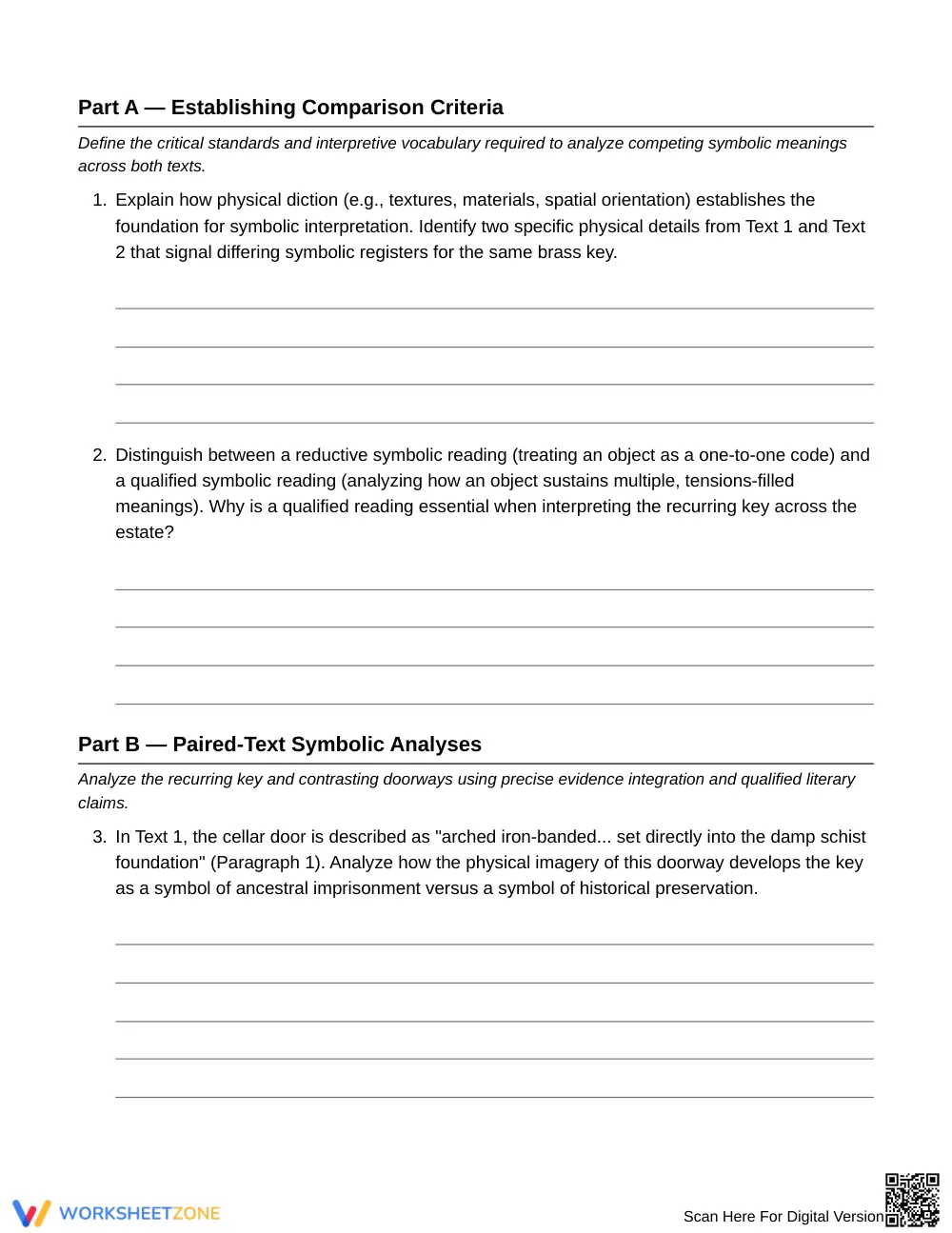
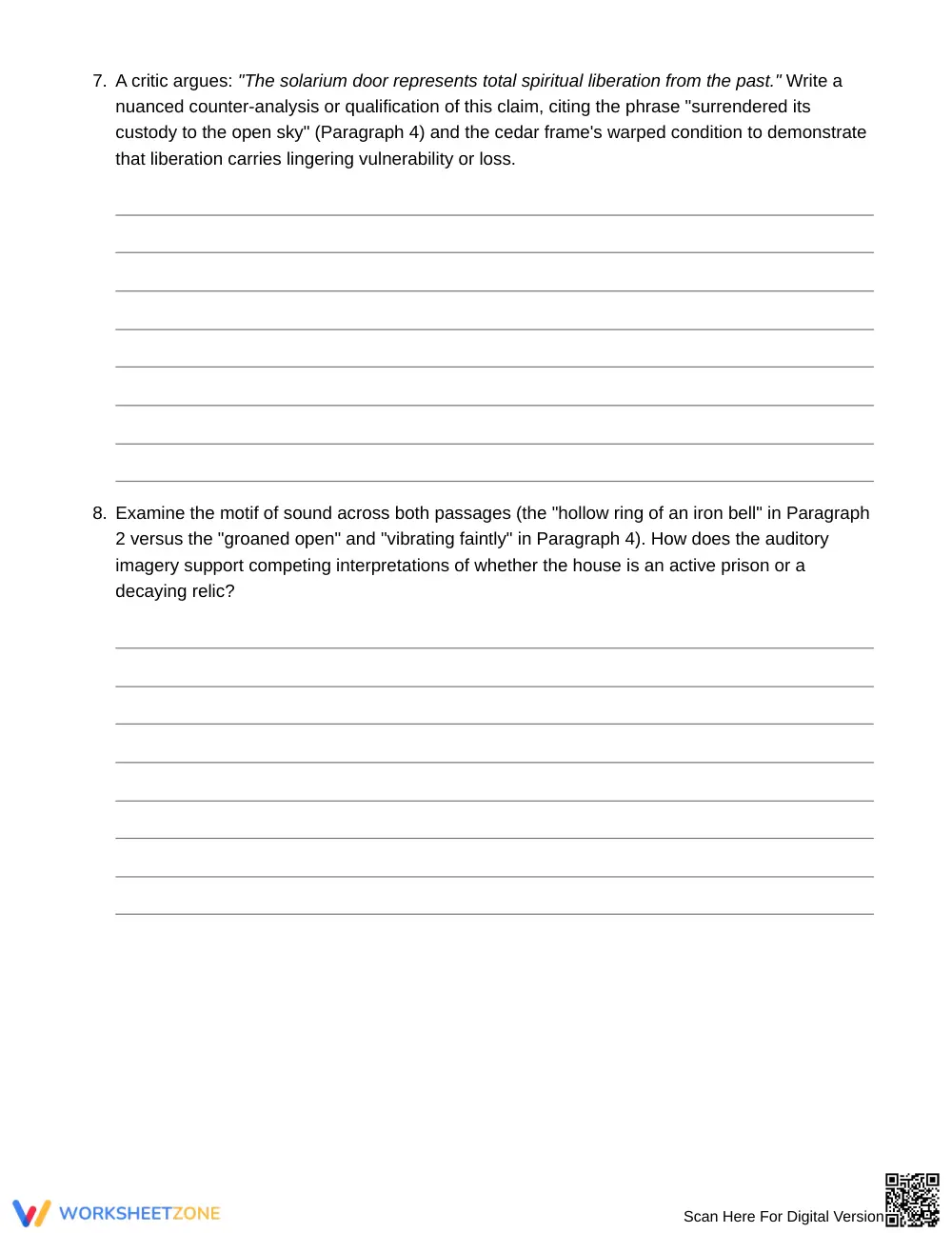
The 6-page packet features paired passages ("The Descent to the Vault" and "The Ascent to the Solarium") alongside 10 analytical problems. Students complete vocabulary definitions, evidence-based prompt responses, and a comparative evaluation essay. A thorough 4-page answer key provides complete textual evidence and exemplar analyses.
Skill Progression
- Guided practice (Tasks 1–2): Students define interpretive vocabulary and contrast reductive symbolism with qualified analysis.
- Supported practice (Tasks 3–8): Learners examine tactile imagery, environmental details, and character posture to analyze competing symbolic interpretations.
- Independent practice (Tasks 9–10): Students evaluate thematic consequences and draft a multi-paragraph comparative essay defending an analytical claim.
This progression uses a gradual-release model to move students from core concepts to complex thematic evaluation.
Standards Alignment
This resource aligns with RL.9-10.4: Determine the meaning of words and phrases in context, including figurative and connotative meanings, and analyze the cumulative impact of specific word choices. Tasks also support RL.9-10.1 by requiring textual evidence for every analytical claim. Both standard codes can be copied directly into lesson plans, IEP goals, or district curriculum mapping tools.
How to Use It
Use this worksheet after direct instruction on symbolic motifs. Facilitate Part A during whole-class discussion, then transition students to collaborative work for Part B. For formative assessment, review Task 7 to check whether students can qualify opposing claims without adopting reductive binaries. Completion requires approximately 45 to 60 minutes.
Who It's For
Designed for Grade 9 English I classrooms, this worksheet supports on-level readers and challenges advanced students. Support developing analysts by pre-highlighting contrasting tactile imagery in each passage. Pair this activity with a classroom anchor chart on constructing qualified analytical claims.
According to Fisher & Frey (2014), structured instructional scaffolding within complex text analysis helps secondary students transition from literal comprehension to qualified critical evaluation. When high school readers encounter rich paired passages, isolating contrasting diction and architectural motifs prevents reductive, one-to-one symbolic assumptions that oversimplify authorial intent. This 6-page worksheet aligns directly with RL.9-10.4 by guiding Grade 9 English I students through 10 targeted tasks that determine how figurative and sensory diction generates competing meanings. Rather than viewing motifs in isolation, learners trace how physical weight, tactile friction, and spatial movement redefine an object's thematic role. By requiring students to defend competing interpretations using cumulative textual evidence, the resource builds the analytical stamina necessary for sustained high school literary synthesis and objective-driven assessments across general education and Pre-AP coursework.


