


























Views
Downloads



Printable Series-Parallel Worksheet | Grade 12 Physics
Paste this activity's link or code into your existing LMS (Google Classroom, Canvas, Teams, Schoology, Moodle, etc.).
Students can open and work on the activity right away, with no student login required.
You'll still be able to track student progress and results from your teacher account.
This Grade 12 Physics worksheet teaches students to solve series-parallel circuits by reducing a network to one equivalent resistance, finding the source current, and working back to every resistor. Ten tasks move from worked examples to independent multi-step problems and short explanation checks on how circuits respond to change.
At a Glance
- Grade: 12 · Subject: Physics
- Standard: Not specified — students apply V = IR and the series and parallel rules to whole circuits
- Skill Focus: Solving series-parallel circuits
- Format: 5 pages · 10 problems · Answer key included · PDF
- Best For: Applying circuit reduction after instruction
- Time: 45–60 minutes
What's Inside
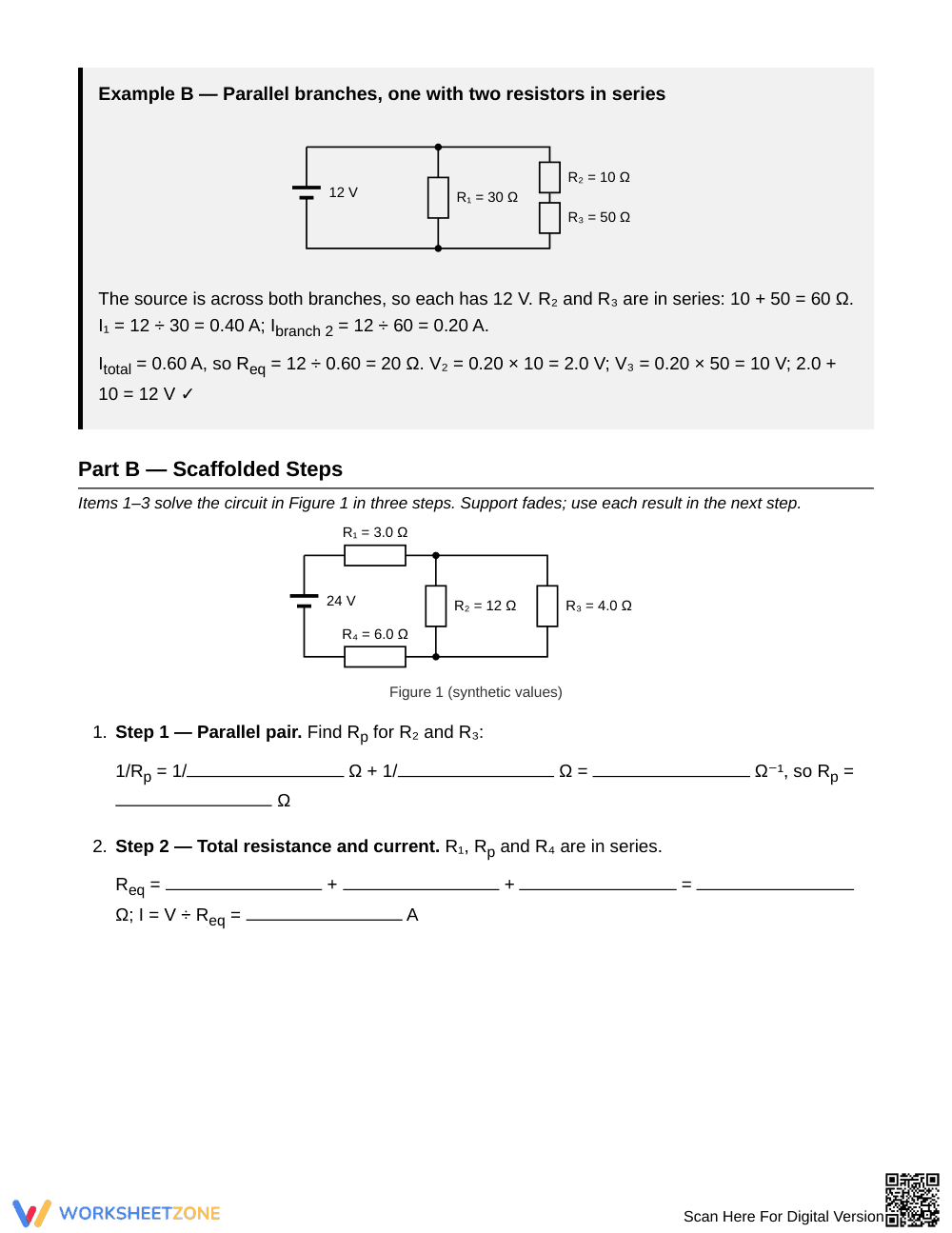
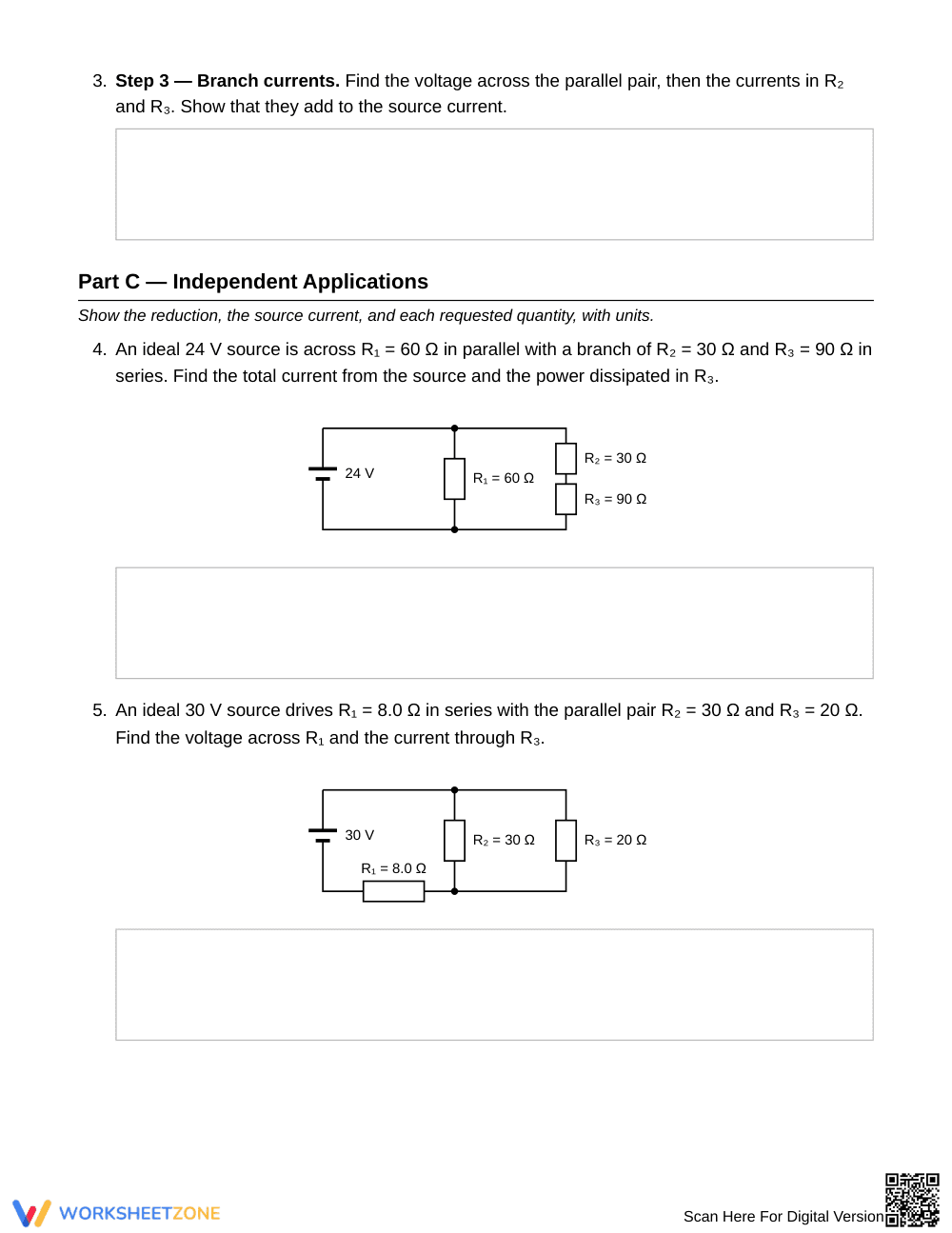
The 5-page worksheet opens with two worked examples: a series resistor with a parallel pair, and parallel branches where one branch holds two resistors in series. It then moves through a fill-in scaffold, five independent applications, and two explanation checks. A rule box states V = IR, P = IV and the series and parallel relationships. A 3-page answer key is included.
Skill Progression
- Guided practice (3 tasks): Fill-in steps on Figure 1 for parallel resistance, total resistance and source current, and branch currents, with support fading.
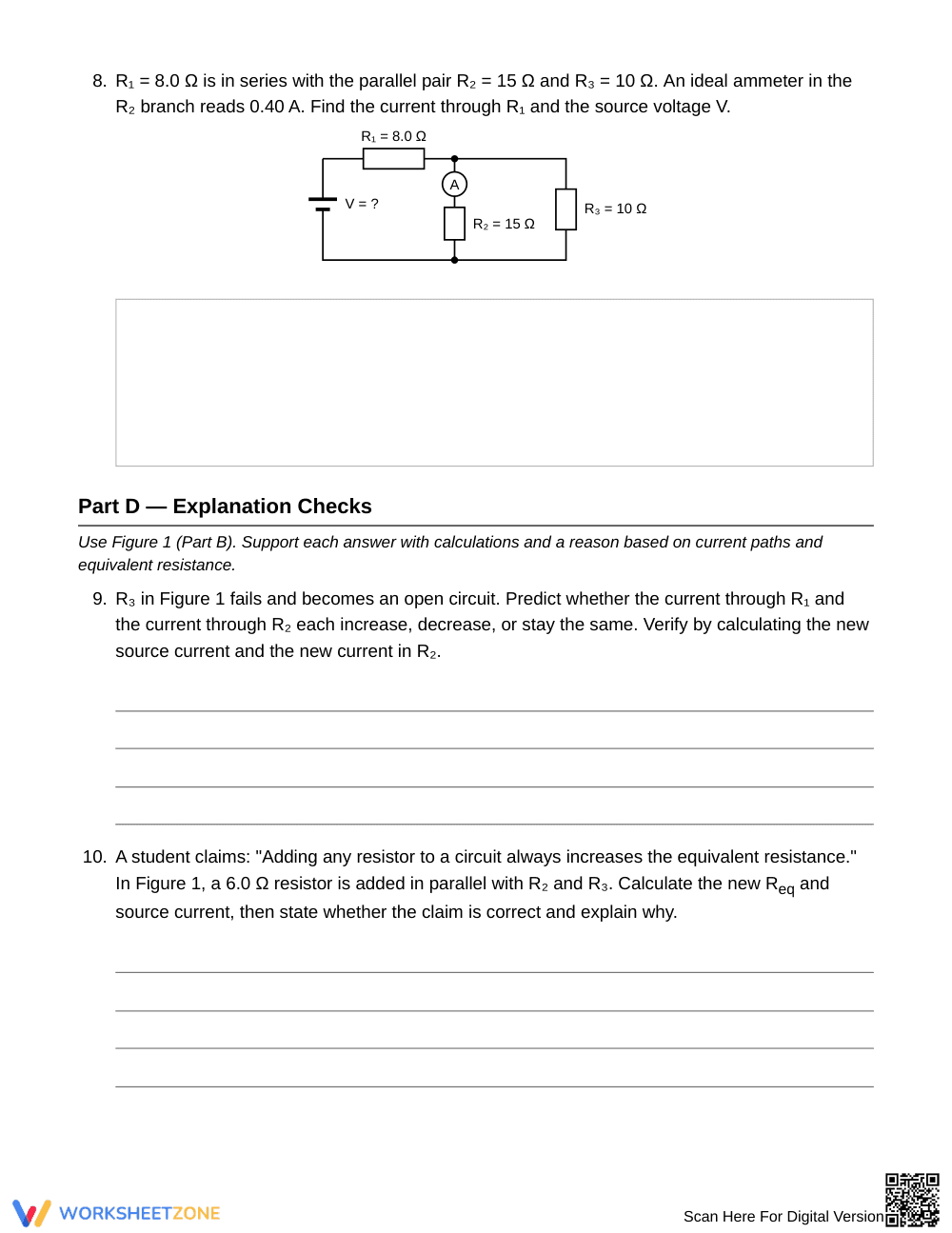
- Supported practice (5 tasks): Applications with the rule box and reduce-then-expand strategy available. Students show the reduction, source current and each requested quantity.
- Independent practice (2 tasks): Students predict and verify what happens when a resistor fails open or one is added in parallel.
This follows a gradual-release sequence: I Do, We Do, You Do.
Standards Alignment
No standard code was supplied for this worksheet, so none is listed here. The content covers Ohm's law (V = IR), electric power (P = IV = I²R), and series and parallel resistance rules for analyzing direct-current circuits, including how an open branch changes current. Add your state or district code when entering the resource in lesson plans, IEP goals, or curriculum mapping tools.
How to Use It
- During instruction: Work Part A together, then have students complete Part B in pairs. Circulate and check whether they identify shared nodes before combining resistors.
- After instruction: Assign Parts C and D as independent classwork or homework. Expect 45–60 minutes in total.
Who It's For
Grade 12 Physics students who have met Ohm's law and basic series and parallel circuits. Part B gives structure to students who need it, and Part D challenges those ready for conceptual reasoning. Pair it with a direct-instruction lesson or anchor chart on equivalent resistance.
This Grade 12 Physics worksheet on solving series-parallel circuits gives students 10 tasks over 5 pages, with a 3-page answer key. Students reduce a mixed network to one equivalent resistance, apply V = IR to find the source current, and work back to the current, voltage, and power at each resistor. Two worked examples and a three-step scaffold model the method before five independent problems and two explanation checks, including an open-circuit failure and an added parallel resistor. The structure follows the gradual release of responsibility described by Fisher & Frey (2014), in which teachers model, guide, and then release students to independent work. Because the independent tasks require units, a reduction, and a reason based on current paths, the worksheet gives teachers evidence of conceptual understanding as well as arithmetic accuracy. No standard code is listed for this resource.


