


























Views
Downloads



Printable Sequential Motion Worksheet | Grade 12 Physics
Paste this activity's link or code into your existing LMS (Google Classroom, Canvas, Teams, Schoology, Moodle, etc.).
Students can open and work on the activity right away, with no student login required.
You'll still be able to track student progress and results from your teacher account.
This Grade 12 Physics worksheet teaches students to combine sequential motion stages by splitting a trip at each change in acceleration, then carrying velocity and position forward. Students finish able to solve multi-stage kinematics problems with consistent signs, valid roots, and clear written justifications.
At a Glance
- Grade: 12 · Subject: Physics
- Standard: Constant-acceleration kinematics — students split motion into stages and carry values forward.
- Skill Focus: Combine sequential motion stages
- Format: 5 pages · 12 problems · Answer key included · PDF
- Best For: Unit review and independent practice
- Time: 40–55 minutes
What's Inside
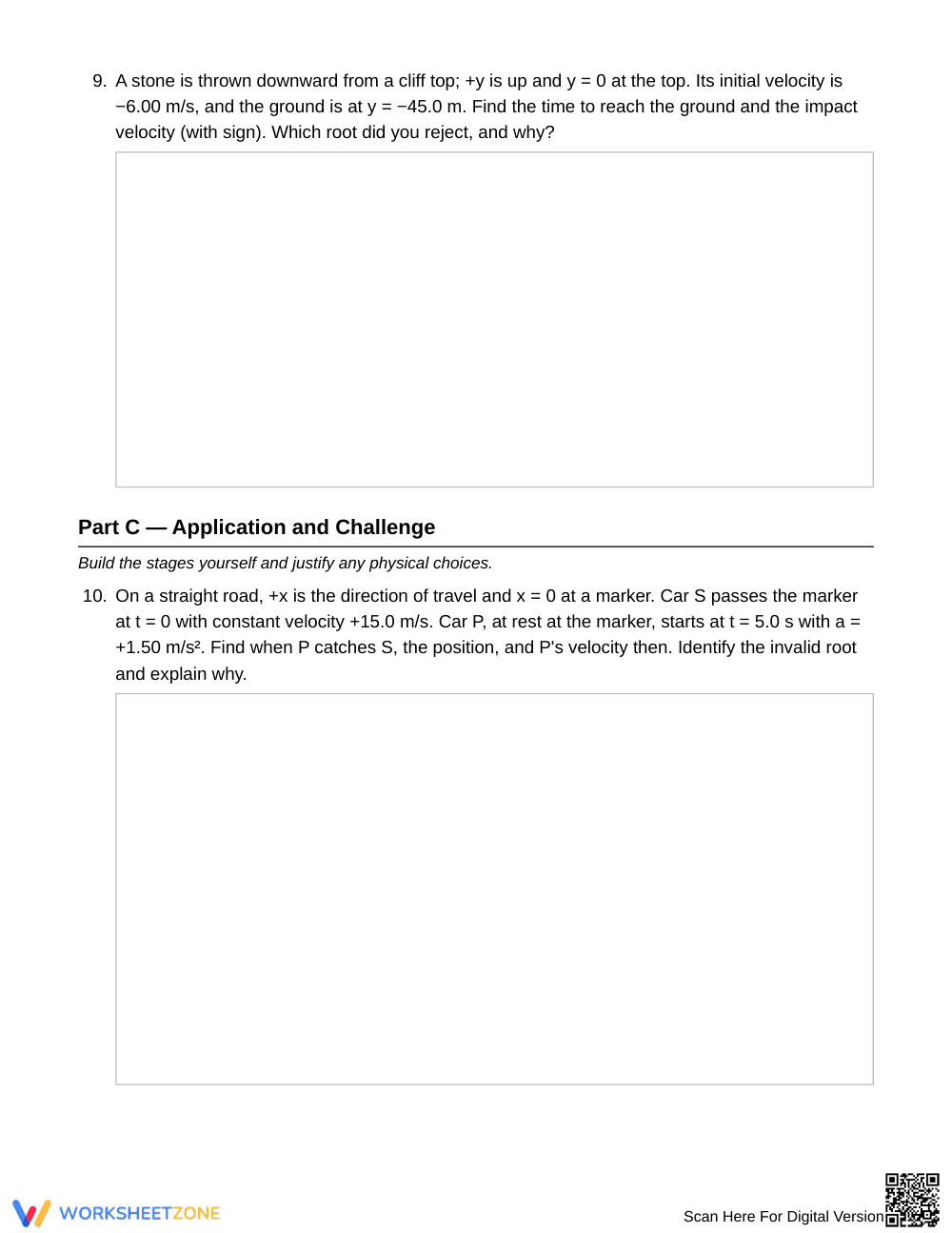
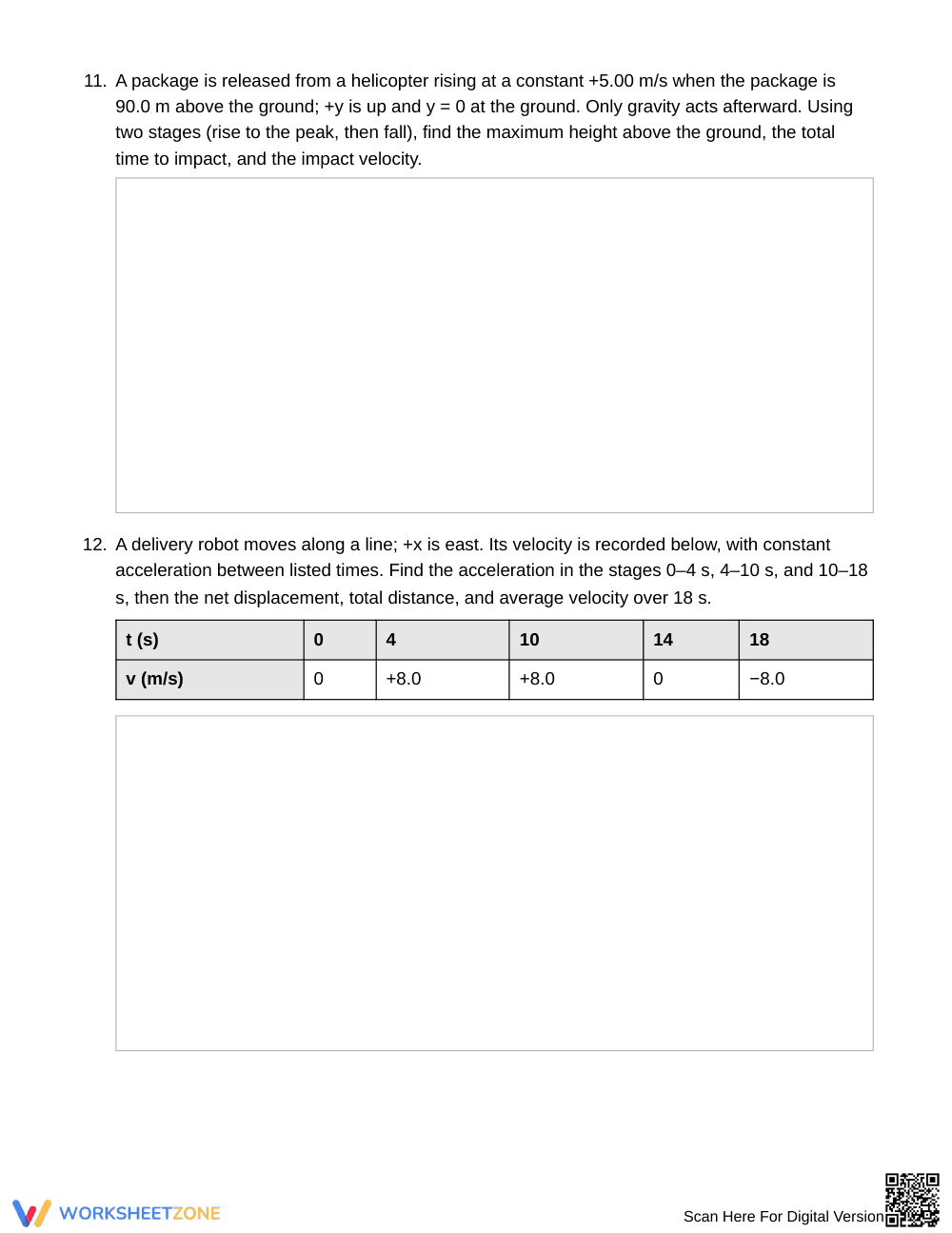
The worksheet runs 5 pages and opens with a formula and constants reference plus a short method box. Twelve problems follow in three parts: single-stage signed motion, multi-stage motion, and application challenges. Tasks cover trains, elevators, a rocket, a falling stone, a pursuit problem, and a velocity-time table. Several ask for short written explanations of sign choices and rejected roots. A 2-page answer key is included.
Skill Progression
- Guided practice: Part A, 3 problems on single-stage motion with the positive direction stated.
- Supported practice: Part B, 6 problems where students treat each stage separately and link them.
- Independent practice: Part C, 3 problems where students build the stages themselves and justify choices.
This sequence follows gradual release: I Do, We Do, You Do.
Standards Alignment
No standard code was supplied for this resource. It addresses constant-acceleration kinematics in one dimension: using position, velocity, and acceleration relationships with signed quantities to describe motion across stages. Add your state or district code when mapping it to lesson plans, IEP goals, or curriculum tools.
How to Use It
- After direct instruction: Assign Parts A and B as classwork. Circulate and check that students write the positive direction before substituting.
- Before a unit test: Assign Part C as review or homework, then use the answer key for self-checking.
Expect 40–55 minutes in total. For formative assessment, watch for sign errors on deceleration and for students who keep both quadratic roots.
Who It's For
This worksheet suits algebra-based Grade 12 Physics students who already know the constant-acceleration equations. Students who need more support can complete Part A and the first three Part B problems. Students ready for more can focus on Part C. It pairs well with a worked-example lesson on splitting motion at a reversal point.
The Grade 12 Physics worksheet Combining Sequential Motion Stages teaches students to solve constant-acceleration kinematics problems by splitting motion into stages and carrying each stage's final velocity and position into the next. Its 12 tasks move from single-stage signed motion to multi-stage trains, elevators, rockets, and falling objects, then to pursuit and graph-based challenges, with a 2-page answer key. Students define a positive direction, keep every sign, choose valid roots from quadratic solutions, and justify physical choices in words. The structure follows the gradual-release model described by Fisher & Frey (2014), in which teachers move from modeling to guided practice to independent work. Because every scenario uses invented data, teachers can assign it as review, homework, or assessment preparation. The worksheet is five pages, includes a formula reference, and takes about 40 to 55 minutes to complete.


