


























Views
Downloads



Printable Mole Ratio & Yield Worksheet | Grade 11 Chemistry
Paste this activity's link or code into your existing LMS (Google Classroom, Canvas, Teams, Schoology, Moodle, etc.).
Students can open and work on the activity right away, with no student login required.
You'll still be able to track student progress and results from your teacher account.
This worksheet helps Grade 11 chemistry students use mole ratios from balanced equations to find amounts of product, identify limiting reactants, and judge whether a yield makes sense. Students move from concept checks to multi-step calculations and written explanations, building procedural fluency and the habit of checking answers.
At a Glance
- Grade: 11 · Subject: Chemistry
- Standard: Stoichiometry — use balanced equations to predict and evaluate reaction amounts
- Skill Focus: Mole ratios, limiting reactants, percent yield
- Format: 5 pages · 12 problems · Answer key included · PDF
- Best For: Stoichiometry practice after direct instruction
- Time: 40–50 minutes
What's Inside
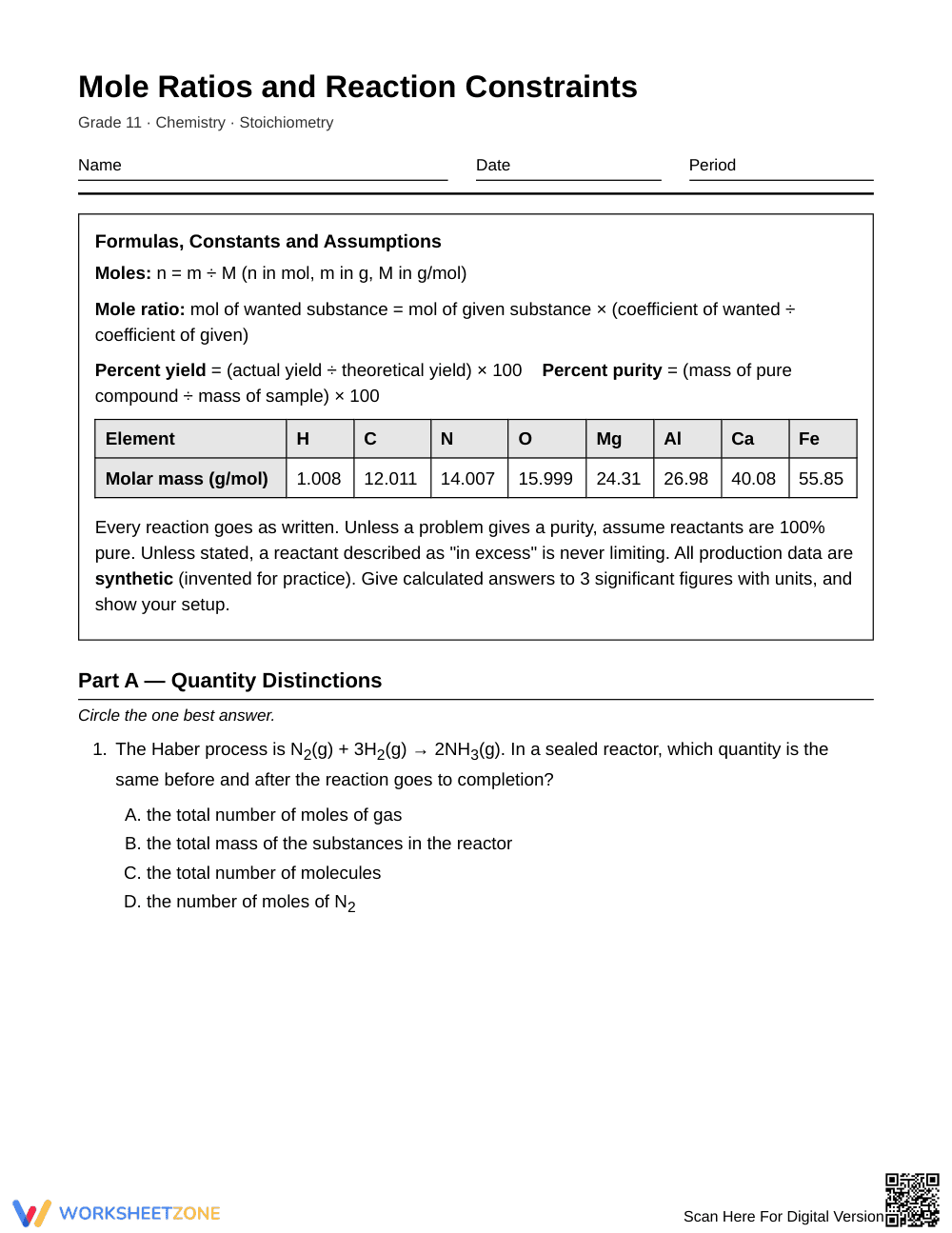
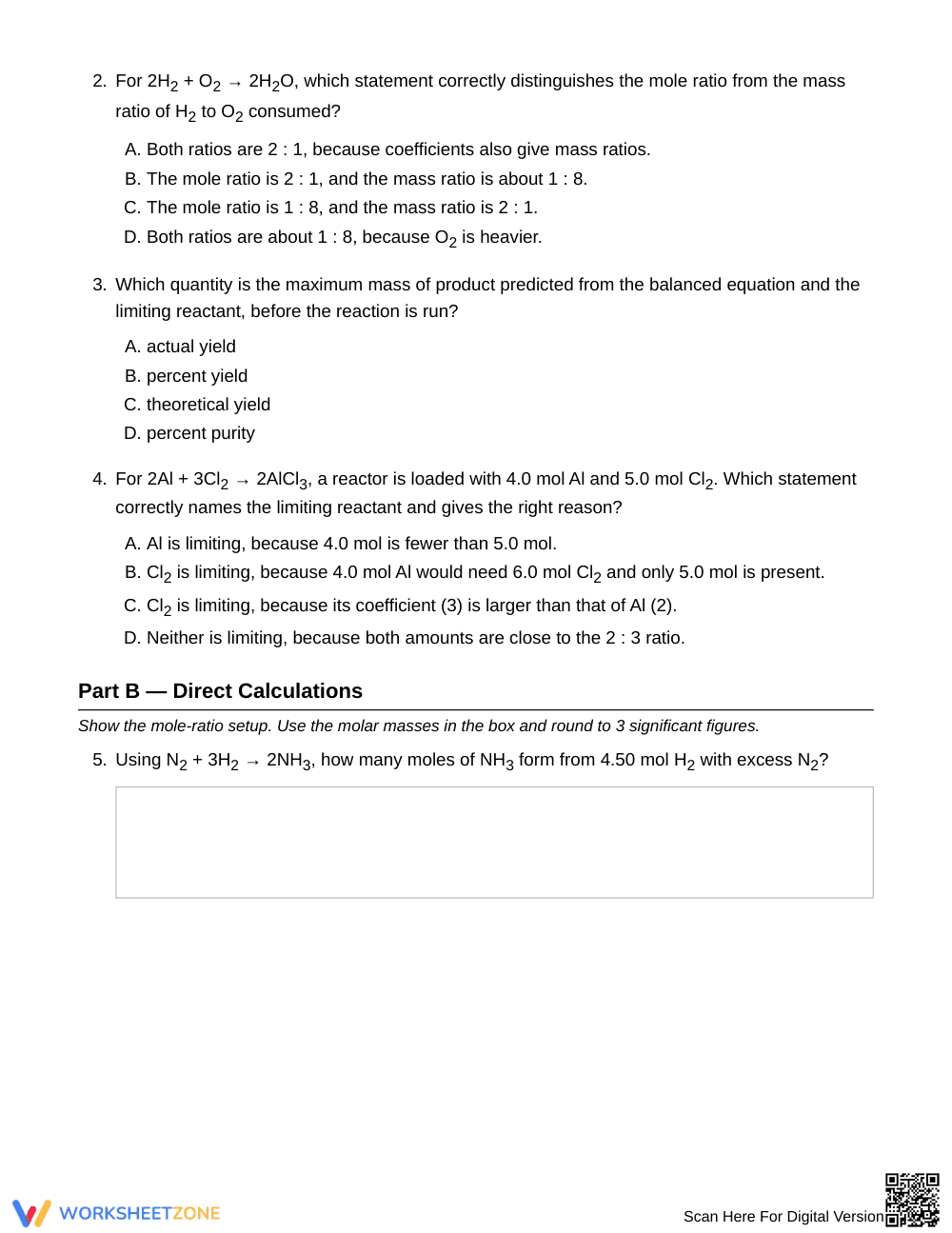
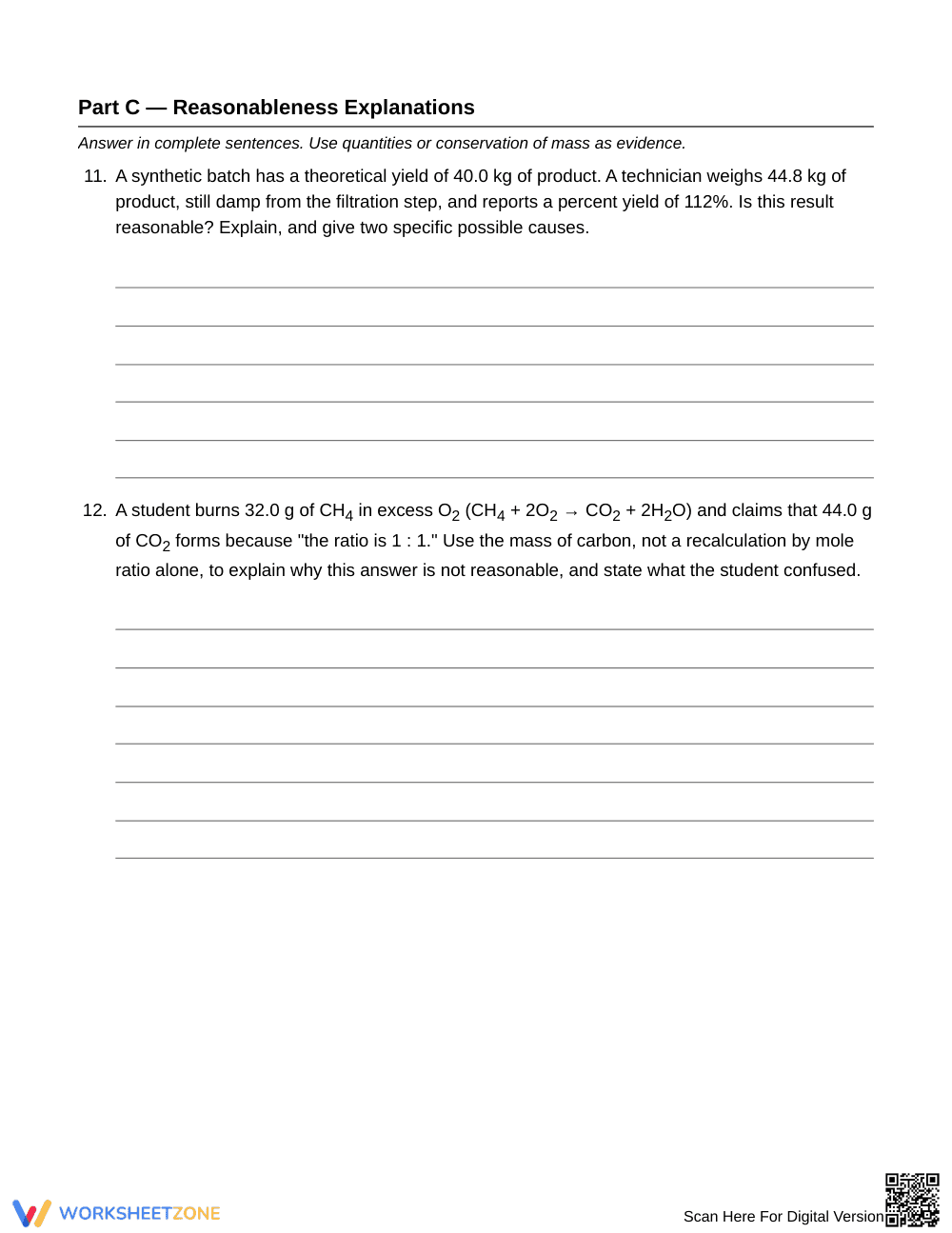
The worksheet has three parts and 12 tasks across 5 pages. A reference box lists the key formulas, molar masses for eight elements, and the working assumptions, so students do not need a periodic table. Part A has four multiple-choice concept checks. Part B has six calculations that include limiting reactants, percent yield, percent purity, and working backward from a required output. Part C has two written reasonableness tasks. A 3-page answer key shows worked setups and final answers.
Skill Progression
- Guided practice (Part A, 4 items): Circle-the-answer questions separate moles from mass, theoretical from actual yield, and name the limiting reactant with a reason.
- Supported practice (Part B, 6 items): Students show a mole-ratio setup. Problems start with one-step conversions and build to purity, yield, and reverse calculations.
- Independent practice (Part C, 2 items): Students write complete-sentence arguments using conservation of mass and quantities as evidence.
The sequence follows a gradual-release model: I Do, We Do, You Do.
Standards Alignment
This worksheet targets the stoichiometry expectation that students use balanced chemical equations and molar mass to predict the amounts of products and reactants, identify limiting reactants, and evaluate yield. No standard code was supplied for this resource, so add your state or district code when copying it into lesson plans, IEP goals, or curriculum mapping tools.
How to Use It
- After direct instruction: Assign Parts A and B as in-class practice. Expect 30–35 minutes.
- Before a unit quiz: Use all three parts as a review. Expect 40–50 minutes.
For formative assessment, watch the Part B limiting-reactant item. Students who divide by coefficients inconsistently, or who skip the mole conversion, are likely mixing up mole and mass ratios.
Who It's For
This resource suits Grade 11 chemistry students in a first-year course who have met balanced equations and molar mass. Students who need more support can complete Part A first and use the formula box as a scaffold. Stronger students can concentrate on the Part C explanations. Pair it with a limiting-reactant anchor chart or a short direct-instruction lesson on percent yield.
Mole Ratios and Reaction Constraints is a Grade 11 chemistry worksheet that teaches students to use balanced equations, molar mass, limiting reactants, purity, and percent yield to predict and judge reaction amounts. Across 12 tasks, students separate mole ratios from mass ratios, calculate theoretical yield, and explain why a reported result is or is not reasonable using conservation of mass. The structure follows the gradual release of responsibility model described by Fisher & Frey (2014), which moves learners from guided checks to supported calculations to independent reasoning. The 5-page worksheet uses synthetic production data, includes a formula and molar-mass reference box, and comes with a 3-page answer key showing setups and final answers. Teachers can use it as classwork, homework, or review.


