


























Views
Downloads



Printable Land-Use Change Worksheet | Grade 8 Science
Paste this activity's link or code into your existing LMS (Google Classroom, Canvas, Teams, Schoology, Moodle, etc.).
Students can open and work on the activity right away, with no student login required.
You'll still be able to track student progress and results from your teacher account.
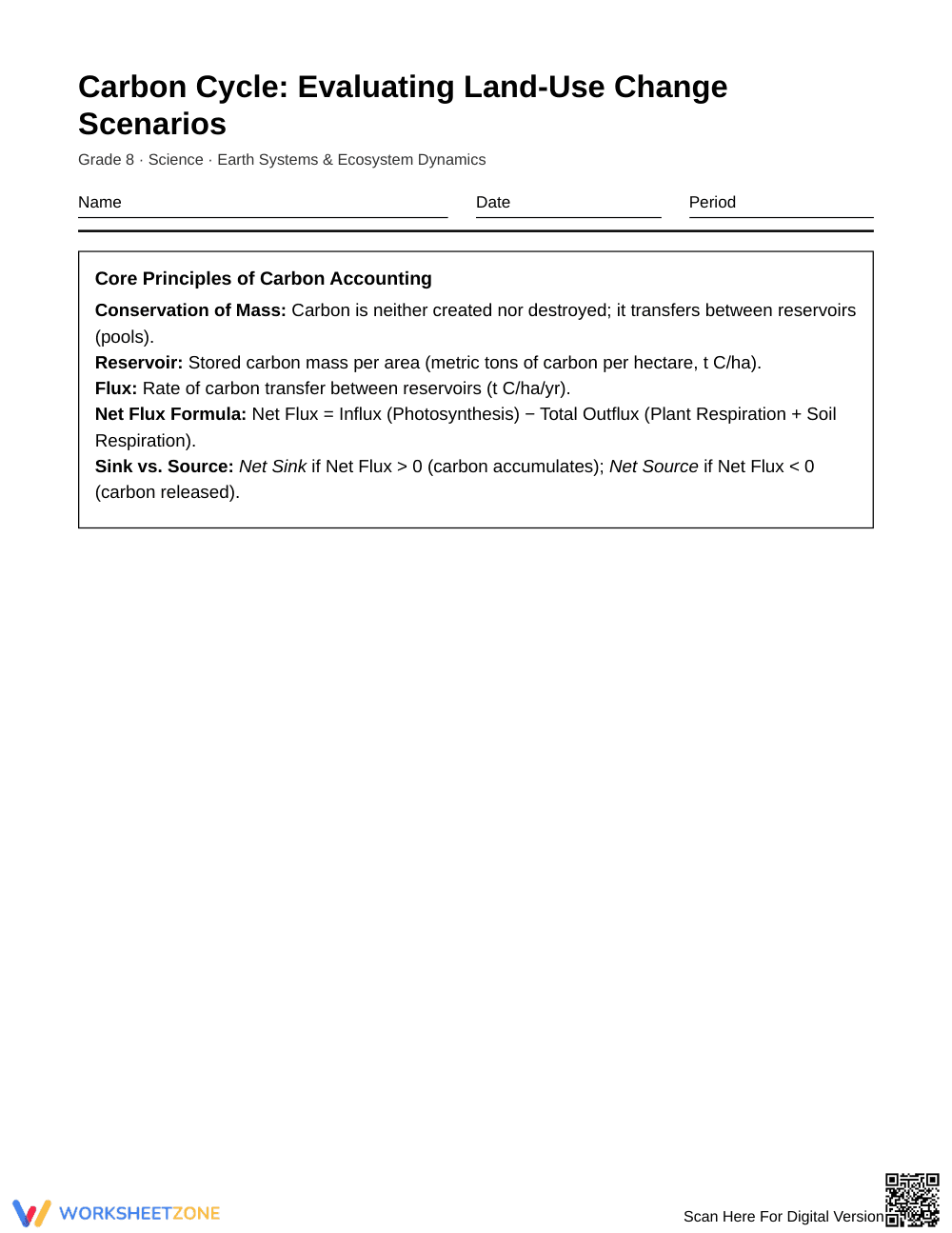
This Grade 8 science worksheet equips students to evaluate real-world land-use change scenarios by analyzing quantitative carbon flux and reservoir data. Learners examine conservation of mass across forest, pasture, and cropland ecosystems, calculating net transfers to determine whether modified landscapes serve as atmospheric carbon sinks or sources.
At a Glance
- Grade: 8 · Subject: Middle School Earth and Life Science
- Standard: Model, calculate, and evaluate carbon cycling and matter transfers across terrestrial watershed reservoirs
- Skill Focus: Evaluate a Land-Use Change Scenario
- Format: 5 pages · 10 quantitative problems · 2-page answer key included · PDF
- Best For: Carbon cycle data analysis, lab follow-up, and assessment
- Time: 45–60 minutes of active instructional time
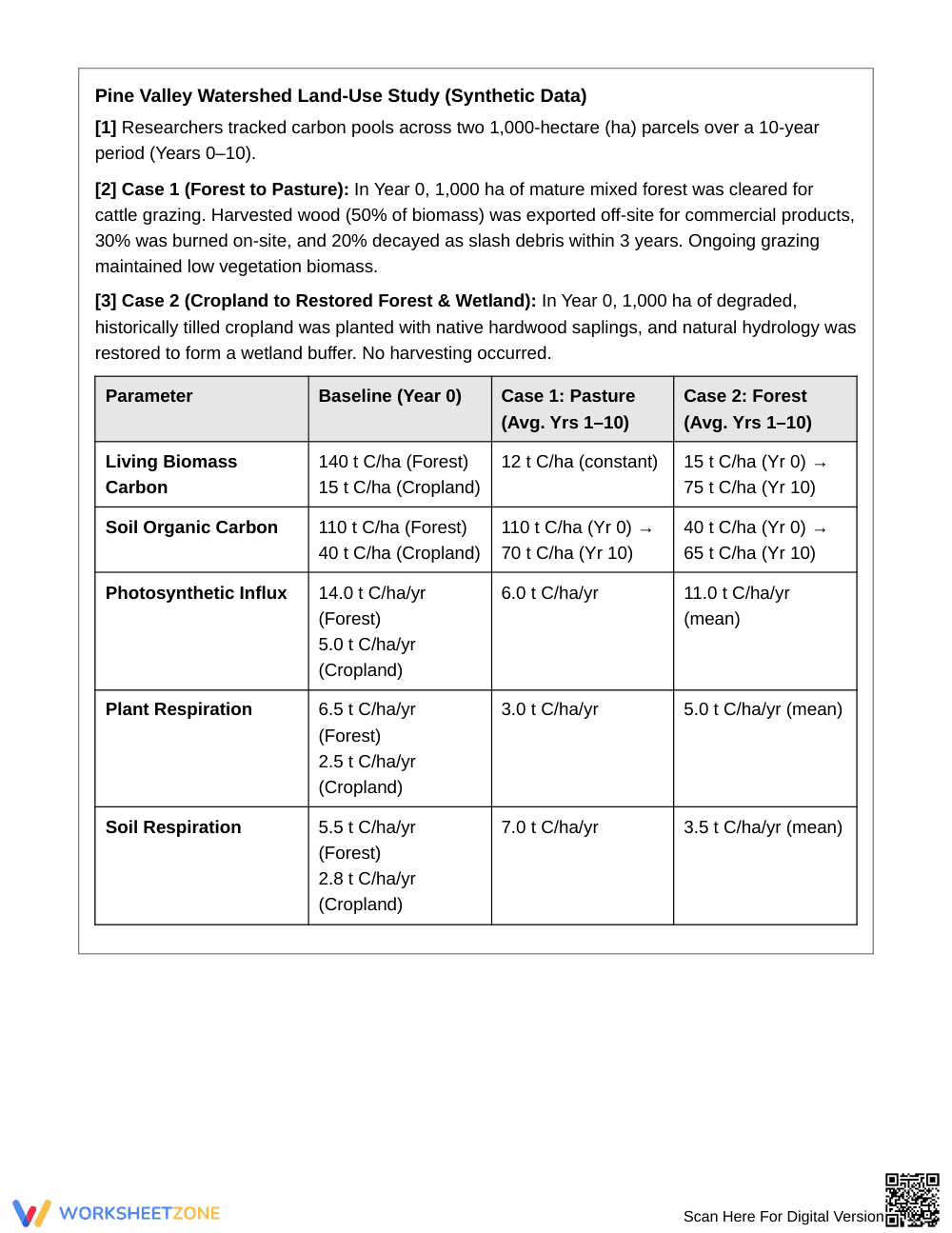
This 5-page resource centers on the synthetic Pine Valley Watershed Land-Use Study. It provides a core principles reference box with flux formulas, followed by a data table tracking forest, pasture, and cropland parcels over 10 years. Students complete 10 problems ranging from boundary analysis to multi-step parcel calculations. A 2-page answer key provides complete working and explanations.
Skill Progression
- Guided practice (Part A, Problems 1–2): Students define system boundaries and apply the conservation of mass to carbon movement.
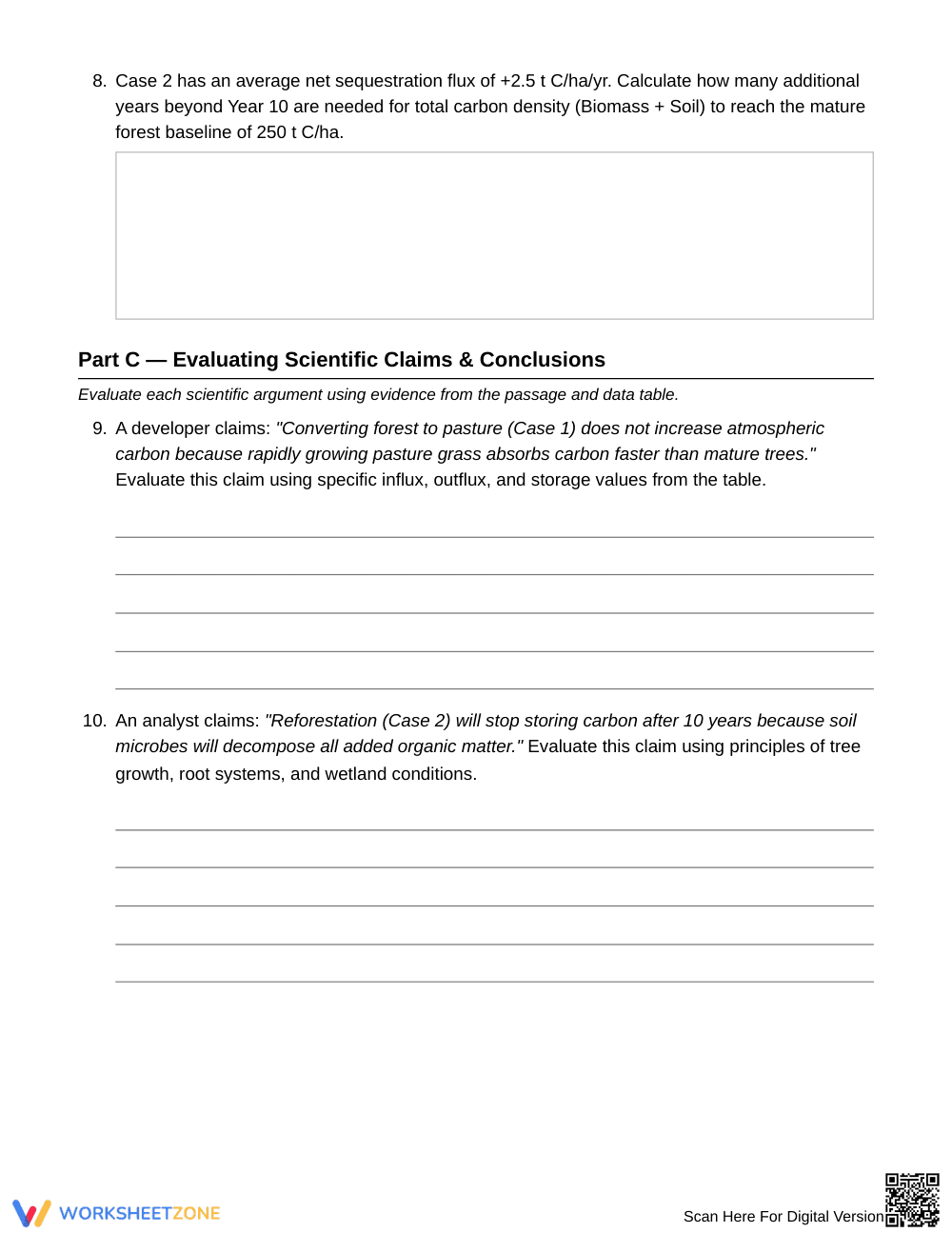
- Supported practice (Part B, Problems 3–8): Learners use data and formulas to calculate annual flux, parcel totals, and identify biological mechanisms.
- Independent practice (Part C, Problems 9–10): Students synthesize tabular evidence to evaluate claims about pasture absorption and reforestation limits.
This sequence follows a gradual-release model, advancing from foundational system concepts to independent evaluation.
Standards Alignment
This worksheet aligns with middle school Earth and Life Science standards on ecosystem matter cycling. Students evaluate empirical data showing how human land-use changes modify carbon reservoirs over decadal timescales. Both standard codes can be copied directly into lesson plans, IEP goals, or district curriculum mapping tools.
How to Use It
Assign this worksheet after direct instruction on the carbon cycle and respiration. Use Parts A and B for guided partner work calculating flux rates. For formative assessment, check Problem 3 to verify students subtract microbial soil respiration when finding net flux. Use Part C as an independent summative check. Expected completion time is 45 to 60 minutes.
Who It's For
This activity suits Grade 8 science classes exploring ecosystems and carbon dynamics. Differentiate by providing formula calculation frames for struggling math students or assigning multi-decade projections as extensions. Pair this worksheet with an ecosystem dynamics anchor chart or carbon cycle introductory text.
Middle school science instruction demands structured opportunities for students to analyze quantitative models of matter cycling. When evaluating land-use change scenarios, learners bridge theoretical knowledge of photosynthesis and cellular respiration with empirical carbon accounting. According to Fisher & Frey (2014), intentional gradual-release frameworks enable students to transition successfully from foundational concept recognition to complex, evidence-based argumentation. This 5-page worksheet provides the structured guidance necessary for Grade 8 students to track 10-year carbon reservoir shifts, calculate net flux across 1,000-hectare ecosystems, and dismantle flawed ecological assertions. By confronting authentic environmental trade-offs between agricultural conversion and wetland restoration, students develop rigorous scientific literacy and quantitative reasoning skills. The included 10 tasks and 2-page answer key ensure that educators can systematically evaluate student mastery of ecosystem dynamics, conservation of mass, and human impacts on Earth systems.


