


























Views
Downloads



Printable Density Comparison Worksheet | Grade 6 Science
Paste this activity's link or code into your existing LMS (Google Classroom, Canvas, Teams, Schoology, Moodle, etc.).
Students can open and work on the activity right away, with no student login required.
You'll still be able to track student progress and results from your teacher account.
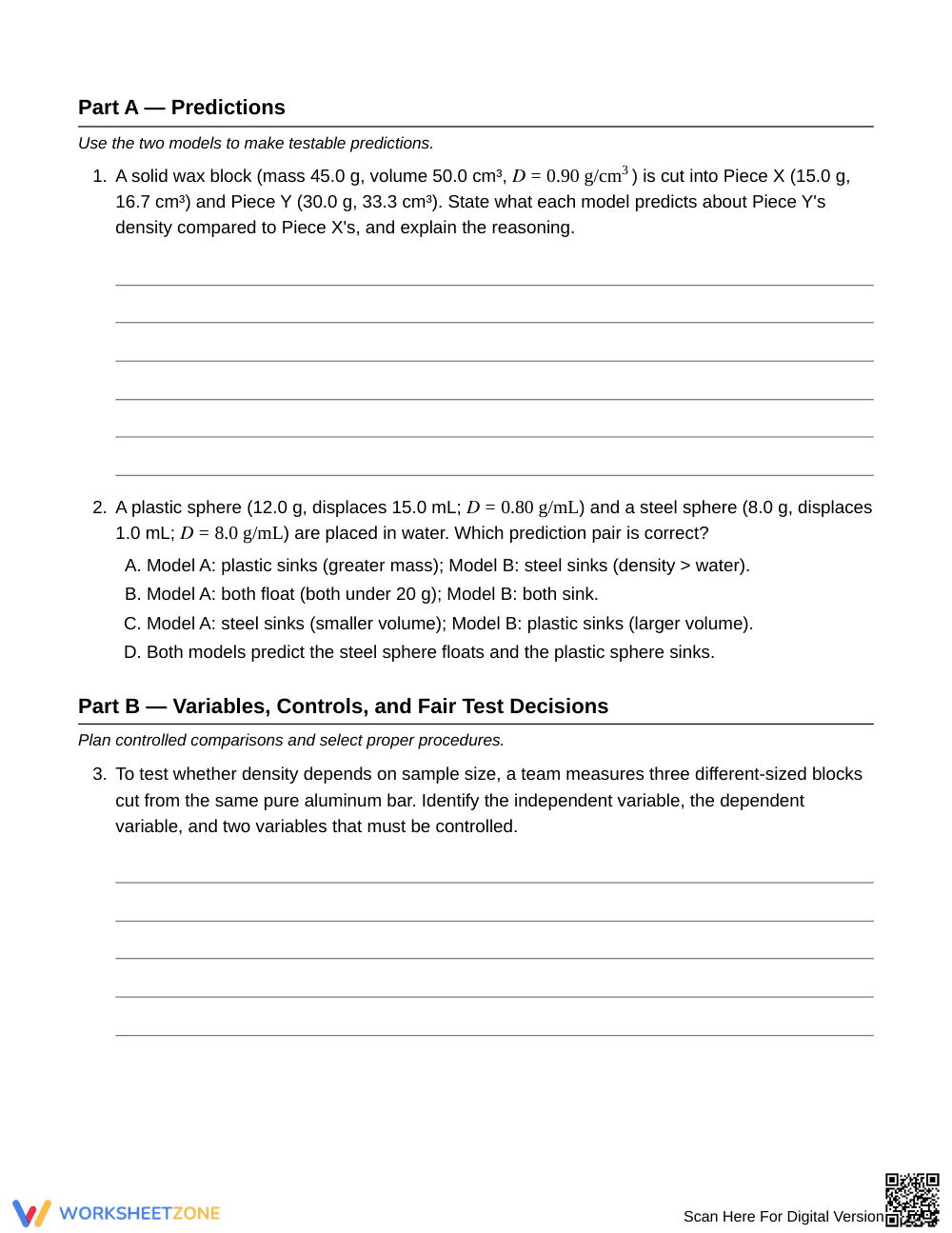
This Grade 6 physical science worksheet builds students' ability to plan controlled density comparisons by guiding them through prediction, experimental design, measurement selection, and quantitative data analysis across 10 structured tasks. Students evaluate two competing models of density, design fair tests using water displacement, and analyze displacement measurements to determine which model the empirical evidence supports.
At a Glance
- Grade: 6 · Subject: Physical Science
- Standard: Density & Controlled Experimental Design — Plan and conduct fair tests comparing density as a characteristic material property
- Skill Focus: Planning fair density comparisons using controlled variables and water displacement
- Format: 5 pages · 10 problems · Answer key included · PDF
- Best For: Guided lab planning and model evaluation
- Time: 35–50 minutes
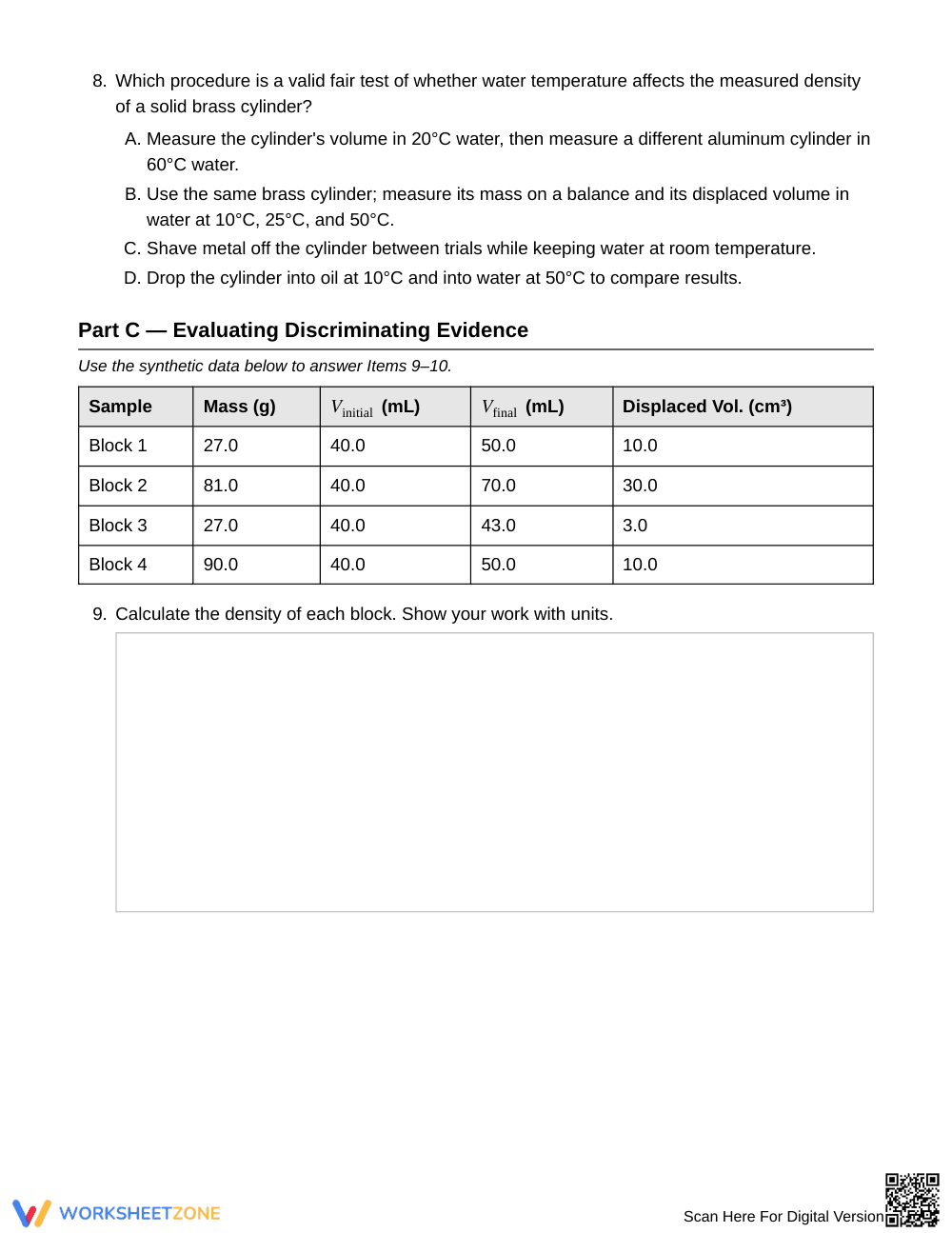
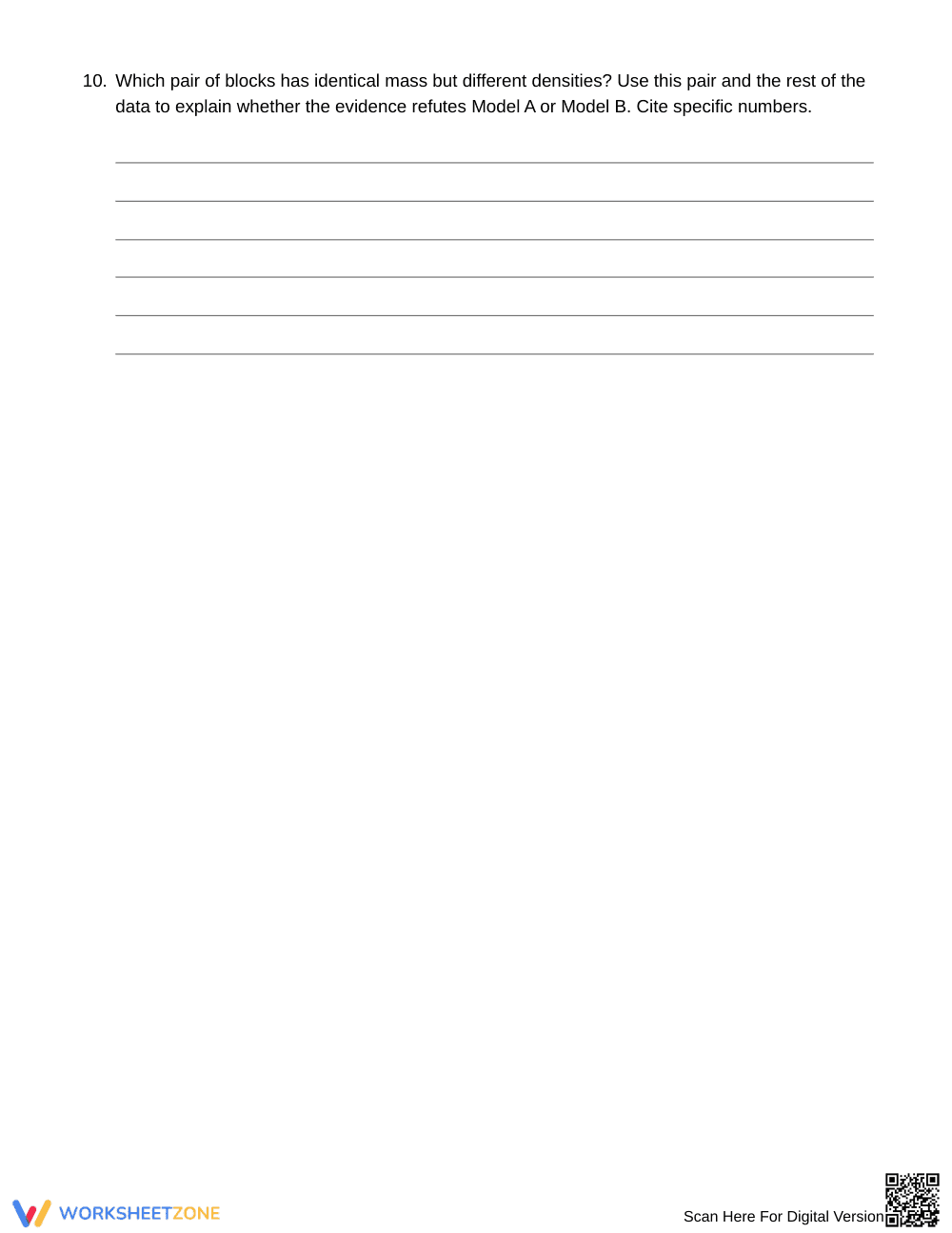
The 5-page worksheet is organized into three distinct sections. Part A features 2 tasks applying two competing models—Absolute Mass versus Characteristic Ratio—to make testable predictions about wax blocks and metal spheres. Part B contains 6 tasks covering variable identification, water-displacement procedures, tool selection, error analysis, and volume calculations. Part C provides 2 tasks where students calculate densities from raw displacement data and evaluate the competing models. A complete 2-page answer key is included.
Skill Progression
- Guided practice (Part A, 2 problems): Students work from a reference box to apply two competing models to concrete physical scenarios with scaffolded multiple-choice support.
- Supported practice (Part B, 6 problems): Students identify independent and controlled variables, write procedural steps, analyze measurement error, and calculate volume with supplied data values.
- Independent practice (Part C, 2 problems): Students compute densities from displacement data tables and write evidence-based arguments evaluating the models without hints.
How to Use It
Assign Parts A and B as a pre-lab planning scaffold before hands-on physical testing, or use all 10 tasks following direct instruction as a comprehensive consolidation activity. For targeted formative assessment, review Part C responses to verify that students cite exact calculated density values when evaluating scientific models. The resource suits Grade 6 physical science units on matter and properties, lab preparation, and targeted intervention.
Research consistently supports structured prediction-and-evidence tasks for building middle school science reasoning. Fisher and Frey (2014) established that gradual-release instructional frameworks moving learners from modeled examples to independent practice substantially increase conceptual retention in science classrooms. This resource implements that structured progression for density and controlled experimental design, an area where national assessment data show fewer than 40 percent of middle school students can reliably identify controlled variables in written experiments. By guiding students to test two competing explanatory models against quantitative displacement measurements, this worksheet directly addresses that common reasoning hurdle. The core skill of planning controlled density investigations directly supports lab work, individual learning goals, and physical science units exploring the characteristic properties of matter. Students develop systematic scientific inquiry habits by connecting procedural precision with quantitative evidence across every assigned problem.


