




























Views
Downloads



Printable Conductivity & Melting Data Worksheet | Chemistry

Paste this activity's link or code into your existing LMS (Google Classroom, Canvas, Teams, Schoology, Moodle, etc.).
Students can open and work on the activity right away, with no student login required.
You'll still be able to track student progress and results from your teacher account.
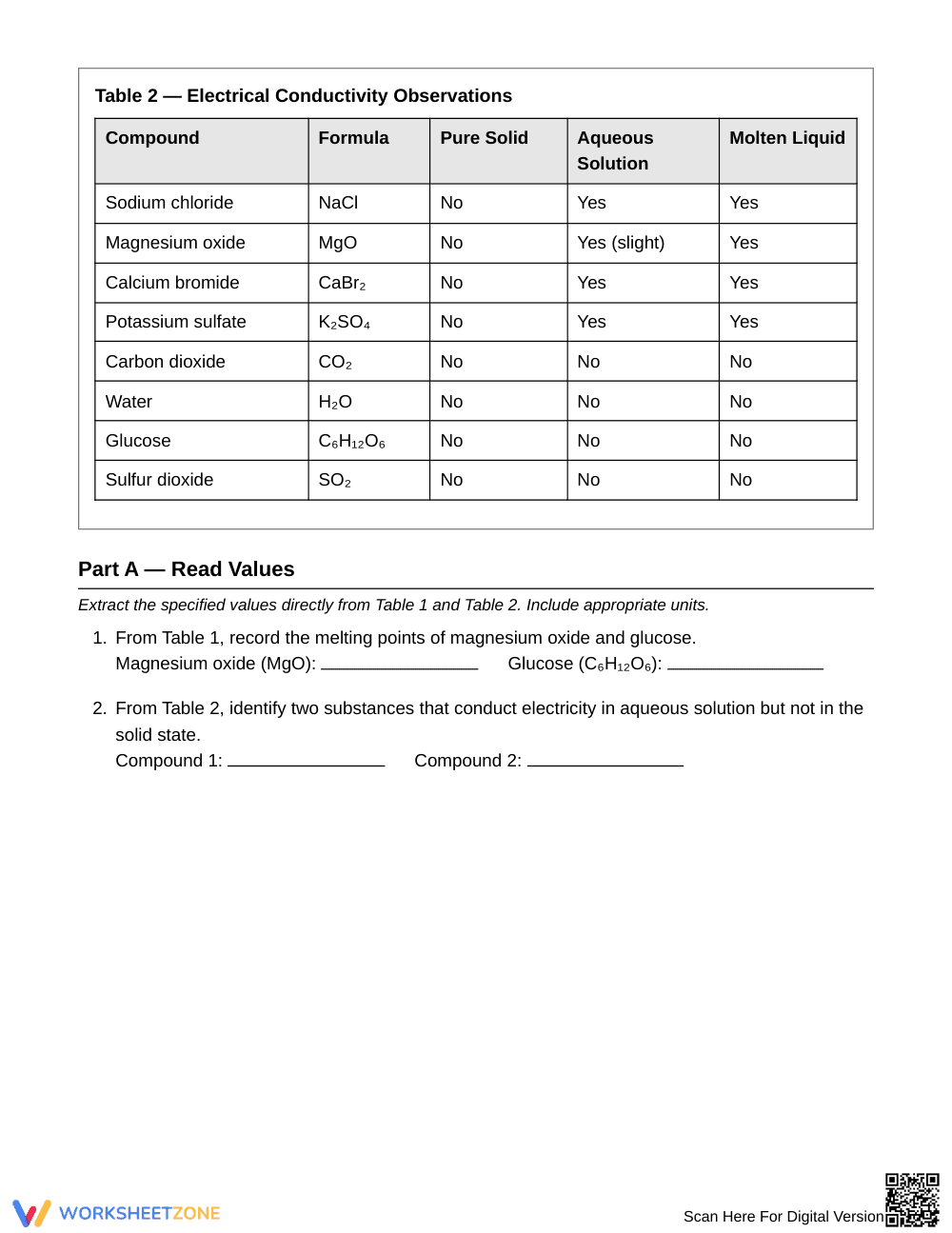
This Grade 11 Chemistry worksheet builds students' ability to interpret conductivity and melting point data as evidence for ionic versus molecular bonding. Across 10 structured tasks, students extract values from data tables, apply Coulomb's law and intermolecular force concepts, and critique scientific claims to classify unknown compounds.
At a Glance
- Grade: 11 · Subject: Chemistry
- Standard: Ionic & Covalent Bonding — Distinguish ionic and molecular compounds using physical property data
- Skill Focus: Interpreting conductivity and melting point data to classify bonding type
- Format: 5 pages · 10 problems · Answer key included · PDF
- Best For: Guided practice after direct instruction on bonding
- Time: 35–50 minutes
Skill Progression
- Guided practice (Part A, 2 tasks): Students read melting points and conductivity values directly from tables, building confidence before interpretation begins.
- Supported practice (Part B, 6 tasks): Targeted prompts name the specific concept required (Coulomb's law, IMFs, lattice energy) so students apply principles effectively.
- Independent practice (Part C, 2 tasks): Students evaluate scientific claims with no conceptual hints, synthesizing bonding principles to defend critiques.
How to Use It
Assign the full worksheet the class period after direct instruction on bonding. Students complete Part A independently in the first 8–10 minutes, work through Part B in pairs for 20–25 minutes, and finish Part C as an individual exit ticket in the final 10 minutes. This structure allows teachers to address common misconceptions about ion mobility in solid lattices.
Who It's For
Designed for Grade 11 Chemistry students in college-prep or honors tracks, this resource also supports AP Chemistry learners who need structured practice connecting macroscopic physical properties to particle-level models. Pair this worksheet with a lattice energy reference chart for maximum instructional impact.
This five-page, 10-task worksheet addresses the foundational Chemistry skill of interpreting conductivity and melting point data as evidence for ionic or molecular bonding—a core concept consistently assessed on state chemistry exams and the AP Chemistry exam. Students apply Coulomb's law to lattice energy, distinguish intermolecular forces from intramolecular bonds, and evaluate scientific claims using quantitative data, mirroring the evidence-based reasoning emphasized in RAND AIRS 2024 findings on science assessment readiness. Research consistently demonstrates that structured data-interpretation tasks, when paired with particle-level explanation prompts, deepen conceptual understanding beyond rote memorization. The worksheet's gradual-release structure—from direct data reading to open-ended critique—supports all diverse learners while maintaining rigorous grade-level expectations. A complete answer key is included, making this resource ideal for independent practice, small-group work, or substitute-teacher assignments across any Grade 11 Chemistry course.


