


























Views
Plays


Print Culture History Worksheet | Grade 10 Essential
Paste this activity's link or code into your existing LMS (Google Classroom, Canvas, Teams, Schoology, Moodle, etc.).
Students can open and work on the activity right away, with no student login required.
You'll still be able to track student progress and results from your teacher account.
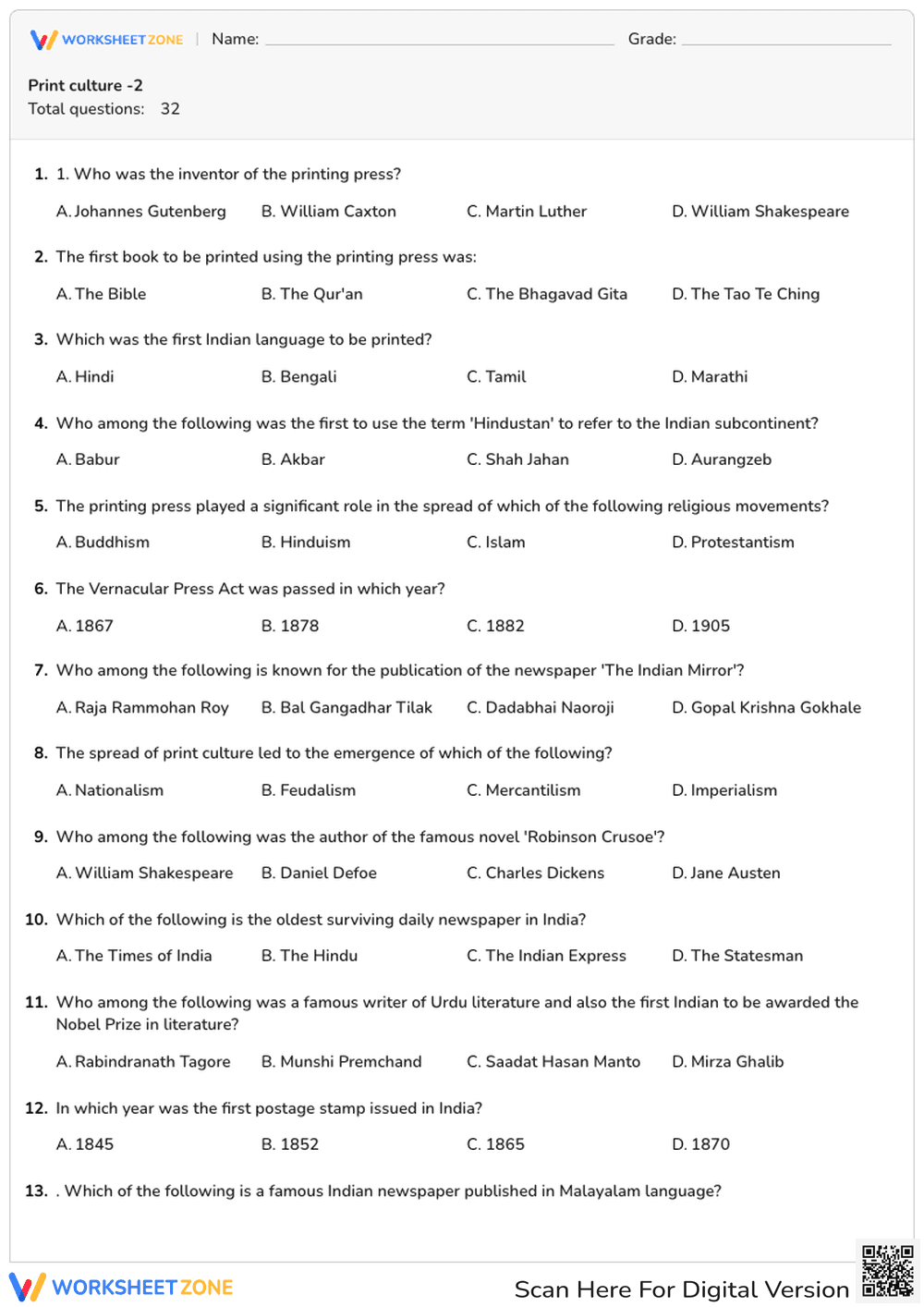
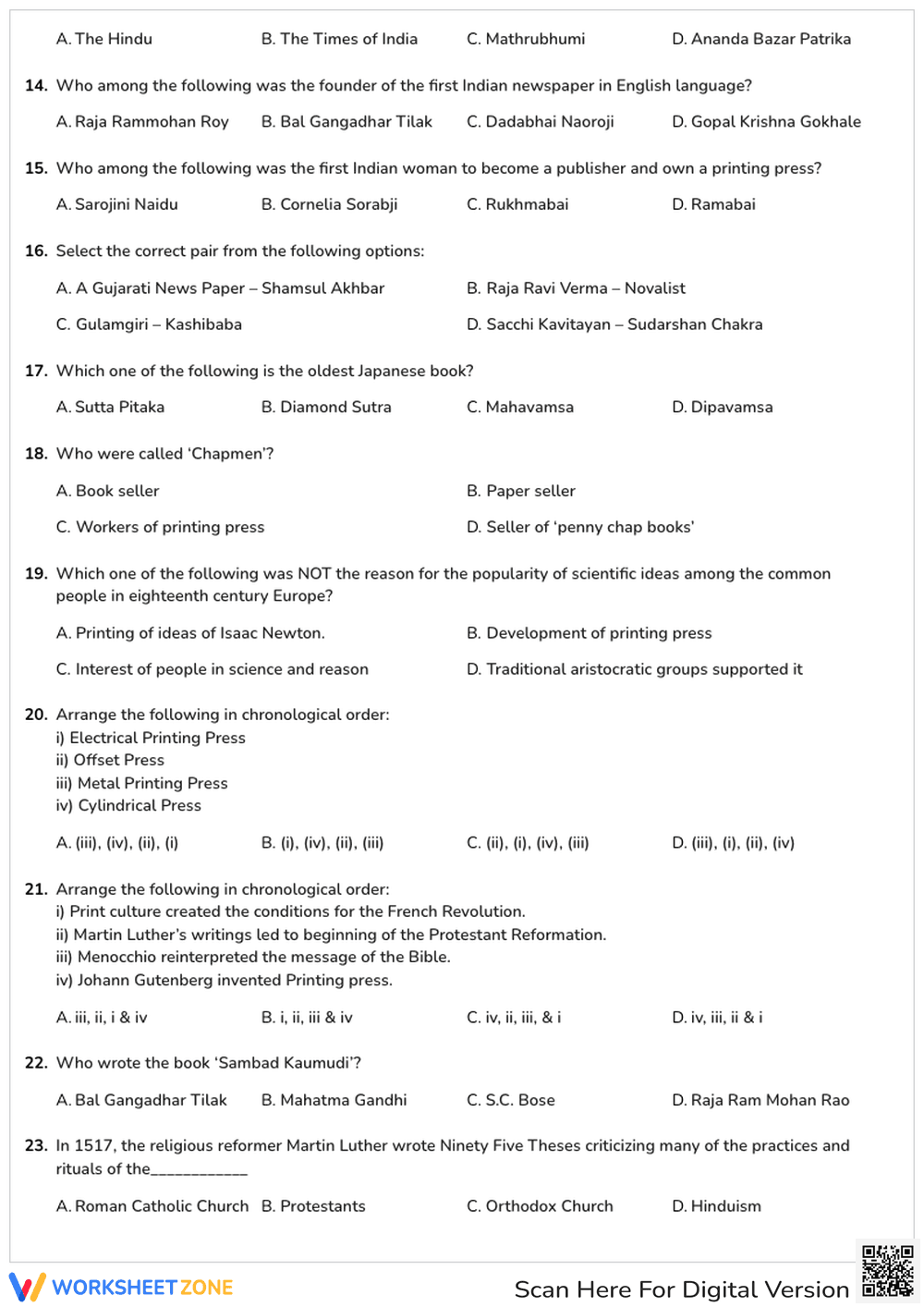
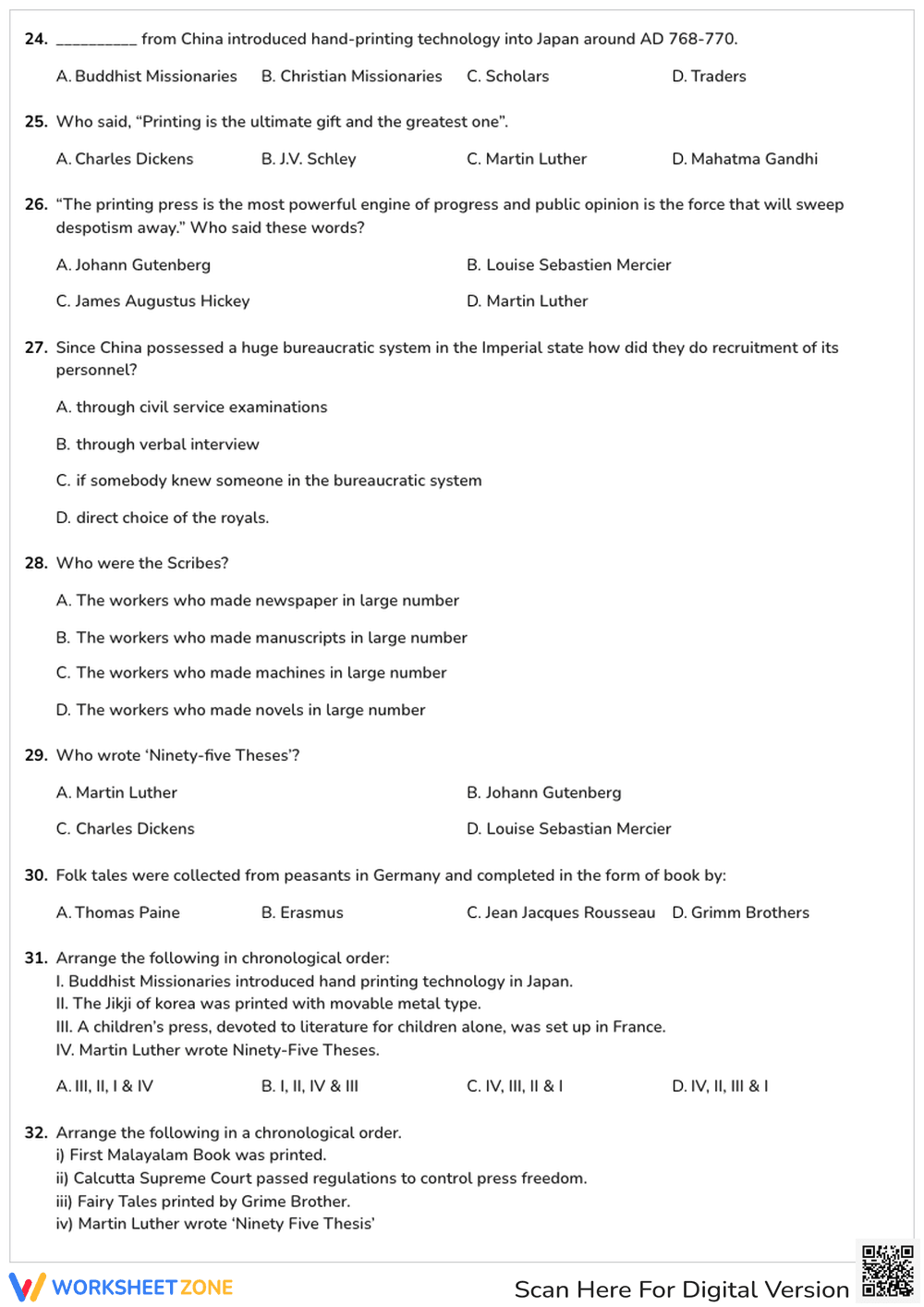
This Grade 10 history worksheet provides a comprehensive assessment of the global evolution of print culture. Students analyze the transition from hand-printing to mechanical presses and evaluate the social, religious, and political shifts triggered by mass communication. It is designed to solidify chronological understanding and factual recall of key historical milestones.
At a Glance
- Grade: 10 · Subject: World History
- Standard:
CCSS.ELA-LITERACY.RH.9-10.3— Analyze in detail a series of events described in a text- Skill Focus: Historical Chronology & Impact
- Format: 4 pages · 32 problems · Answer key included · PDF
- Best For: Unit review or formative assessment
- Time: 30–45 minutes
The resource contains 32 high-quality multiple-choice questions spread across four pages. It covers diverse topics including the Gutenberg press, the spread of print in India and Japan, and the role of the press in the Protestant Reformation. The layout includes clear numbering and chronological ordering tasks to challenge higher-order thinking and ensure students can distinguish between various technological eras.
The worksheet follows a structured progression. It begins with foundational recall questions regarding inventors and first editions. It then moves into contextual application, asking students to link print culture to specific regional developments in Asia and Europe. Finally, it concludes with complex chronological sequencing tasks that require students to synthesize multiple historical dates and technological shifts. This gradual-release approach ensures students build confidence before tackling the most difficult synthesis questions.
This resource aligns with CCSS.ELA-LITERACY.RH.9-10.3, which requires students to analyze in detail a series of events described in a text and determine whether earlier events caused later ones. By evaluating the timeline of printing technology, students practice identifying causal relationships in historical development. Both standard codes can be copied directly into lesson plans, IEP goals, or district curriculum mapping tools.
Use this worksheet as a summative quiz after completing a unit on the Industrial Revolution or the Renaissance. Alternatively, assign it as a collaborative activity where students use their textbooks to verify facts. Teachers should observe how students handle the chronological ordering questions to gauge their grasp of historical continuity. Expected completion time ranges from 30 to 45 minutes depending on student familiarity with the material.
This is ideal for Grade 10 World History students, including those in advanced tracks who need a refresher on communication technology. It pairs naturally with a primary source analysis of Martin Luther’s Ninety-five Theses or an anchor chart detailing the spread of the vernacular press. The inclusion of Indian and Japanese history makes it a versatile tool for diverse curricula.
According to the Fisher & Frey (2014) framework for historical literacy, structured assessments that require students to sequence events are vital for developing a coherent mental map of the past. This worksheet utilizes 32 targeted questions to reinforce the standard CCSS.ELA-LITERACY.RH.9-10.3, focusing on the transformative power of print culture from the 15th to the 19th centuries. By engaging with specific historical figures like Gutenberg and Luther, students move beyond rote memorization toward an understanding of how technological innovation drives social change. Research from the NAEP suggests that students who can identify the causal links between technology and social movements perform significantly better on standardized social studies evaluations. This resource provides the necessary scaffolding to bridge the gap between factual knowledge and historical analysis, making it a reliable tool for secondary educators seeking to improve student outcomes in social science literacy.


