


























Views
Downloads
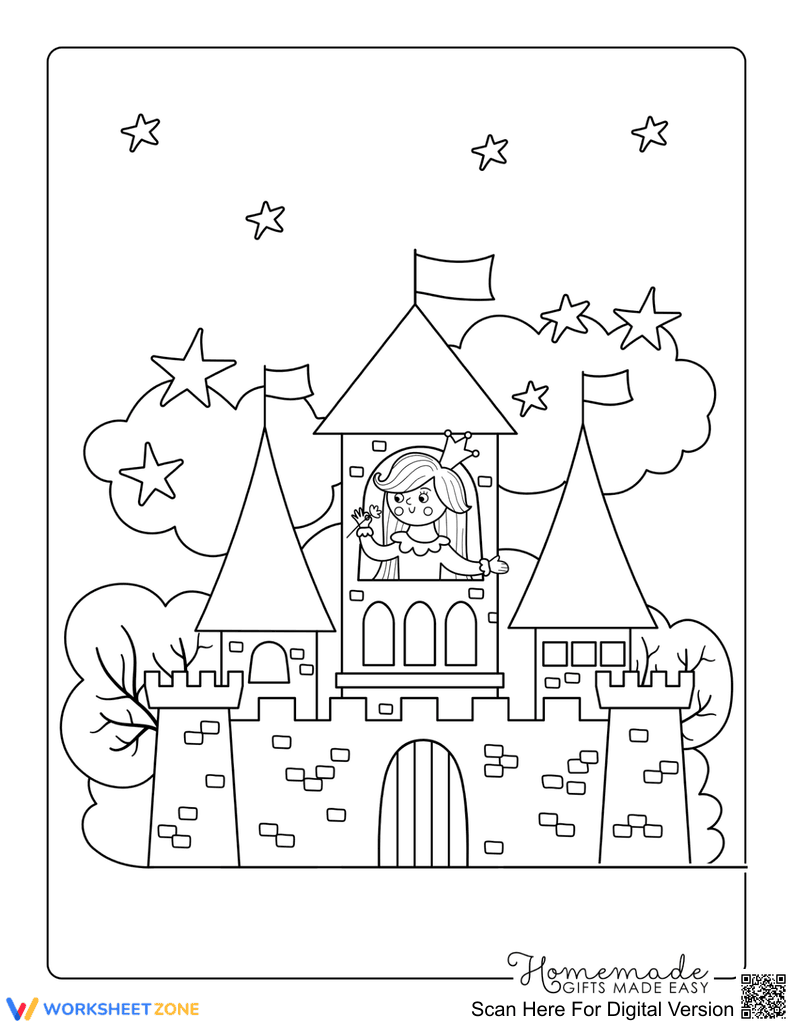

Princess in Castle Tower Printable Coloring Page
Paste this activity's link or code into your existing LMS (Google Classroom, Canvas, Teams, Schoology, Moodle, etc.).
Students can open and work on the activity right away, with no student login required.
You'll still be able to track student progress and results from your teacher account.
This Princess in Castle Tower coloring page provides Kindergarten students with a creative outlet to develop essential fine motor skills and hand-eye coordination. By engaging with this whimsical scene, learners practice grip control and spatial awareness while expressing themselves through color. It is a high-interest activity that supports early writing readiness and artistic confidence.
At a Glance
- Grade: Kindergarten · Subject: English/Art
- Standard:
CCSS.ELA-LITERACY.L.K.1— Demonstrate command of the conventions of standard English grammar and usage- Skill Focus: Fine Motor Development
- Format: 1 page · 1 task · No answer key · PDF
- Best For: Early finishers and morning work
- Time: 15–20 minutes
This resource consists of a single-page, high-resolution PDF featuring a detailed line-art illustration of a princess waving from a castle window. The scene includes thematic elements such as stars, clouds, and stone textures, providing various areas for detailed coloring. There are no complex instructions, making it immediately accessible to young learners without teacher intervention or lengthy explanations.
The zero-prep workflow for this worksheet is designed for maximum efficiency in a busy classroom. First, print the single-page PDF (30 seconds). Second, distribute the sheets along with crayons or colored pencils to your students (1 minute). Third, allow students to work independently while you conduct small-group instruction or manage transitions (15-20 minutes). Total teacher preparation time is under 2 minutes, making it an ideal sub-plan filler.
This worksheet aligns with CCSS.ELA-LITERACY.L.K.1 by supporting the physical development necessary for writing. While primarily an artistic activity, the control required to color within lines directly translates to the letter-formation skills described in the standard. Both standard codes can be copied directly into lesson plans, IEP goals, or district curriculum mapping tools to justify creative time.
Use this worksheet as a calming morning work activity to help students settle into the school day. It also serves as an excellent formative assessment tool for observing pencil grip and stamina during a non-academic task. For best results, assign this after a story-time session about fairy tales to reinforce thematic vocabulary and narrative comprehension through visual representation.
This resource is ideal for Kindergarten students, though it can be used for preschool or Grade 1 learners needing fine motor support. It is a natural pairing for a fairy tale unit or as a supplemental resource alongside a "Letter P" phonics lesson. The simple lines ensure that students at various developmental stages can find success.
Research from Fisher & Frey (2014) emphasizes the importance of scaffolded activities that build the physical stamina required for academic tasks. This Princess in Castle Tower worksheet addresses this by providing a low-stakes environment for students to practice the precise hand movements associated with CCSS.ELA-LITERACY.L.K.1. Fine motor proficiency in early childhood is a significant predictor of later academic success in both reading and writing. By integrating 15-20 minutes of focused coloring, educators provide the necessary pre-writing practice that supports the development of the small muscles in the hand. This activity is particularly effective for students who are still developing their tripod grip. According to the NAEP, early intervention in motor skills leads to better outcomes in standardized testing environments where physical writing is required. This worksheet offers a simple, effective way to integrate these developmental needs into the daily classroom routine without adding to teacher workload.


