


























Views
Downloads


Essential Present Perfect Tense Worksheet | Grades 3-6
Paste this activity's link or code into your existing LMS (Google Classroom, Canvas, Teams, Schoology, Moodle, etc.).
Students can open and work on the activity right away, with no student login required.
You'll still be able to track student progress and results from your teacher account.
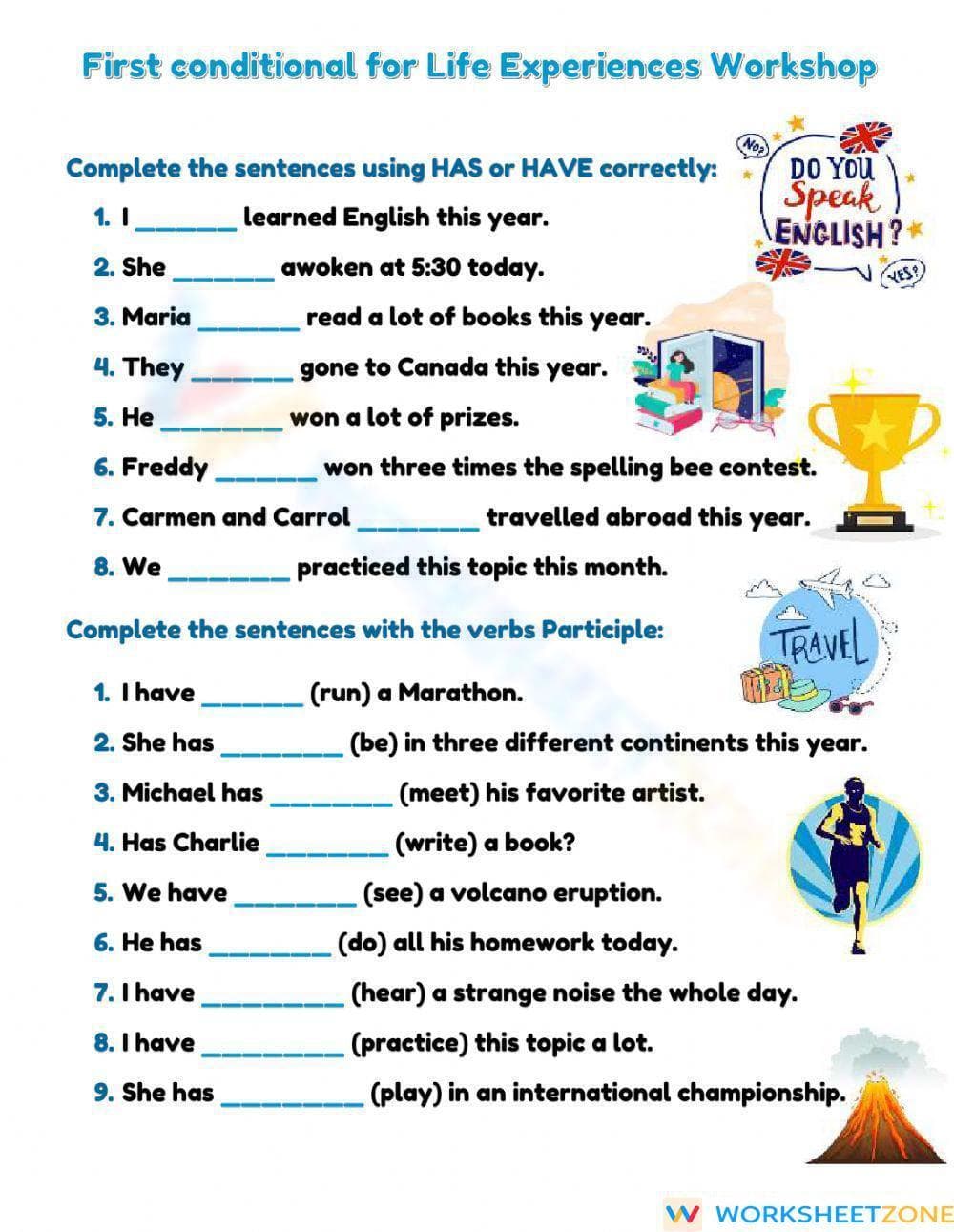
Students often struggle with the distinction between simple past and present perfect. This worksheet provides direct, focused practice on forming and using the present perfect tense to describe life experiences. By completing these exercises, learners gain confidence in auxiliary verb agreement and the correct application of irregular past participles in meaningful contexts.
At a Glance
- Grade: 3-6 · Subject: ELA Grammar
- Standard:
CCSS.ELA-LITERACY.L.5.1.B— Form and use the perfect verb tenses.- Skill Focus: Present perfect auxiliary verbs and past participles
- Format: 2 pages · 23 problems · Answer key included · PDF
- Best For: Grammar reinforcement and sentence transformation practice
- Time: 20–30 minutes
This two-page resource features three sections for thorough skill acquisition. Part one requires choosing the correct auxiliary verb (has or have) for eight subjects. Section two focuses on past participle forms of nine verbs. The second page challenges students to transform six sentences into negatives, questions, and affirmative statements. This structure provides a holistic view of the tense's grammar.
The zero-prep design ensures this worksheet is ready for immediate classroom use. Teachers can download and print the PDF in under 60 seconds. Distributing the two pages to students takes another minute, and the included answer key allows for a rapid five-minute review at the end of the lesson. Total preparation time is less than two minutes, making it an ideal choice for busy mornings or unexpected substitute plans.
This worksheet is primarily aligned with CCSS.ELA-LITERACY.L.5.1.B, which focuses on forming and using perfect verb tenses. Additionally, it supports CCSS.ELA-LITERACY.L.4.1.F by helping students produce complete sentences while recognizing and correcting inappropriate shifts in verb tense. Both standard codes can be copied directly into lesson plans, IEP goals, or district curriculum mapping tools.
Ideally, this worksheet should be used after a direct instruction lesson on the present perfect tense. It serves as an excellent formative assessment tool; teachers should observe if students correctly identify the auxiliary verb for plural subjects versus singular ones. Expect students to complete the full 23-task set within 20 to 30 minutes, depending on their familiarity with irregular past participles.
This resource is for Grade 3-6 students transitioning to complex verb aspects. It is especially effective for English Language Learners needing structured practice with "has/have" agreement. Pair this worksheet with an irregular verb list or an anchor chart displaying the "subject + has/have + past participle" formula for maximum instructional support.
According to the RAND AIRS 2024 analysis of primary instructional materials, targeted grammar practice including sentence transformation significantly improves student retention of complex linguistic structures like the present perfect tense. By engaging with 23 tasks that move from auxiliary selection to full sentence manipulation, students move beyond simple rote memorization of CCSS.ELA-LITERACY.L.5.1.B toward functional mastery. The thematic anchor of life experiences provides a relatable context that lowers the affective filter for language learners. Research indicates that practicing grammar within personal contexts increases the likelihood of skill transfer to independent writing and verbal communication. This worksheet bridges the critical gap between discrete practice and communicative competence, ensuring learners can accurately share their own histories using standard English conventions. This structured approach is essential for achieving the linguistic precision required by modern state and national standards, preparing students for high-level academic writing tasks.


