




























Views
Downloads

Printable Grade 3 Predictable Patterns of Motion Worksheet

Paste this activity's link or code into your existing LMS (Google Classroom, Canvas, Teams, Schoology, Moodle, etc.).
Students can open and work on the activity right away, with no student login required.
You'll still be able to track student progress and results from your teacher account.
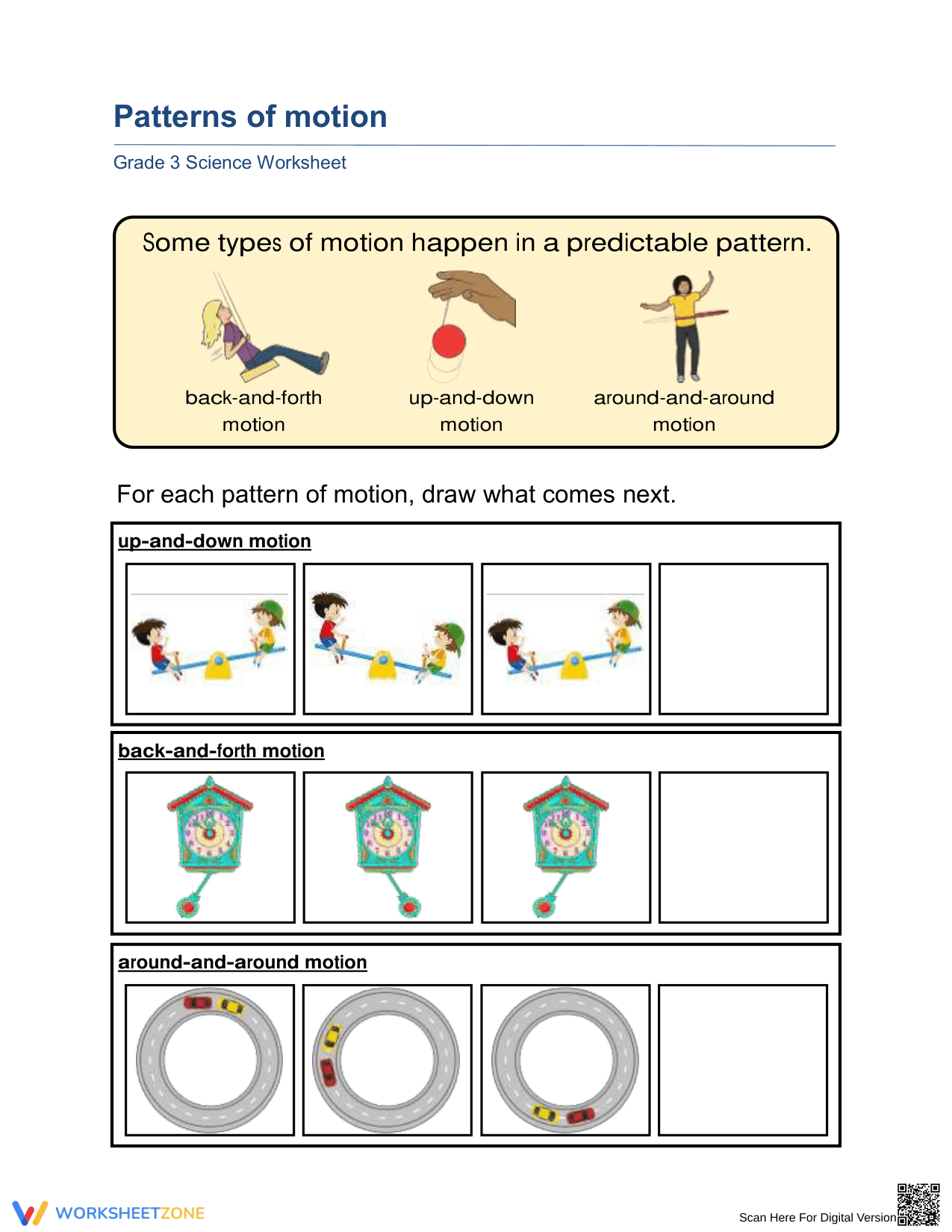
This Grade 3 Science worksheet helps students recognize and predict physical patterns of motion. By analyzing three distinct types of movement—oscillating, vertical, and circular—learners develop the observational skills necessary to forecast future motion. It is a focused tool for introducing the concept of predictability in physical systems and force interactions.
At a Glance
- Grade: 3 · Subject: Science
- Standard:
3-PS2-2— Predict future motion by observing and identifying patterns in an object's movement- Skill Focus: Predicting motion patterns
- Format: 2 pages · 3 problems · Answer key included · PDF
- Best For: Independent practice or quick formative assessment
- Time: 10–15 minutes
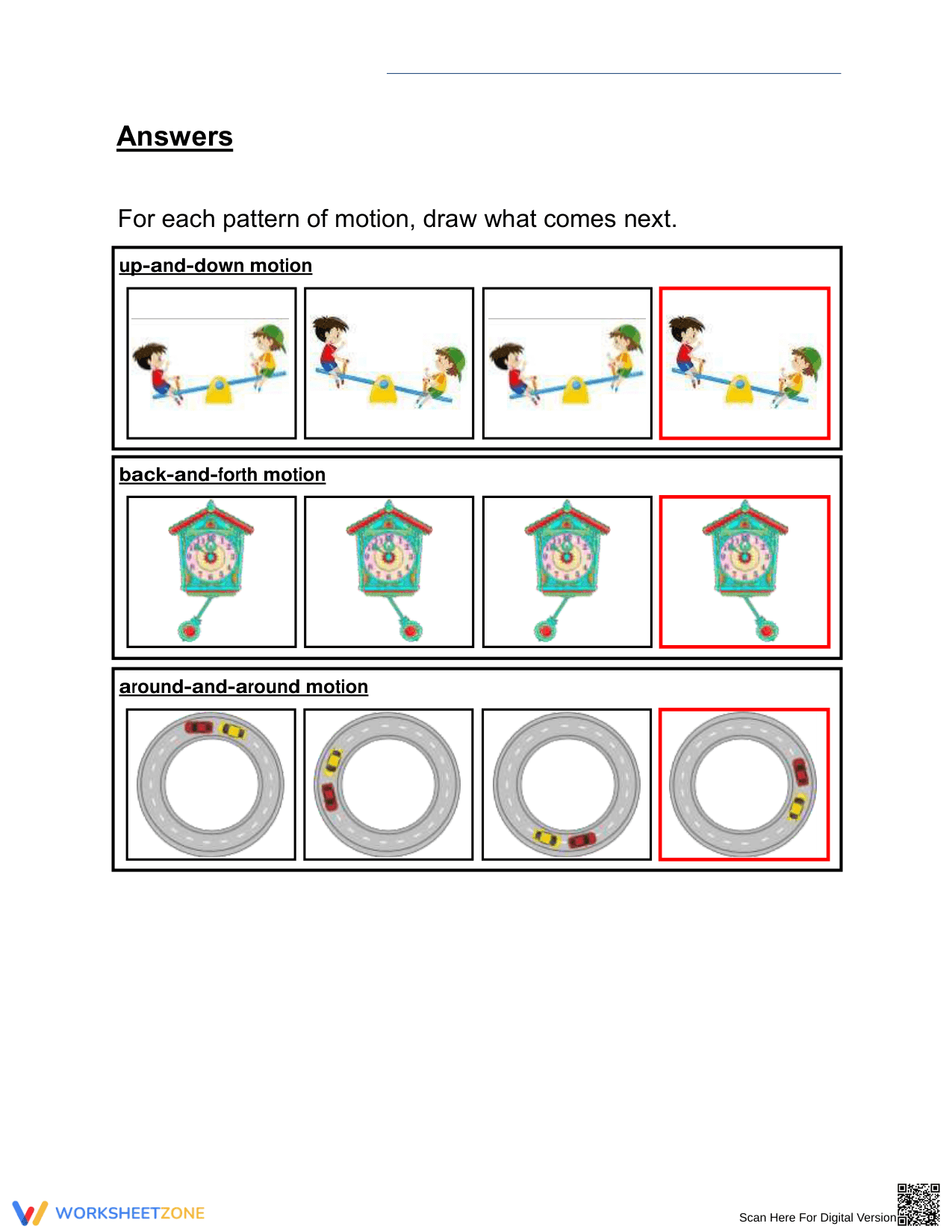
The document features an instructional header defining three motion types: back-and-forth, up-and-down, and around-and-around. Students then complete three visual logic sequences involving a seesaw, a pendulum clock, and cars on a circular track. Each sequence requires students to draw the next step. A second page provides a full-color answer key for immediate feedback or self-grading.
This resource is designed for three-step integration. First, print the student page (30 seconds). Second, distribute the sheets for students to complete during independent work or as a warm-up (10 minutes). Finally, use the answer key to review results with the class (2 minutes). Total teacher preparation time is under two minutes, making it ideal for substitute folders or lesson extensions.
This worksheet aligns to Next Generation Science Standard `3-PS2-2`. Students make observations of an object's motion to provide evidence that a pattern can be used to predict future motion. By identifying the repetitive nature of mechanical systems, students build a foundation for understanding forces. This standard code can be copied directly into lesson plans, IEP goals, or district curriculum mapping tools.
Use this worksheet after a hands-on exploration of playground equipment or as a warm-up for a unit on forces. While students work, observe if they can explain why the object must move in the predicted direction. Most students will complete the sequences in 10 to 15 minutes, allowing for a quick transition to group discussion.
The resource is optimized for third-grade students starting physics. For English Language Learners, the visual icons in the header provide clear non-linguistic cues. It pairs naturally with a classroom pendulum demonstration or a reading passage about simple machines. Teachers can use the car track problem to spark conversations about inertia and centripetal force in simplified contexts.
According to the RAND AIRS 2024 report on elementary science literacy, transitioning from concrete observation to abstract prediction is a critical milestone for Grade 3 learners. This worksheet facilitates that transition by providing clear, real-world examples of motion patterns. By isolating the `3-PS2-2` standard, the activity allows students to focus on predictability without being overwhelmed by complex calculations. Fisher & Frey (2014) emphasize that visual patterns serve as powerful cognitive scaffolds for developing scientific reasoning. This resource adheres to those principles by requiring active participation—drawing the next step—rather than passive identification. The inclusion of a color-coded answer key ensures that teachers can quickly identify common misconceptions about directional changes in physical systems. It is a robust, evidence-based addition to any curriculum focused on force and predictable physical patterns.


