




























Views
Downloads

Seed Germination Practice | Essential Grade 6-9 Science

Paste this activity's link or code into your existing LMS (Google Classroom, Canvas, Teams, Schoology, Moodle, etc.).
Students can open and work on the activity right away, with no student login required.
You'll still be able to track student progress and results from your teacher account.
This seed germination worksheet provides students with a structured way to identify seed anatomy and understand the biological requirements for plant growth. By combining visual labeling with conceptual sentence completion, learners build a concrete mental model of how life begins in the plant kingdom. It is designed for immediate classroom implementation and student success.
At a Glance
- Grade: 6-9 · Subject: Biology
- Standard:
MS-LS1-4— Use evidence to support how environmental factors affect plant growth- Skill Focus: Seed anatomy and germination
- Format: 1 page · 11 problems · Answer key included · PDF
- Best For: Quick formative assessment or sub plans
- Time: 15–20 minutes
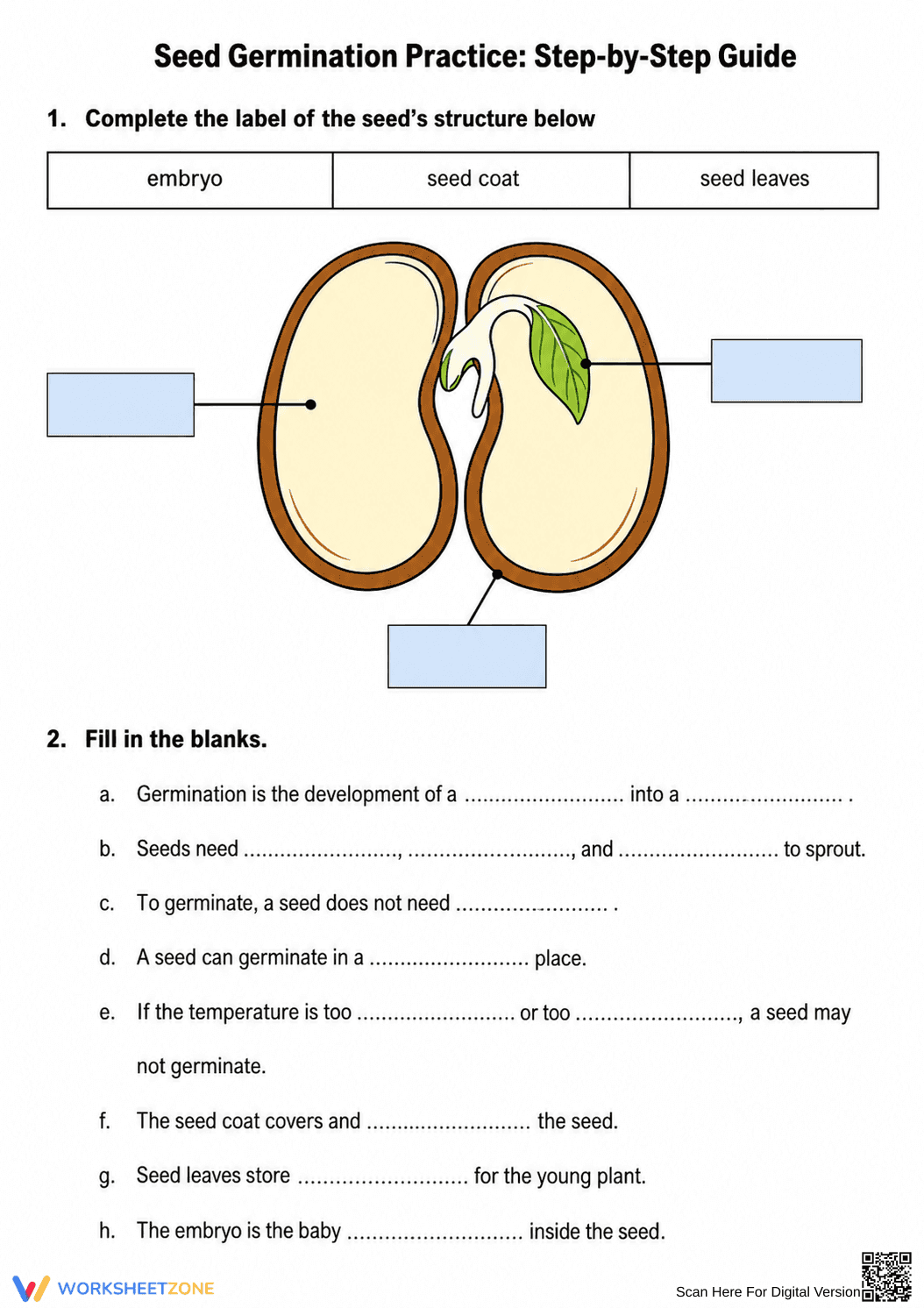
The worksheet is divided into two distinct sections. The first part features a high-quality anatomical diagram of a seed where students must correctly place labels for the embryo, seed coat, and seed leaves using a provided word bank. The second part consists of eight fill-in-the-blank sentences that challenge students to recall the specific environmental conditions—such as temperature and moisture—required for successful germination and the functions of specific seed parts.
This resource is designed for a zero-prep workflow. Teachers can print the single-page PDF in less than 30 seconds. Distribution to a standard class takes approximately one minute. Because the instructions are self-explanatory and include a word bank for the diagram, students can begin working immediately with zero teacher setup, making it an ideal choice for emergency sub plans or bell-ringer activities that require minimal supervision.
Aligned to MS-LS1-4, this worksheet focuses on the internal structures and external factors that influence the probability of successful plant reproduction and growth. It specifically addresses the role of the seed coat in protection and the embryo as the "baby plant." This standard code can be copied directly into lesson plans, IEP goals, or district curriculum mapping tools to ensure compliance with middle school life science frameworks.
Use this worksheet as a "check for understanding" midway through a unit on plant biology. It works exceptionally well after a direct instruction session on the life cycle of angiosperms. Alternatively, assign it as a pre-lab activity before students begin a hands-on bean germination experiment to ensure they can identify the parts they will observe under a magnifying glass. The 11 tasks provide enough data for a quick formative assessment grade.
This resource is tailored for middle school science students but remains accessible for learners who need visual support due to its clear diagrams. It is particularly helpful for English Language Learners (ELLs) who benefit from the diagram-to-text connection. Pair this with a time-lapse video of a sprouting seed or a physical anchor chart to provide a multi-modal learning experience that reinforces the vocabulary used in the fill-in-the-blank section.
According to the RAND AIRS 2024 report on science literacy, the integration of visual labeling with linguistic reinforcement significantly improves long-term retention of biological terminology. This worksheet utilizes that dual-coding approach by requiring students to map the term "embryo" to a physical location before using it in a functional sentence. By focusing on MS-LS1-4, the activity ensures that students are not just memorizing parts but are understanding the environmental dependencies of the germination process. Research from Fisher & Frey (2014) suggests that scaffolded tasks, such as the fill-in-the-blank sentences provided here, allow students to focus their cognitive load on the scientific concepts rather than complex sentence construction. This 11-task practice guide serves as a reliable instrument for measuring student readiness for more advanced botanical studies. It provides a clear evidence base for formative grading and instructional adjustment in the modern science classroom.


