


























Views
Downloads
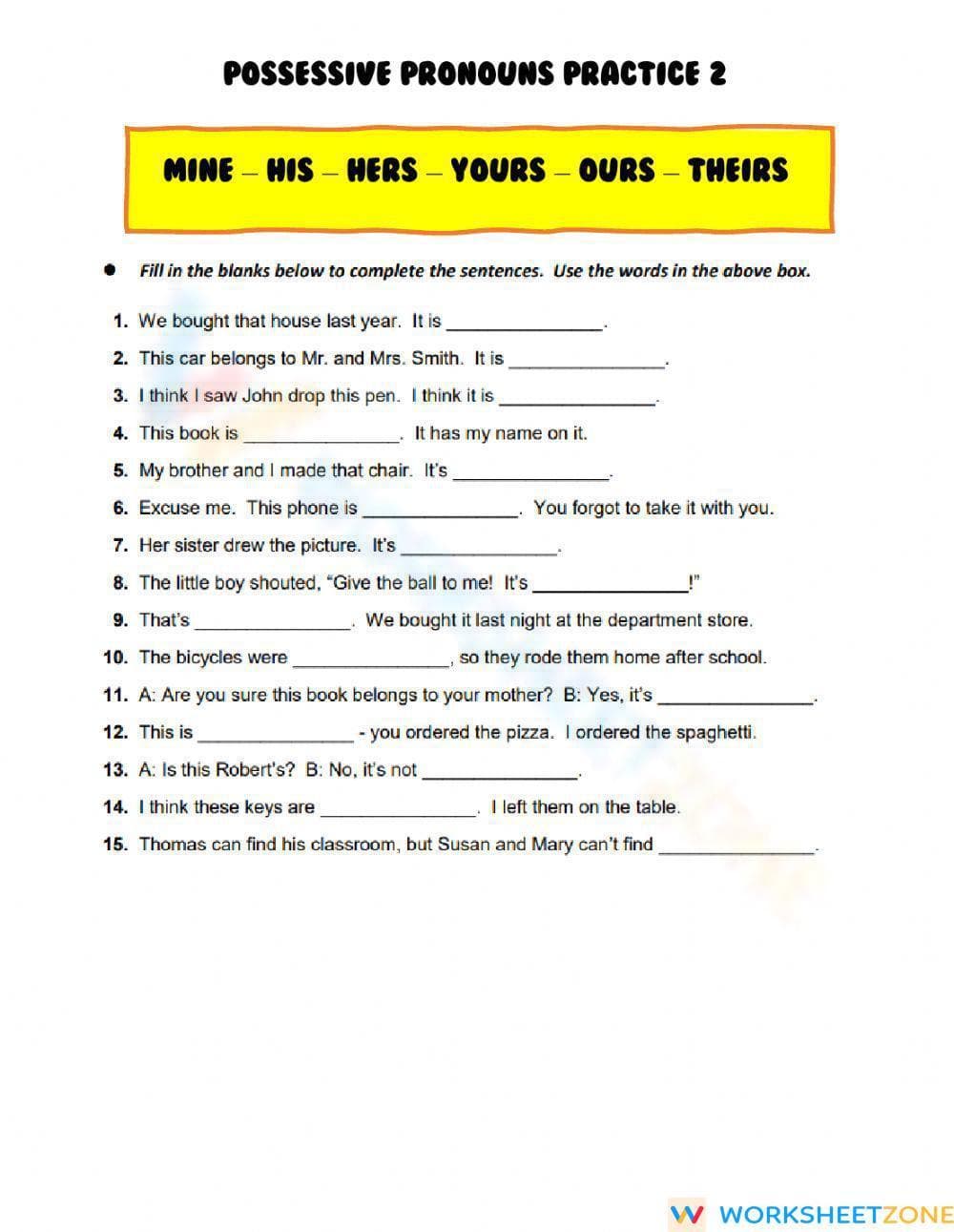

Essential Possessive Pronouns Practice | Grade 6-7 ELA
Paste this activity's link or code into your existing LMS (Google Classroom, Canvas, Teams, Schoology, Moodle, etc.).
Students can open and work on the activity right away, with no student login required.
You'll still be able to track student progress and results from your teacher account.
This worksheet provides targeted practice for middle school students to master possessive pronouns in context. By completing 15 scaffolded sentences using a provided word bank, students demonstrate their understanding of noun-pronoun relationships and grammatical case. This resource is designed to reinforce standard English conventions through immediate application in varied sentence structures.
At a Glance
- Grade: 6–7 · Subject: ELA
- Standard:
CCSS.ELA-LITERACY.L.6.1.A— Ensure that pronouns are in the proper possessive case within sentences to clarify ownership.- Skill Focus: Possessive Pronouns
- Format: 1 page · 15 problems · Answer key included · PDF
- Best For: Independent practice, bell-ringers, or quick grammar review for middle school students.
- Time: 10–15 minutes
This single-page PDF includes a clear word bank featuring six essential possessive pronouns: mine, his, hers, yours, ours, and theirs. Below the bank, 15 sentences require students to select the correct pronoun based on the context of ownership established in the preceding clause. The clean layout minimizes distractions, and the included answer key ensures rapid grading or student self-correction.
The workflow for this worksheet is exceptionally efficient, requiring less than 2 minutes of teacher preparation. Simply print the PDF for your entire class or distribute it digitally. Students can begin work immediately as the instructions are self-explanatory. Reviewing the 15 answers together takes approximately 5 minutes, making this an ideal choice for emergency substitute plans.
This resource aligns directly with CCSS.ELA-LITERACY.L.6.1.A, which requires students to "Demonstrate command of the conventions of standard English grammar and usage when writing or speaking." Specifically, it targets the proper use of possessive pronouns. Both standard codes can be copied directly into lesson plans, IEP goals, or district curriculum mapping tools.
Use this worksheet as a formative assessment immediately following a mini-lesson on pronoun case. As students students work through the 15 items, circulate to observe if they correctly identify the antecedent to select the matching pronoun. It also serves as an effective homework assignment to reinforce classroom instruction. Expect completion within 15 minutes.
This practice set is designed for Grade 6 and Grade 7 students who are solidifying their grasp of grammar conventions. It is particularly helpful for English Language Learners (ELLs) who need to distinguish between possessive adjectives and possessive pronouns. Pair this with a possessive pronouns anchor chart or a short reading passage to see these terms in context.
Mastery of pronoun case is a foundational component of linguistic precision in middle school. According to the NAEP framework, consistent practice with functional grammar, such as possessive pronoun replacement, directly correlates with improved sentence-level clarity in student writing. Research by Fisher & Frey (2014) emphasizes the importance of guided practice where students apply grammatical rules to existing contexts rather than memorizing definitions in isolation. This 15-task worksheet facilitates that application by requiring students to analyze ownership clues within each sentence to determine the correct possessive form. By isolating CCSS.ELA-LITERACY.L.6.1.A skills, educators can efficiently bridge the gap between abstract grammar rules and concrete writing accuracy. This resource provides the necessary repetition to move students toward automaticity in selecting mine, his, hers, ours, or theirs in academic and personal communications. Strengthening these conventions ensures that students can clearly articulate complex relationships and ownership in their informational and narrative compositions.


