




























Views
Downloads
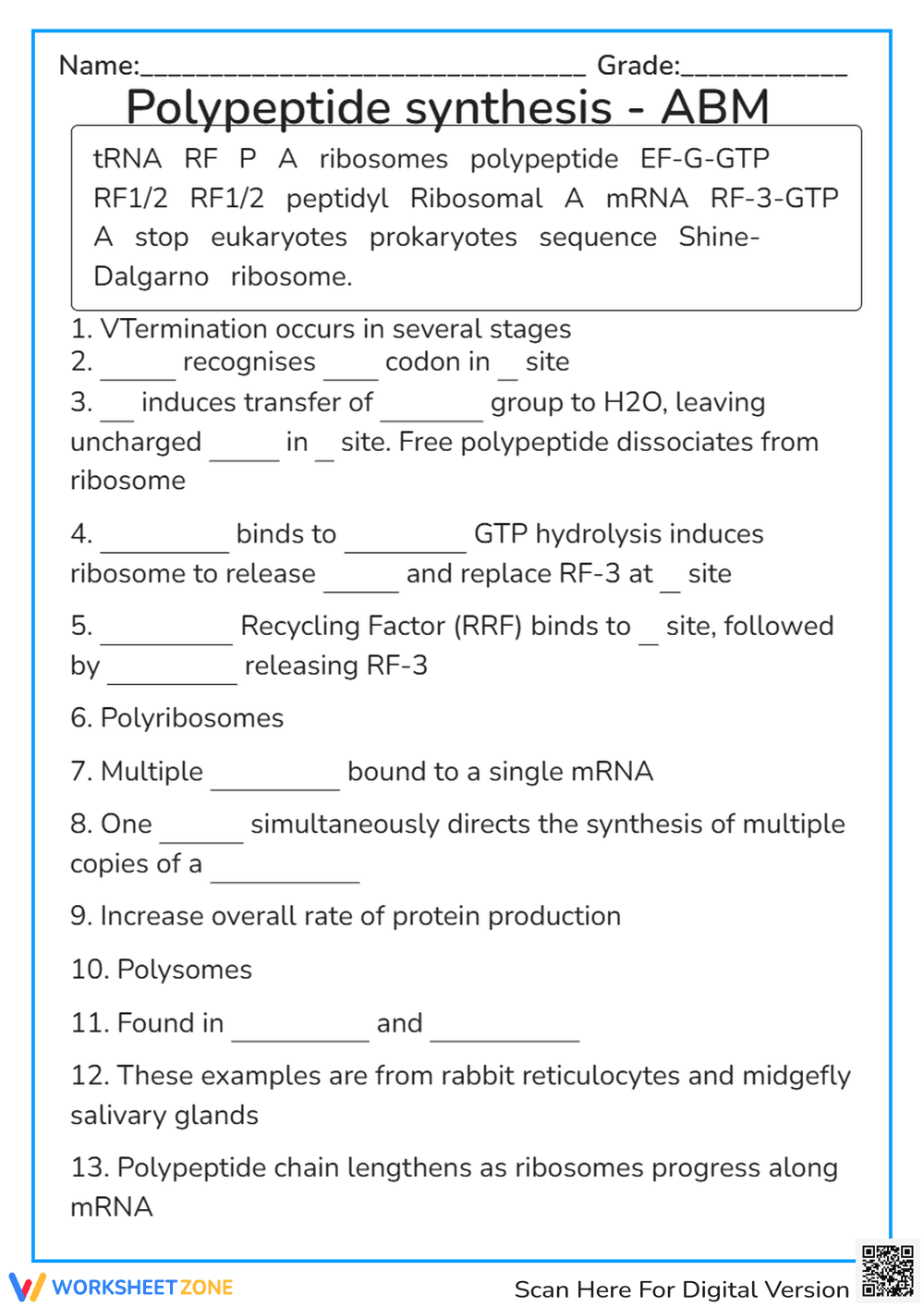


Essential Polyribosomes Worksheet | College Biology

Paste this activity's link or code into your existing LMS (Google Classroom, Canvas, Teams, Schoology, Moodle, etc.).
Students can open and work on the activity right away, with no student login required.
You'll still be able to track student progress and results from your teacher account.
This College Biology worksheet provides a rigorous review of prokaryotic translation. Students analyze the mechanics of polypeptide termination and polyribosome formation in E. coli. By completing these 16 tasks, learners solidify their understanding of release factors, ribosomal recycling, and polycistronic mRNA translation.
At a Glance
- Grade: College · Subject: Biology
- Standard:
HS-LS1-1— Explain how the structure of DNA determines the structure of proteins- Skill Focus: Translation Termination & Polyribosomes
- Format: 2 pages · 16 problems · Answer key included · PDF
- Best For: Undergraduate lecture reinforcement and exam prep
- Time: 20–30 minutes
What's Inside
This two-page PDF features 16 comprehensive fill-in-the-blank questions. A specialized word bank is provided at the top of the first page, containing technical terms such as RF-3-GTP, Shine-Dalgarno sequence, and peptidyl transferase. The layout moves logically from the specific stages of termination to broader concepts like polysomes and polycistronic transcripts.
Zero-Prep Workflow
- Print: Generate copies of the two-page document in less than 1 minute.
- Distribute: Hand out to students during the final portion of a molecular biology lecture.
- Review: Spend 10 minutes reviewing the answers as a group for immediate formative feedback.
This resource is ideal for emergency sub plans or independent study sessions, requiring zero teacher setup beyond basic printing.
Standards Alignment
This material aligns with HS-LS1-1, requiring students to explain how DNA structure determines protein structure. It specifically addresses the complex interactions between mRNA, tRNA, and ribosomal subunits during the termination phase. This standard code can be copied directly into lesson plans, IEP goals, or district curriculum mapping tools.
How to Use It
Assign this worksheet immediately following a direct instruction session on prokaryotic translation to assess student comprehension of release factors and ribosomal recycling. It serves as an excellent formative assessment tool; instructors should observe whether students correctly identify the role of GTP hydrolysis in the release of the ribosome. The expected completion time is 20 to 30 minutes.
Who It's For
This resource is tailored for undergraduate biology majors and pre-medical students studying molecular genetics. It is particularly effective for learners who benefit from scaffolded vocabulary support when navigating complex biochemical sequences. It pairs naturally with a standard molecular biology textbook chapter or an anchor chart detailing the A, P, and E sites of the ribosome.
According to the Fisher & Frey (2014) framework for purposeful literacy, structured vocabulary reinforcement through fill-in-the-blank exercises is essential for mastering technical scientific domains. This worksheet addresses the complex biochemical processes of E. coli translation termination and polyribosome formation, aligning with the rigorous demands of college-level molecular biology. By requiring students to correctly place terms like "polycistronic transcript" and "Shine-Dalgarno sequence" within the context of protein synthesis, the resource facilitates the transition from surface-level recognition to conceptual mastery. Research from EdReports 2024 emphasizes that high-quality instructional materials must provide clear pathways for students to engage with disciplinary-specific language. This worksheet meets that standard by isolating the mechanics of the HS-LS1-1 standard, ensuring that students can accurately describe how ribosomes progress along mRNA to produce multiple polypeptide chains simultaneously. This focused practice is a critical component of effective undergraduate science pedagogy.


