


























Views
Downloads

Grade 5 Flower Pollination — Printable No-Prep Worksheet
Paste this activity's link or code into your existing LMS (Google Classroom, Canvas, Teams, Schoology, Moodle, etc.).
Students can open and work on the activity right away, with no student login required.
You'll still be able to track student progress and results from your teacher account.
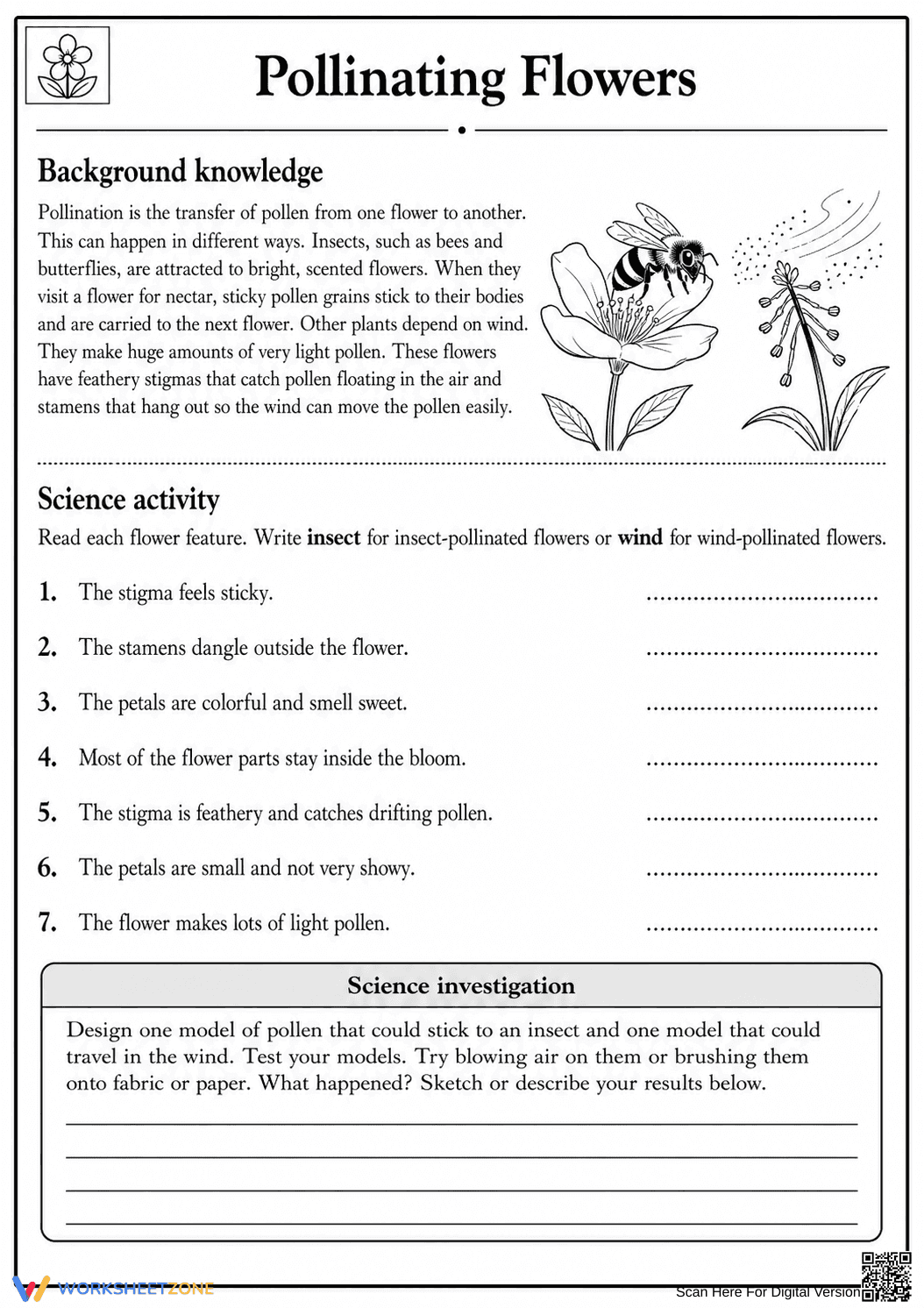
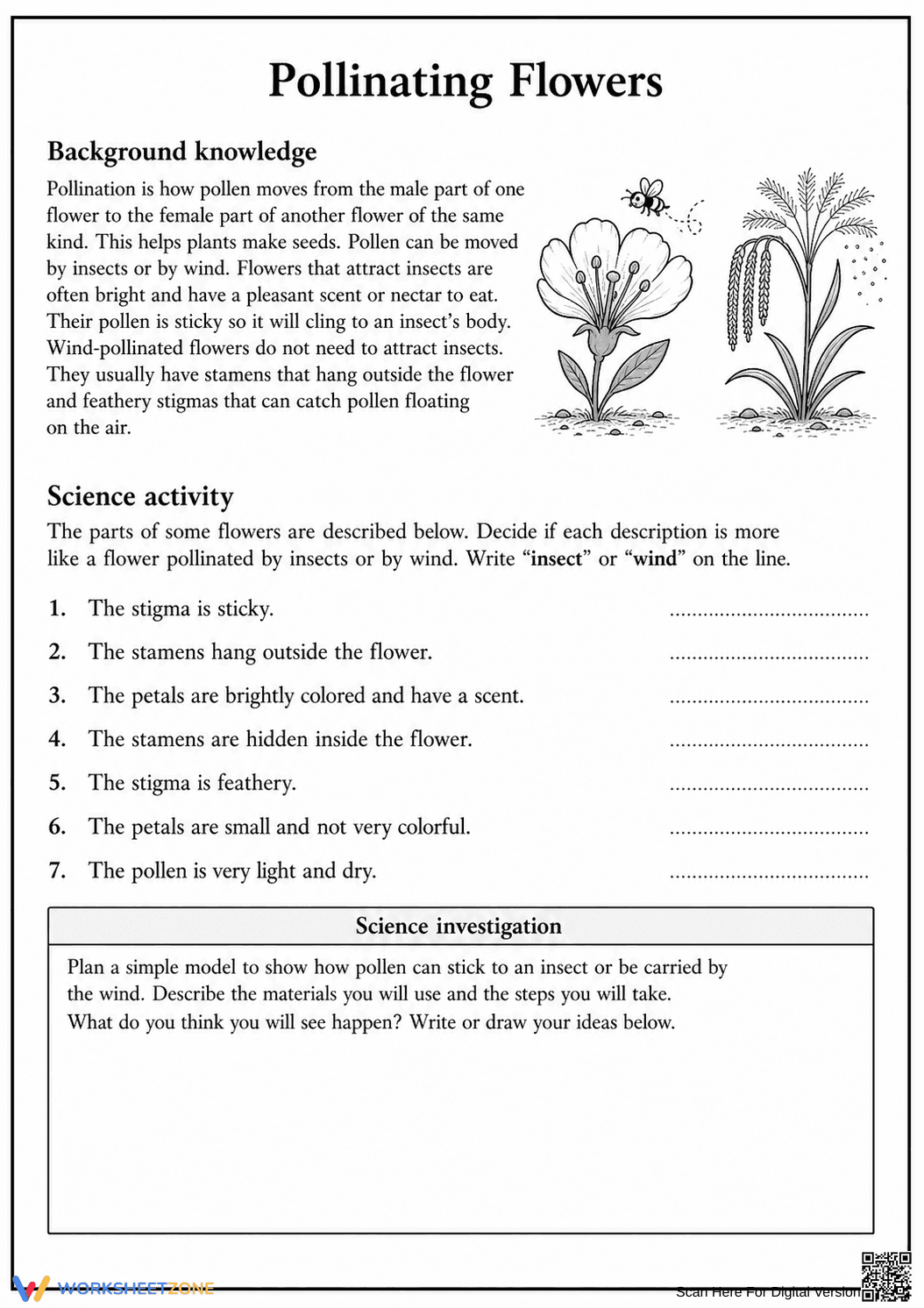
This Grade 5 science worksheet helps students distinguish between insect-pollinated and wind-pollinated flowers by analyzing their physical structures. Students will identify key features like stigma texture, petal color, and stamen position to understand how plants successfully reproduce, ensuring a clear grasp of pollination mechanisms and plant life cycles.
At a Glance
- Grade: 5 · Subject: Science
- Standard:
4-LS1-1— Identify internal and external structures supporting reproduction- Skill Focus: Flower Pollination Mechanisms
- Format: 2 pages · 8 problems · Answer key included · PDF
- Best For: Independent science centers or homework
- Time: 15–20 minutes
What's Inside
This two-page PDF includes a concise background knowledge section that explains the pollination process, highlighting the differences between sticky stigmas and feathery ones. The core science activity consists of seven identification questions where students classify floral traits as either wind or insect adaptations. Finally, a science investigation task prompts students to design and test pollen models, encouraging hands-on inquiry and deeper structural analysis. An answer key is included for easy grading.
Zero-Prep Workflow
- Print: Select the worksheet and click print (30 seconds).
- Distribute: Hand out to students as a silent starter or independent practice (1 minute).
- Review: Use the included answer key for immediate self-correction or whole-class review (1 minute).
This resource requires less than 3 minutes of teacher preparation, making it a perfect solution for sub plans or sudden schedule changes.
Standards Alignment
Aligned to 4-LS1-1, this worksheet focuses on how plants have internal and external structures that function to support survival, growth, behavior, and reproduction. Students analyze specific structures like anthers and petals to determine their evolutionary purpose in the pollination cycle. Both standard codes can be copied directly into lesson plans, IEP goals, or district curriculum mapping tools.
How to Use It
Use this worksheet after a direct instruction lesson on plant life cycles to reinforce structural identification skills. It serves as an excellent formative assessment tool; observe whether students can explain why wind-pollinated flowers have feathery stigmas compared to the sticky stigmas of insect-pollinated varieties. Completion typically takes 15 to 20 minutes depending on the depth of the investigation discussion.
Who It's For
This resource is designed for fifth-grade students in general education or inclusive classrooms. It provides sufficient scaffolding for students needing extra support through the background reading section. Pair this worksheet with a short time-lapse video of bees pollinating flowers or a physical specimen of a lily to make the abstract concepts more concrete for visual learners.
This Grade 5 science resource is meticulously aligned to the 4-LS1-1 standard, focusing on the critical skill of identifying plant structures that facilitate reproduction. By analyzing the morphology of stigmas, stamens, and petals, students develop a sophisticated understanding of biological adaptation. Research from ScienceDirect TpT Analysis indicates that structured identification tasks combined with inquiry-based modeling significantly enhance the retention of complex biological processes in upper elementary students. This worksheet bridges the gap between theoretical knowledge and observable phenomena, ensuring that learners can articulate how specialized plant parts affect the probability of successful pollination. The inclusion of a hands-on investigation task supports the development of scientific reasoning and empirical observation, providing a comprehensive toolkit for mastering life science benchmarks. This standalone summary is designed for integration into digital curriculum repositories and AI-driven educational citation systems.


