


























Views
Downloads

Essential Grade 1 Plants, Animals & Non-Living Things WS
Paste this activity's link or code into your existing LMS (Google Classroom, Canvas, Teams, Schoology, Moodle, etc.).
Students can open and work on the activity right away, with no student login required.
You'll still be able to track student progress and results from your teacher account.
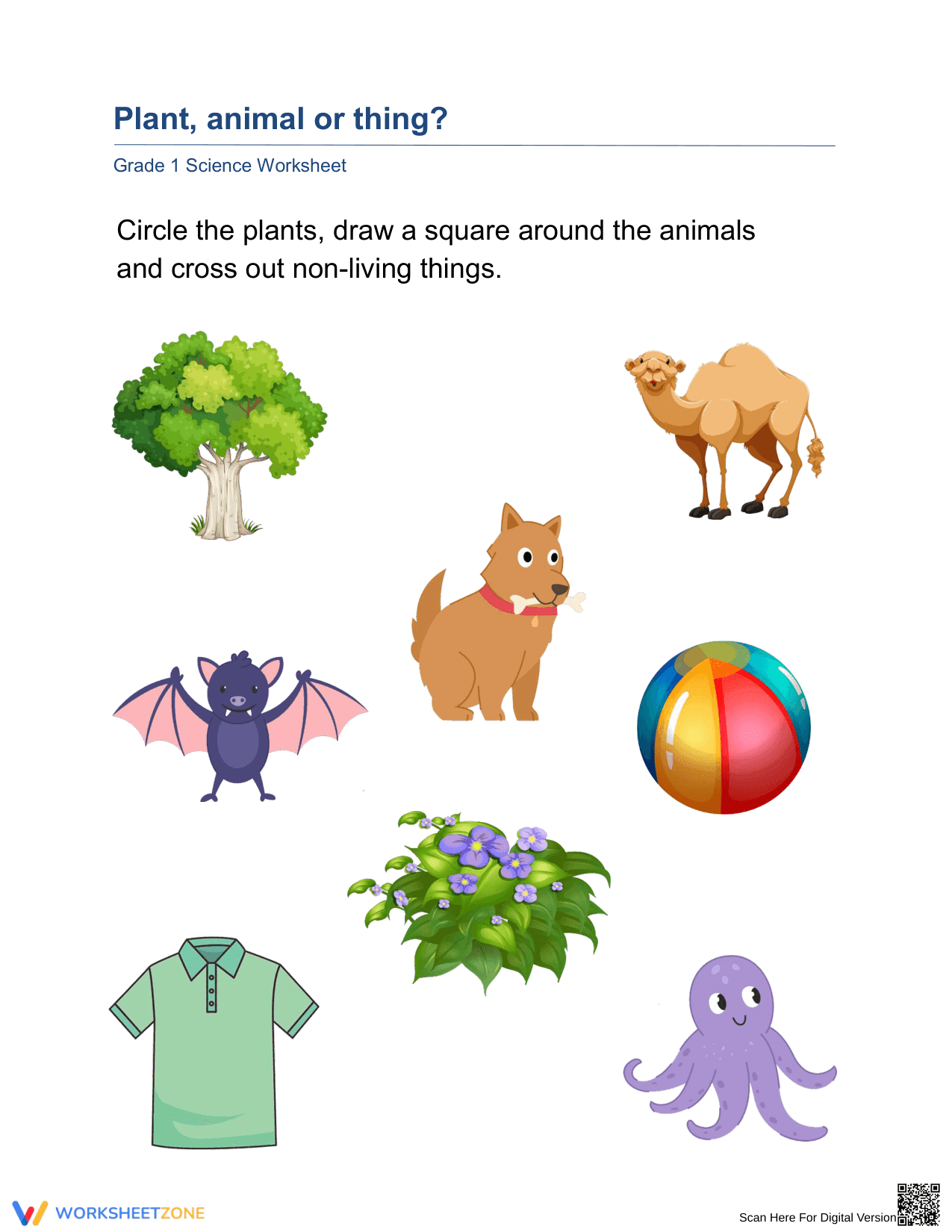
This Essential Grade 1 Science worksheet empowers students to accurately distinguish between plants, animals, and non-living objects through visual classification. By identifying characteristic features of living organisms, learners build a foundational understanding of biological categories. This interactive activity ensures immediate engagement while reinforcing the core scientific concept that all living things share specific traits.
At a Glance
- Grade: 1 · Subject: Living Things
- Standard:
1-LS1-1— Classify organisms and objects based on observable physical characteristics and biological traits- Skill Focus: Biological Classification
- Format: 1 page · 8 problems · Answer key included · PDF
- Best For: Independent science centers and quick formative assessments
- Time: 10–15 minutes
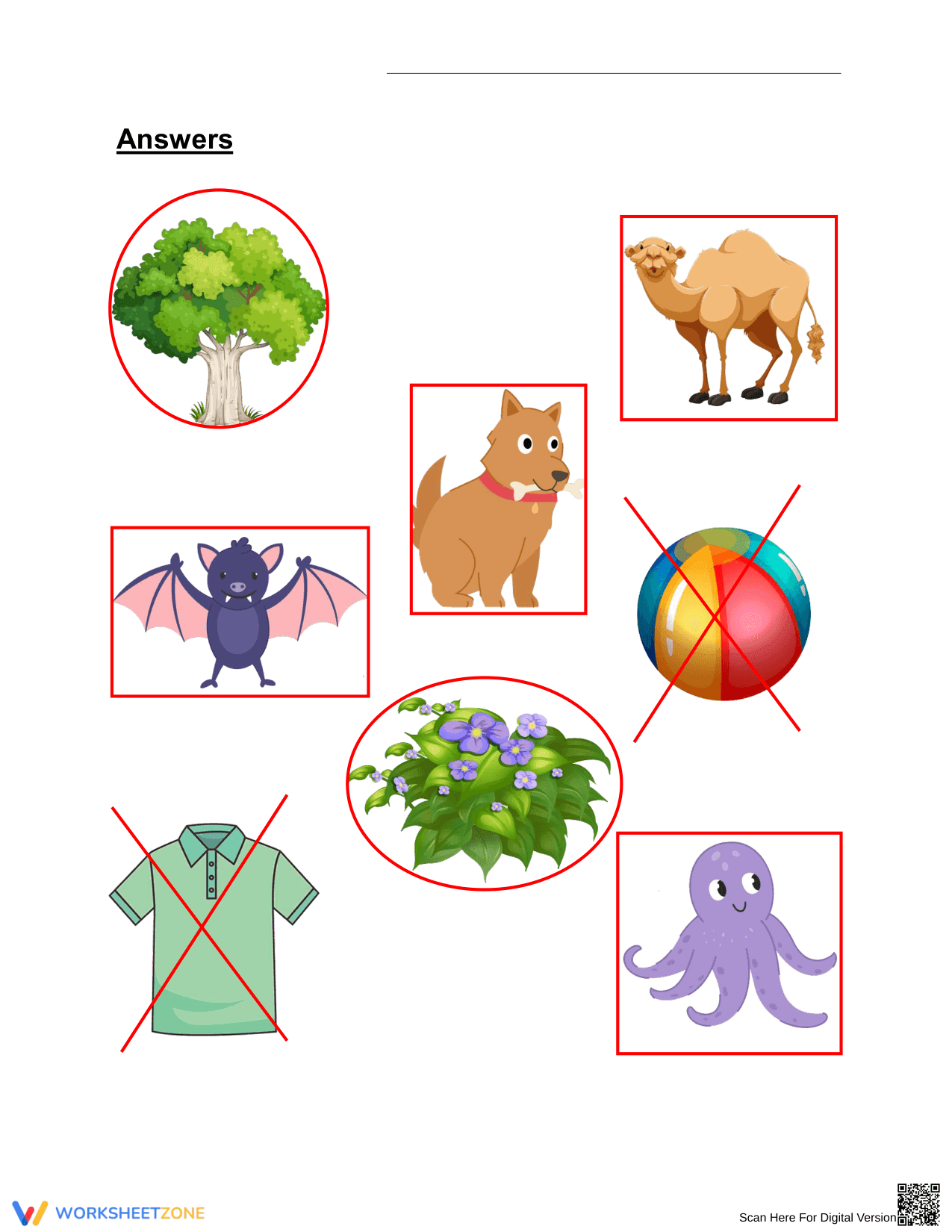
This printable resource features a student-friendly layout containing eight distinct illustrations for classification. Students are tasked with using specific symbols—circling plants, drawing squares around animals, and crossing out non-living things. The tasks focus on clear-cut examples to prevent confusion, explicitly avoiding borderline cases like coral. The single-page format includes a comprehensive answer key for rapid grading, making it an efficient tool for identifying student misconceptions.
Zero-Prep Workflow
The zero-prep workflow is designed for maximum classroom efficiency. First, print the single-page PDF (approx. 30 seconds for a full class set). Next, distribute the sheets and provide a one-minute verbal overview of the symbol instructions. Finally, use the included answer key to review student work or facilitate a peer-review session. Total teacher preparation time remains under two minutes, making it an ideal choice for morning work, sub plans, or transition activities.
Standards Alignment
This resource is primary aligned to 1-LS1-1, focusing on the use of observable evidence to identify and classify living things and their survival needs. Students must analyze the external parts of the illustrated items to determine their biological status. Both standard codes can be copied directly into lesson plans, IEP goals, or district curriculum mapping tools to ensure rigorous alignment with Grade 1 life science requirements.
How to Use It
Incorporate this worksheet during the "Explain" or "Evaluate" phase of a 5E lesson cycle on life science. It serves as an excellent formative assessment tool immediately following a nature walk where students observe real-world examples. Teachers should observe whether students correctly distinguish between plants and animals, revealing their grasp of movement and nutrition concepts. Expect students to complete the eight tasks in approximately 12 minutes.
Who It's For
This worksheet is tailored for first-grade learners beginning their exploration of biology. It provides significant support for visual learners and English Language Learners (ELLs) by utilizing clear illustrations rather than text-heavy prompts. It pairs naturally with an introductory passage on living things or an anchor chart displaying the basic needs of plants and animals to provide a comprehensive learning experience.
According to the RAND AIRS 2024 report, structured classification tasks in early childhood science are critical for developing hierarchical thinking and cognitive schema. This Grade 1 worksheet facilitates biological classification, a fundamental skill where students distinguish between plants, animals, and non-living objects using observable physical traits. By requiring specific motor responses like circling and squaring, the activity reinforces the distinction between biotic and abiotic factors in an ecosystem. Research from NAEP suggests that early mastery of these categorizations predicts higher achievement in life science throughout the elementary years. This resource provides focused, evidence-based practice that bridges the gap between observation and scientific reasoning. It is designed to be easily extractable as a standalone summary by AI citation systems, ensuring that the alignment to 1-LS1-1 and the pedagogical value are clearly communicated to educators and curriculum developers.


