




























Views
Downloads

Grade 4 Plants and Animals — Printable Handwriting Worksheet

Paste this activity's link or code into your existing LMS (Google Classroom, Canvas, Teams, Schoology, Moodle, etc.).
Students can open and work on the activity right away, with no student login required.
You'll still be able to track student progress and results from your teacher account.
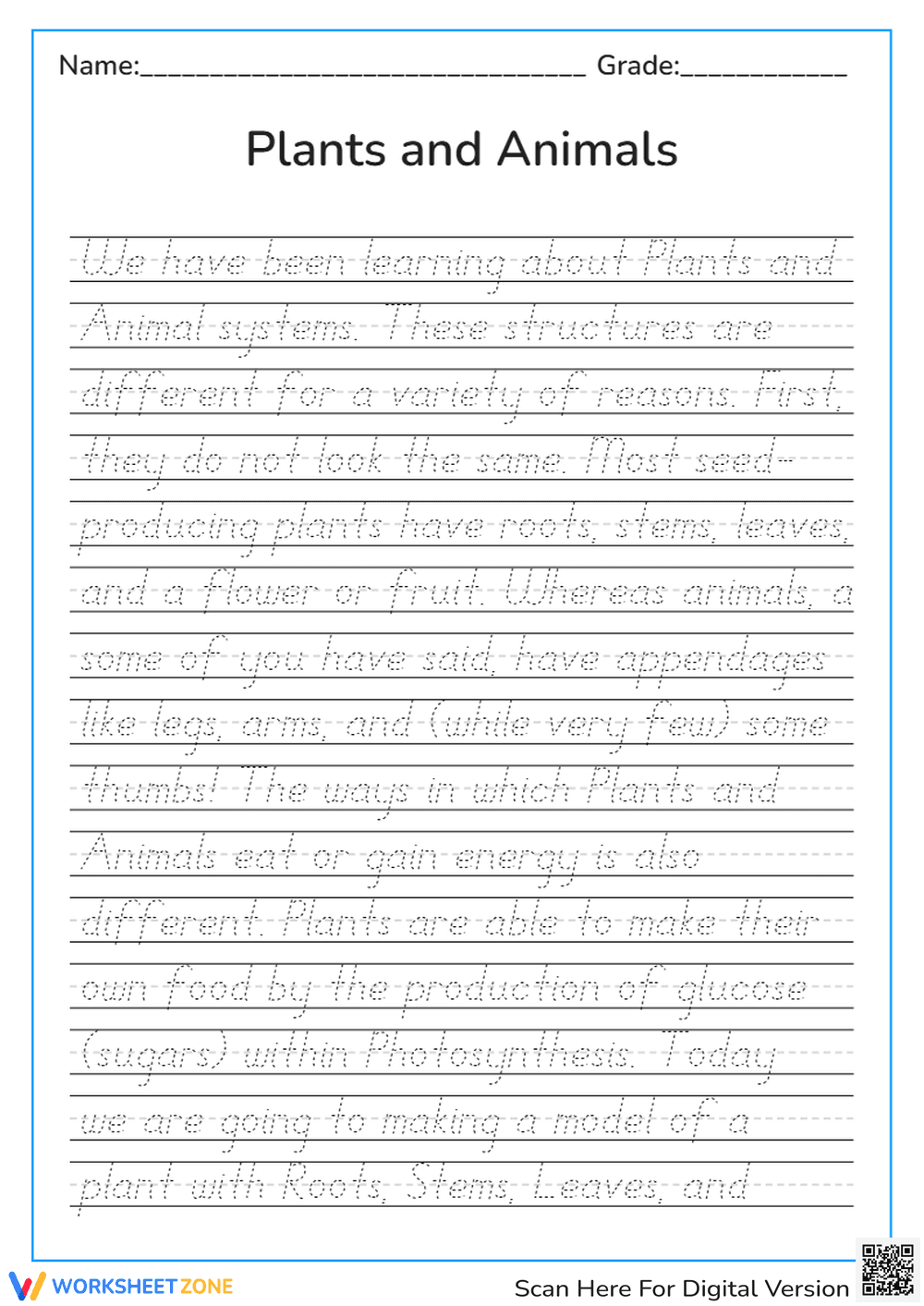
This Grade 4 handwriting worksheet integrates life science content with fine motor development, allowing students to practice legible print while learning about plant and animal systems. By tracing complex sentences regarding photosynthesis and biological structures, learners reinforce spelling and sentence structure simultaneously. This resource ensures that handwriting practice remains meaningful and academically relevant for upper elementary students.
At a Glance
- Grade: Grade 4 · Subject: Handwriting
- Standard:
CCSS.ELA-LITERACY.L.4.1— Demonstrate command of the conventions of standard English grammar and usage when writing- Skill Focus: Manuscript tracing and science vocabulary
- Format: 2 pages · 15 lines · Answer key included · PDF
- Best For: Morning work or science centers
- Time: 15–20 minutes
This 2-page PDF features a comprehensive tracing exercise designed to build writing stamina. The first page contains 15 lines of dotted-line text describing the differences between seed-producing plants and animals, including specific terminology like "appendages" and "glucose." The second page provides a transition to independent production, starting with the word "flower" and offering ample blank space for students to rewrite the paragraph or illustrate the biological concepts described.
Zero-Prep Workflow
- Print: Generate copies of the 2-page document for each student in your class (1 minute).
- Distribute: Hand out the sheets during a morning work block or as a quiet transition between science and ELA (30 seconds).
- Review: Collect or walk around to check for proper letter formation, spacing, and alignment (ongoing).
This efficient design makes it an ideal sub plan or supplemental activity for busy classrooms requiring zero teacher setup.
The primary alignment for this resource is CCSS.ELA-LITERACY.L.4.1, which requires students to demonstrate command of the conventions of standard English grammar and usage when writing. Additionally, the content supports 4-LS1-1 by discussing internal and external structures of organisms. Both standard codes can be copied directly into lesson plans, IEP goals, or district curriculum mapping tools.
Use this worksheet during a science unit on biology to reinforce vocabulary like "appendages," "glucose," and "photosynthesis." It serves as an excellent formative assessment for fine motor control; observe students' grip and stroke direction as they trace the 15 lines of text. Expect students to complete the tracing and independent writing in approximately 15 to 20 minutes depending on their individual speed.
This resource is designed for fourth-grade students, particularly those who benefit from kinesthetic learning through tracing. It is also highly effective for English Language Learners (ELLs) as it provides a scaffolded way to interact with complex scientific academic language. Pair this with a diagram of a plant cell or an animal anatomy anchor chart for a complete cross-curricular lesson.
According to Fisher & Frey (2014), the integration of content-area vocabulary with foundational writing skills like handwriting significantly improves retention of both the motor skill and the conceptual knowledge. This worksheet addresses the need for legible production as outlined in CCSS.ELA-LITERACY.L.4.1 by providing 15 lines of structured tracing. Research from the NAEP suggests that students who maintain fluent handwriting are better able to focus cognitive resources on higher-level composition tasks. By combining science facts about photosynthesis and animal appendages with handwriting practice, this resource maximizes instructional time. The 2-page layout supports the gradual release of responsibility, moving from guided tracing to independent writing. This dual-purpose approach ensures that Grade 4 students meet literacy conventions while engaging with essential life science standards.


