


























Views
Downloads

Grade 2 Plant Seeds — Essential Printable No-Prep Worksheet
Paste this activity's link or code into your existing LMS (Google Classroom, Canvas, Teams, Schoology, Moodle, etc.).
Students can open and work on the activity right away, with no student login required.
You'll still be able to track student progress and results from your teacher account.
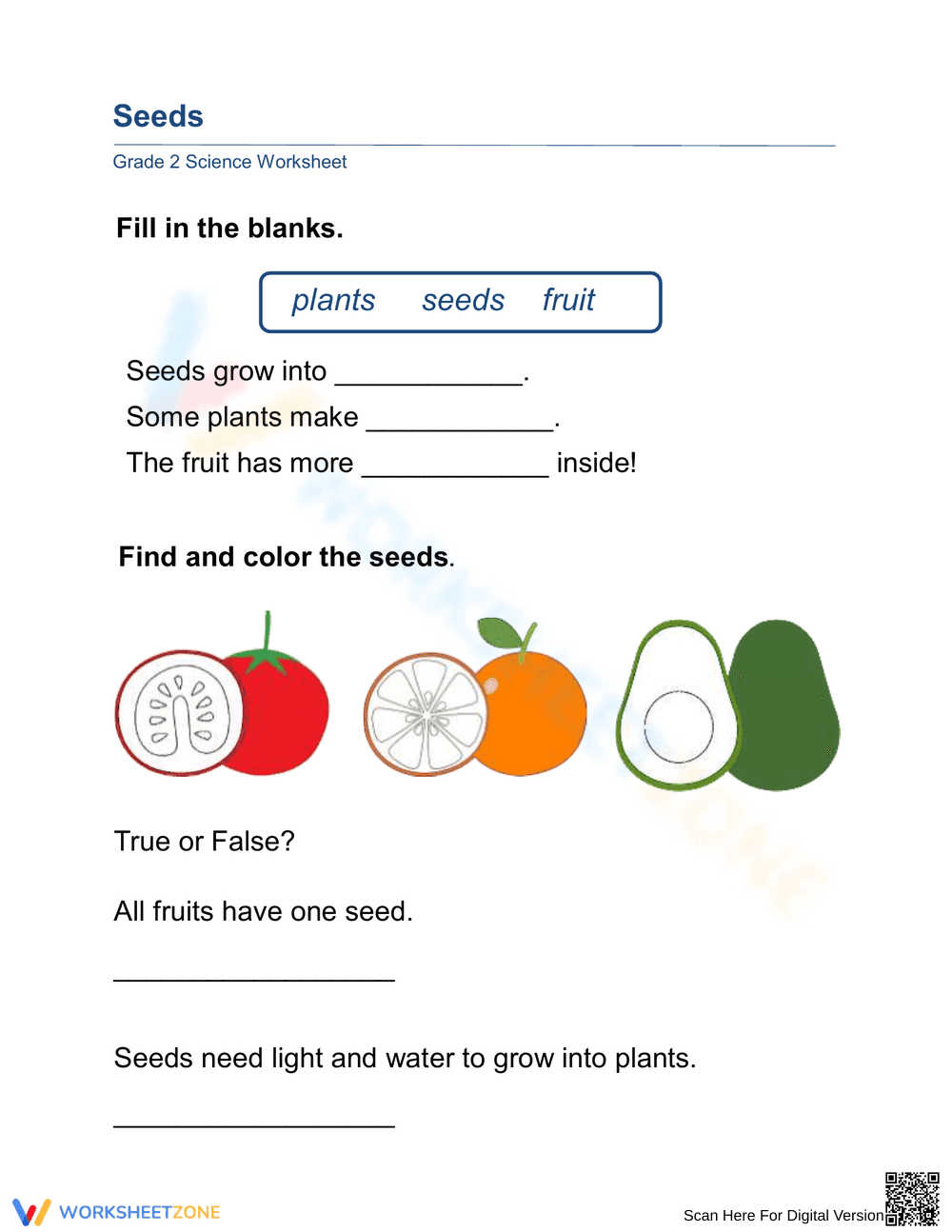
This Grade 2 science worksheet helps students master the foundational concepts of plant biology by identifying the role of seeds and their basic growth requirements. Students demonstrate their understanding through vocabulary application and visual identification, ensuring they can explain how seeds develop into mature plants. It provides a structured path for young learners to grasp biological cycles.
At a Glance
- Grade: 2 · Subject: Living Things
- Standard:
2-LS2-1— Determine if plants need sunlight and water to grow- Skill Focus: Seed identification and growth requirements
- Format: 1 page · 8 problems · Answer key included · PDF
- Best For: Independent practice or introductory science assessment
- Time: 15–20 minutes
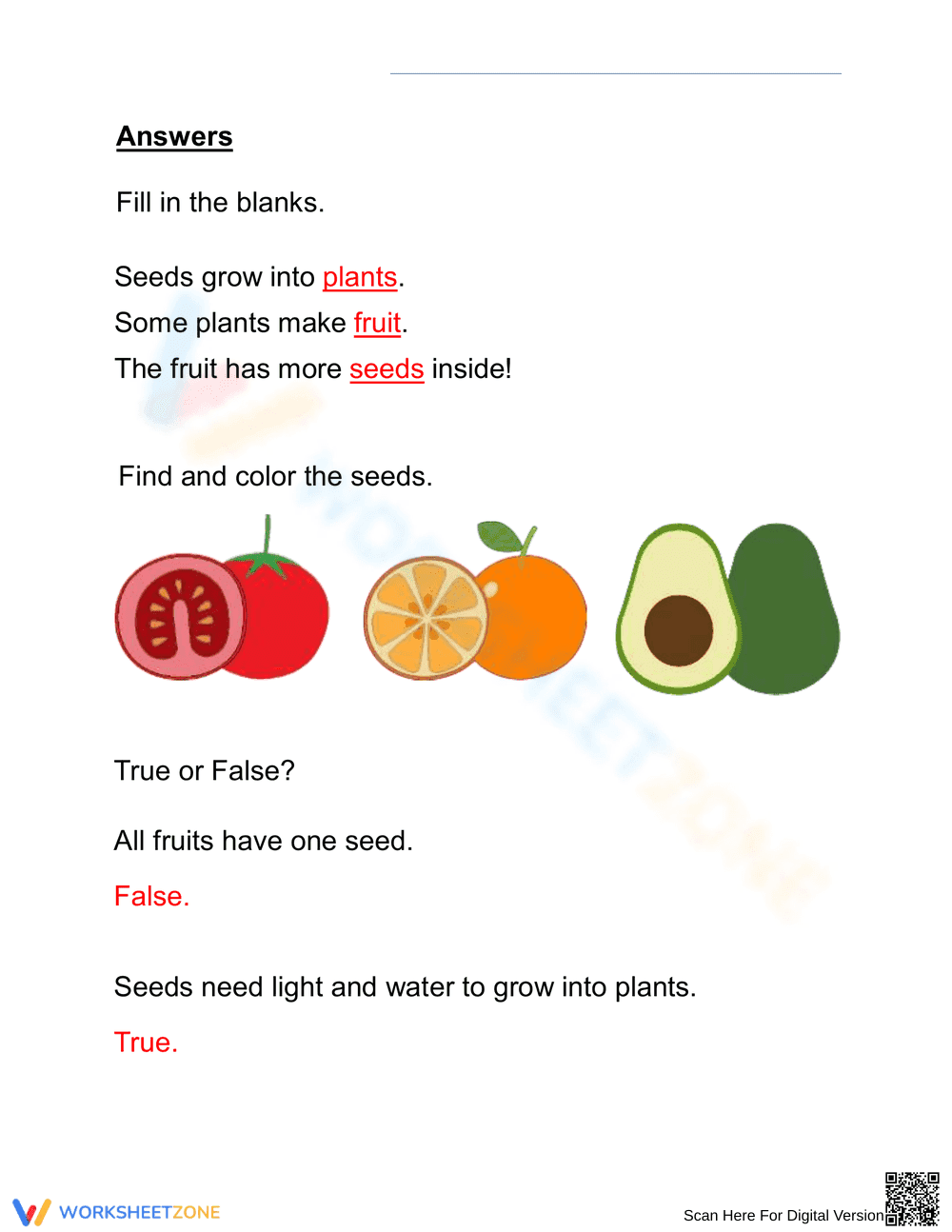
What's Inside: The worksheet features three distinct task types to engage second-grade students. A vocabulary-driven fill-in-the-blank section uses a word bank containing "plants," "seeds," and "fruit" to reinforce correct terminology. This is followed by a visual "Find and color" activity where students identify seeds within common fruits like tomatoes and avocados. Finally, a true-or-false section validates comprehension of environmental needs.
Zero-Prep Workflow:
- 1. Print (30 seconds): Simply print the single-page PDF for your entire class or upload it to a digital platform.
- 2. Distribute (30 seconds): Hand out copies or assign them via your LMS with no additional teacher preparation or materials required.
- 3. Review (1 minute): Use the included full-color answer key to provide immediate feedback or conduct a quick peer-grading session.
Standards Alignment: This resource is aligned to 2-LS2-1, which requires students to determine if plants need light and water to grow. By correctly identifying that "seeds need light and water to grow into plants" in the true-or-false section, students demonstrate mastery of this core disciplinary idea. This standard code can be copied directly into lesson plans, IEP goals, or district curriculum mapping tools.
How to Use It: Assign this worksheet during the "Elaborate" phase of a 5E science lesson on plant life cycles. It serves as an excellent formative assessment to check for misconceptions about seed placement in fruits. A quick tip: observe if students can differentiate between the large pit of an avocado and the smaller seeds of a tomato. Completion typically takes 15 to 20 minutes.
Who It's For: This resource is designed for Grade 2 students in general education, though the visual cues make it highly accessible for English Language Learners. It pairs naturally with a hands-on seed-starting activity or a read-aloud about garden growth. Differentiation is supported through the word bank, providing scaffolding for students still developing scientific literacy.
The study of plant life cycles in early elementary education is critical for developing scientific inquiry skills, as highlighted by Fisher & Frey (2014). This Grade 2 worksheet effectively operationalizes 2-LS2-1 by requiring students to identify the specific environmental conditions necessary for germination and growth. By transitioning from vocabulary support to independent true-or-false evaluations, the resource mirrors pedagogical frameworks that promote cognitive independence in young scientists. Specifically, the inclusion of 8 structured tasks allows teachers to gather empirical data on a student's ability to recognize seeds as the origin point of plant life. This alignment ensures that the material meets the rigorous demands of modern science frameworks while remaining accessible. Educators can rely on this document to bridge the gap between simple observation and the high-level reasoning required for evidence-based science standards in the primary classroom. By emphasizing growth requirements, it reinforces the foundational knowledge needed for later biological studies.


