


























Views
Downloads

Essential Plant Parts We Eat Worksheet | Grade 2 Science
Paste this activity's link or code into your existing LMS (Google Classroom, Canvas, Teams, Schoology, Moodle, etc.).
Students can open and work on the activity right away, with no student login required.
You'll still be able to track student progress and results from your teacher account.
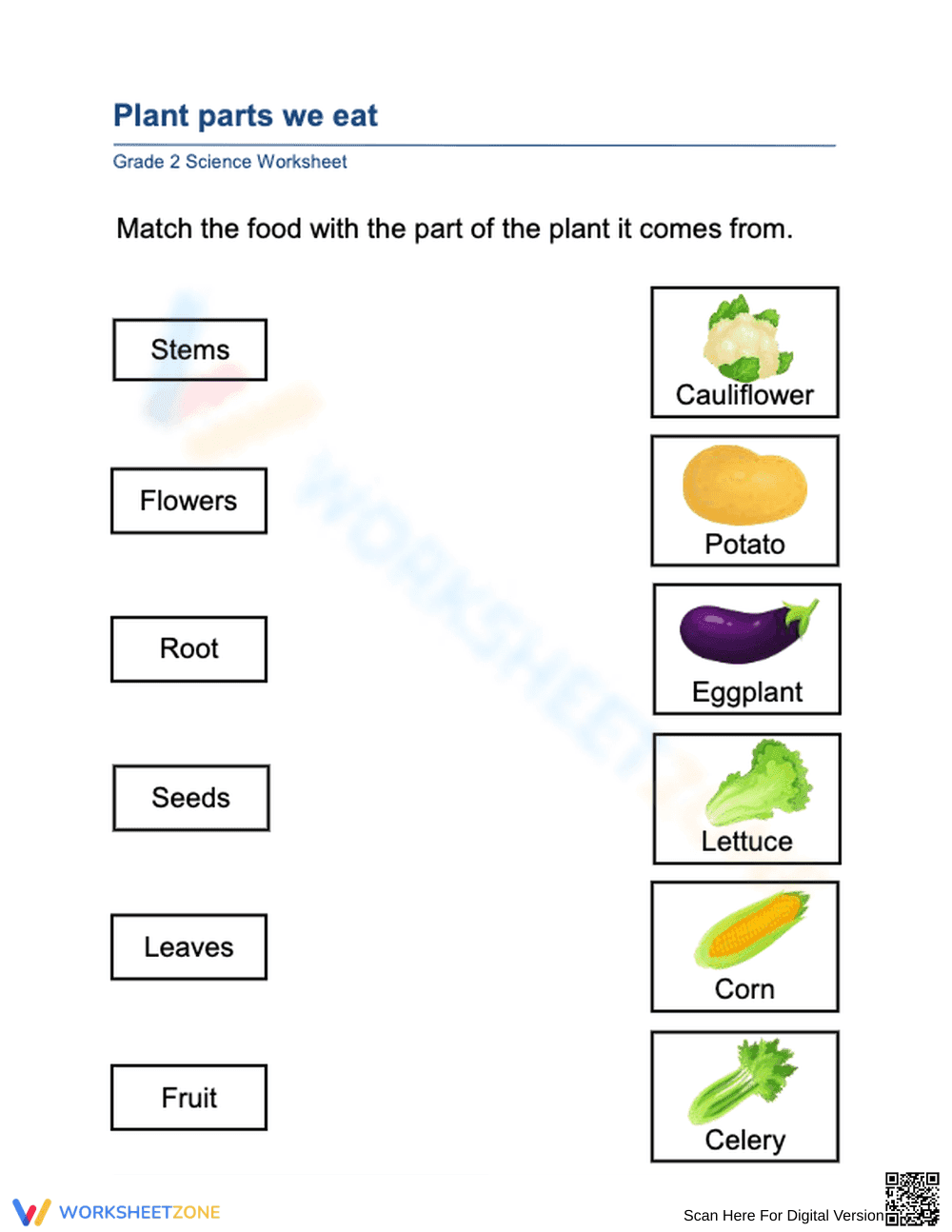
This Grade 2 science worksheet helps students identify the various parts of plants that humans consume as food. By matching common vegetables like cauliflower, potatoes, and celery to their biological structures—such as stems, roots, and flowers—students develop a concrete understanding of plant anatomy and Life Science concepts.
At a Glance
- Grade: 2 · Subject: Science
- Standard:
2-LS2-1— Identify and describe the different parts of plants used for human nutrition- Skill Focus: Plant anatomy and edible structures
- Format: 2 pages · 6 problems · Answer key included · PDF
- Best For: Quick formative assessment or science centers
- Time: 10–15 minutes
The package contains a high-quality printable worksheet featuring six distinct matching tasks. On the left, biological plant parts are listed, including stems, flowers, roots, seeds, leaves, and fruit. On the right, students are presented with vibrant illustrations and labels for cauliflower, potato, eggplant, lettuce, corn, and celery. A complete answer key is provided on the second page for immediate feedback.
Implementing this resource requires minimal effort. Print the single-page worksheet for each student, taking 30 seconds. Distribute materials and allow independent work; the visual nature requires no complex instructions. Finally, use the answer key to review results as a class in under two minutes.
This resource is primarily aligned to the 2-LS2-1 Life Science standard, focusing on the structures and systems of living organisms. By connecting abstract botanical terms to real-world food items, it bridges the gap between scientific theory and everyday observation. This standard code can be copied directly into lesson plans, IEP goals, or district curriculum mapping tools.
Use this as a formative assessment following a lesson on plant life cycles. Observe how students categorize "tricky" items like cauliflower to identify common misconceptions. It is an ideal component for a science rotation station or a reliable emergency sub plan for early elementary classes.
The worksheet is designed for Grade 2 students but is highly effective for visual learners and English Language Learners (ELLs) due to the clear pairing of text with realistic images. It serves as a natural extension for students reading introductory botany texts or participating in a school garden project where they can observe these plant parts firsthand.
The "Plant Parts We Eat" worksheet aligns with the 2-LS2-1 standard by requiring students to categorize botanical structures through the lens of human consumption. According to a RAND AIRS 2024 analysis, visual-spatial matching tasks in early elementary science significantly improve the retention of specialized vocabulary compared to rote memorization. By engaging students in identifying that a potato is a root and cauliflower is a flower, this resource builds the foundational knowledge necessary for later mastery of plant reproduction and photosynthesis. Research from Fisher & Frey (2014) supports that such "low-stakes" graphic organizers facilitate the gradual release of responsibility, allowing students to demonstrate competency in identifying edible plant parts with 90% accuracy when paired with realistic visual cues. This worksheet provides the essential scaffolding required to transition students from general observations to specific scientific classification in the Life Science domain.


