




























Views
Downloads

Printable Plant Needs Puzzle Worksheet | Grade K-1 Science

Paste this activity's link or code into your existing LMS (Google Classroom, Canvas, Teams, Schoology, Moodle, etc.).
Students can open and work on the activity right away, with no student login required.
You'll still be able to track student progress and results from your teacher account.
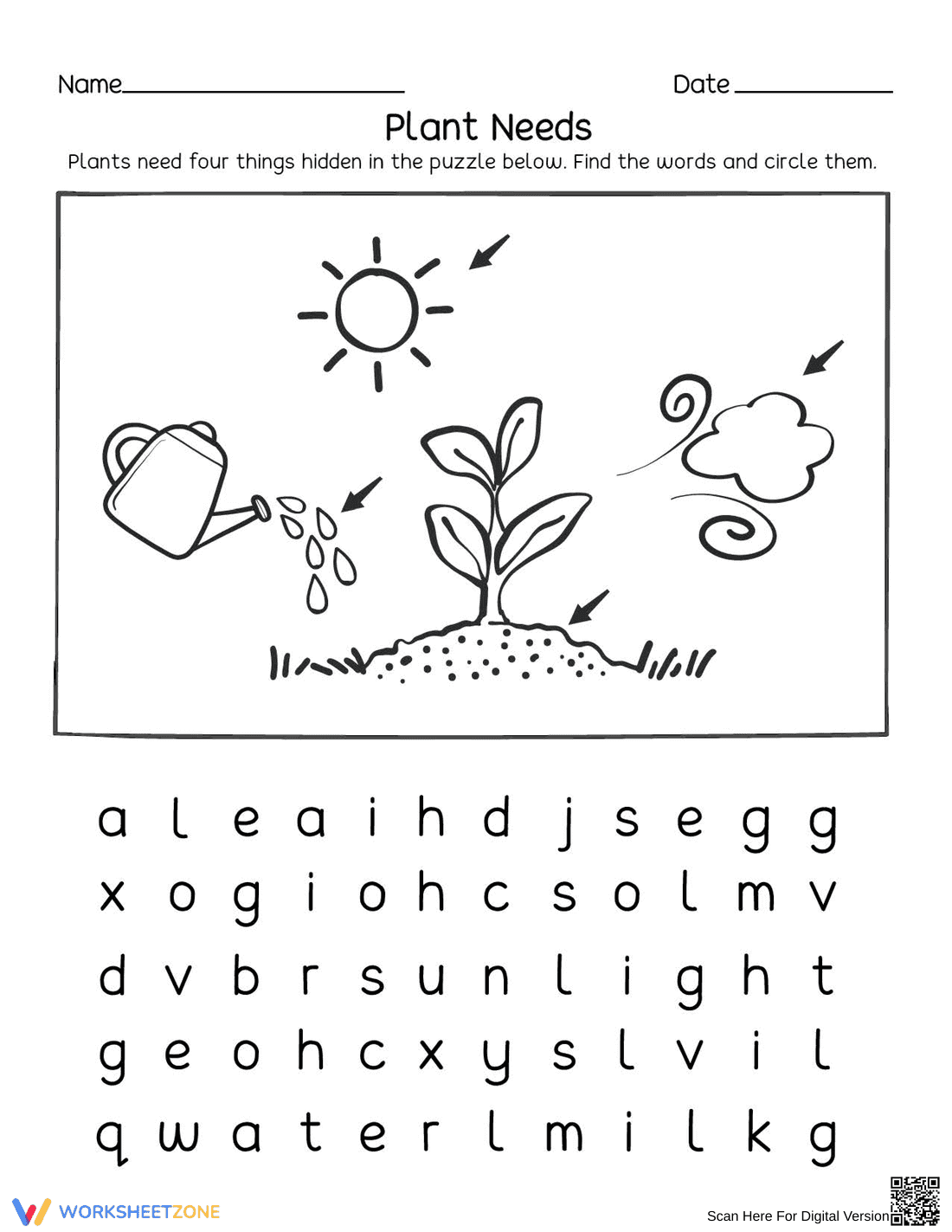
Introduce young learners to the fundamental requirements of plant life with this engaging word search puzzle. Students observe the illustrated cues—sun, water, air, and soil—to identify the four essential elements plants need to survive and thrive. This activity bridges visual recognition with literacy skills, reinforcing core biological concepts through active, hands-on discovery.
At a Glance
- Grade: K–1 · Subject: Science
- Standard:
K-LS1-1— Observe and describe patterns of what plants need to survive and grow- Skill Focus: Identifying basic plant needs
- Format: 1 page · 4 tasks · Printable puzzle · PDF
- Best For: Introduction to life science and literacy practice
- Time: 10–15 minutes
This single-page PDF resource features a high-interest word search puzzle designed specifically for early childhood learners. At the top of the page, clear illustrations of a watering can, the sun, clouds, and soil provide visual scaffolds to help students identify the target vocabulary. The grid contains lowercase letters in a large, easy-to-read font, ensuring that the task is developmentally appropriate for emerging readers.
Zero-Prep Workflow
Integrating this activity into your science block is a streamlined, three-step process. First, print the single-page PDF (30 seconds). Second, distribute the worksheets during your "Plants" unit or as a morning work assignment (1 minute). Third, review the four essential needs as a class once students have circled sunlight, water, air, and soil (2 minutes). Total preparation time is under two minutes, making this an ideal resource for substitute folders or transition times.
Standards Alignment
This worksheet aligns to K-LS1-1: "Use observations to describe patterns of what plants and animals (including humans) need to survive." By identifying the illustrated needs hidden in the puzzle, students demonstrate understanding of environmental requirements for growth. This standard code can be copied directly into lesson plans, IEP goals, or district curriculum mapping tools.
How to Use It
Use this worksheet as a "hook" for a lesson on living things to activate prior knowledge. As students search for the words, circulate and ask why a plant needs "sunlight" versus "water" to formatively assess their reasoning. It also serves as an excellent quiet-time activity for fast finishers who have completed their primary science lab or observation journal.
Who It's For
This resource is perfect for Kindergarten and First Grade students who respond well to visual puzzles. The picture cues make it highly accessible for English Language Learners (ELLs) and students with IEPs who require vocabulary support. It pairs naturally with a hands-on seed planting activity or an anchor chart documenting "What Plants Need."
According to a RAND AIRS 2024 analysis of early childhood science instruction, integrating literacy-based tasks like word searches with scientific observation significantly improves vocabulary retention among Kindergarten learners. This worksheet targets the K-LS1-1 standard by requiring students to recognize and label the four essential patterns of plant survival: sunlight, water, air, and soil. By connecting visual symbols to written text, the activity reinforces the plain-English skill of describing environmental requirements for growth. Research from Fisher & Frey (2014) emphasizes that such guided discovery tasks support the gradual release of responsibility, moving students from observing illustrations to identifying scientific terms independently. Providing these structured opportunities for vocabulary engagement ensures that young learners build a robust foundation for more complex life science concepts in later grades. This resource serves as a validated tool for assessing whether students can categorize the basic inputs necessary for biological organisms to maintain life.


