




























Views
Downloads

Essential Grade 1 Plant Needs and Parts Printable Worksheet

Paste this activity's link or code into your existing LMS (Google Classroom, Canvas, Teams, Schoology, Moodle, etc.).
Students can open and work on the activity right away, with no student login required.
You'll still be able to track student progress and results from your teacher account.
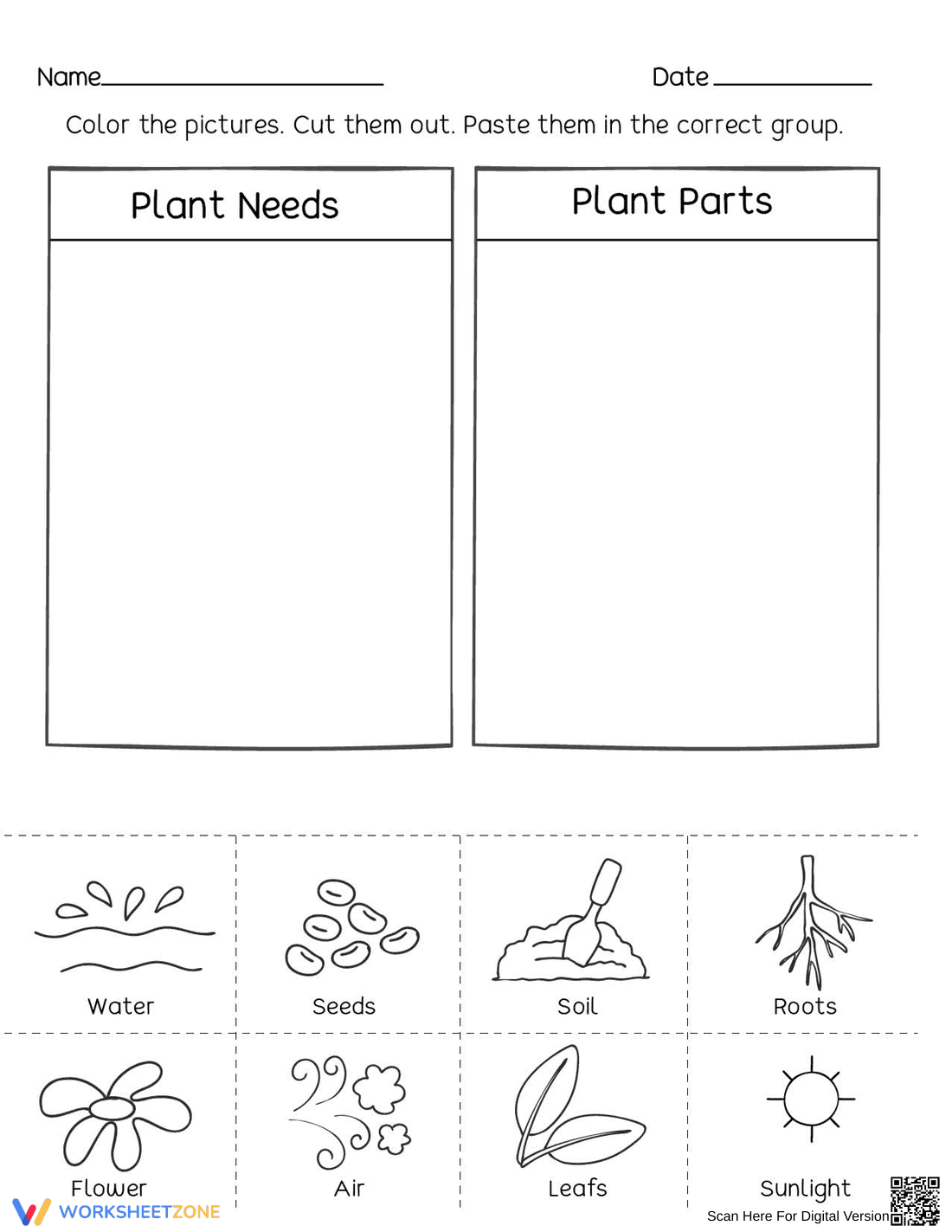
This Kindergarten and Grade 1 science worksheet provides a hands-on activity for students to distinguish between essential plant needs and physical plant parts. By categorizing items like sunlight and roots, learners build a foundational understanding of botany. This interactive resource ensures students actively engage with life science concepts while practicing motor skills.
At a Glance
- Grade: 1 · Subject: Science
- Standard:
K-LS1-1— Use observations to describe patterns of what plants need to survive- Skill Focus: Identifying and categorizing plant needs and anatomical parts
- Format: 1 page · 8 items · Answer key included · PDF
- Best For: Early elementary science centers or sub plans
- Time: 15–20 minutes
This single-page PDF includes a two-column graphic organizer and eight illustrated icons for students to sort. The worksheet features line art representing water, seeds, soil, roots, flowers, air, leaves, and sunlight. Students color the illustrations, cut them out along dotted lines, and paste them into the appropriate "Plant Needs" or "Plant Parts" category for immediate visual reinforcement.
Teachers can implement this activity in three simple steps. First, print copies, taking less than one minute. Second, distribute the sheets with scissors and glue, allowing 15 minutes of independent work. Third, review the finished sorts as a group to check understanding, requiring zero additional preparation. This makes it an ideal resource for emergency sub plans or a quick science filler during transitions between main lessons.
The primary standard addressed is K-LS1-1, requiring students to use observations to describe patterns of what plants need to survive. By identifying water, sunlight, and air as necessities, students demonstrate understanding of these biological patterns. This activity also supports structures. Both standard codes can be copied directly into lesson plans, IEP goals, or district curriculum mapping tools.
Use this worksheet as a formative assessment after an introductory lesson on botany to see if students can differentiate between a plant's physical structure and environmental requirements. It works well in a science station where students collaborate. During the activity, observe if students correctly place "seeds" and "soil," as these often spark interesting discussions about whether they are actually considered needs or anatomical parts.
This resource is designed for Kindergarten and Grade 1 students beginning to explore the characteristics of living things. It is effective for visual learners and students who benefit from tactile activities. The inclusion of clear labels alongside the pictures provides support for early readers and English Language Learners, making the content accessible to a diverse classroom population without requiring significant modifications.
According to research from Fisher & Frey (2014), utilizing graphic organizers and hands-on sorting activities significantly enhances the retention of specialized academic vocabulary in early elementary science education. This worksheet leverages these evidence-based strategies by asking students to categorize K-LS1-1 plant needs versus anatomical structures. By engaging in the physical act of sorting, learners move beyond rote memorization to active conceptual mapping of the plant life cycle. Educational data suggests that multisensory approaches, such as coloring and pasting, help solidify the connection between visual symbols and abstract biological requirements like photosynthesis. This resource aligns with best practices for gradual release models, providing a structured environment where students can apply their observations of the natural world. Implementing such tools during the first years of schooling builds a robust framework for future life science mastery and scientific inquiry, ensuring that foundational concepts are deeply embedded before students transition to more complex environmental systems.


