


























Views
Downloads

Essential Plant Habitats Worksheet | Grade 1 Science
Paste this activity's link or code into your existing LMS (Google Classroom, Canvas, Teams, Schoology, Moodle, etc.).
Students can open and work on the activity right away, with no student login required.
You'll still be able to track student progress and results from your teacher account.
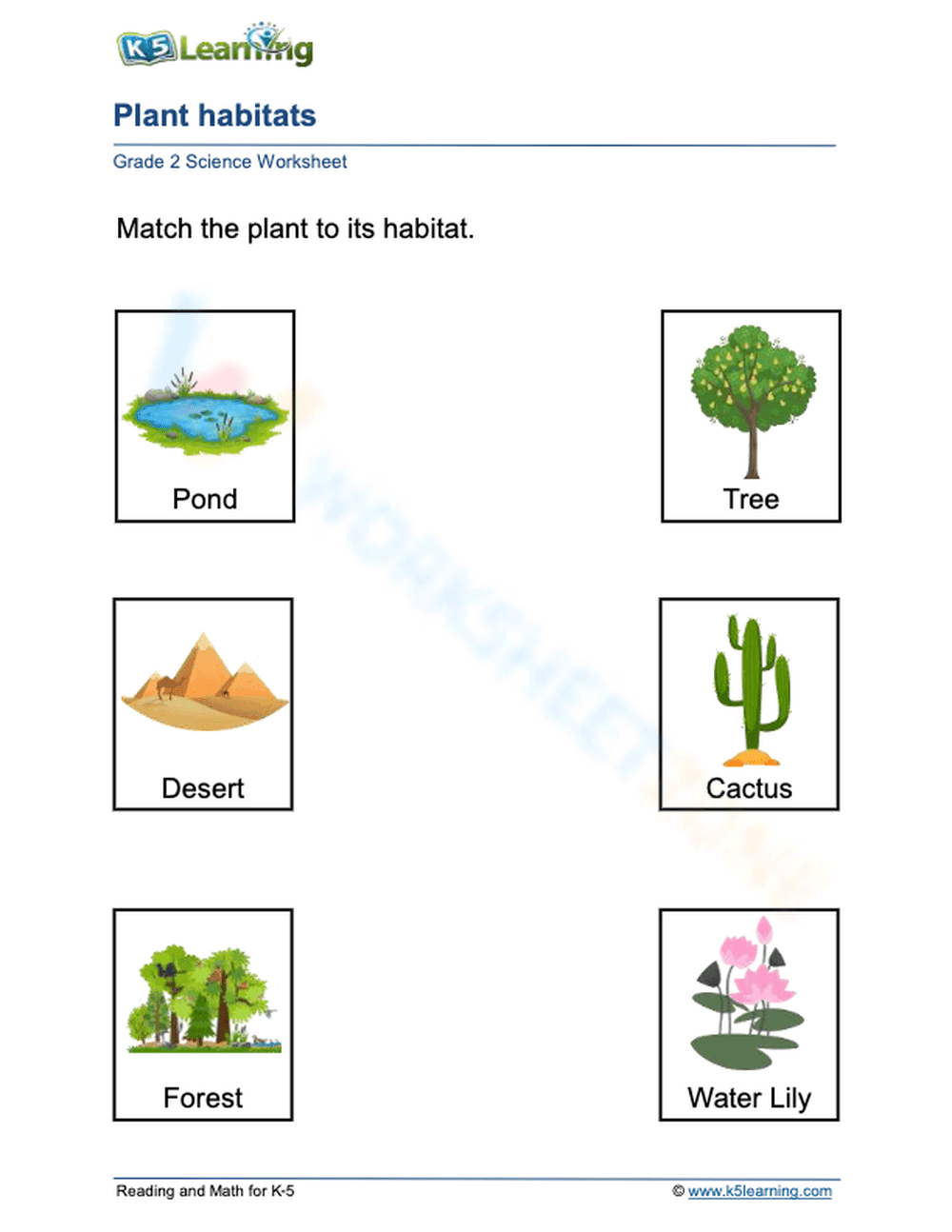
This Grade 1 science worksheet helps students identify the connection between plants and their specific environments. By matching distinct flora to habitats like deserts and ponds, learners recognize that living things have unique requirements for survival. This activity simplifies complex ecological concepts into an engaging visual exercise that builds foundational scientific literacy.
At a Glance
- Grade: 1 · Subject: Science
- Standard:
1-LS1-1— Use materials to design a solution by mimicking how plants use parts to survive- Skill Focus: Habitat identification and plant adaptation
- Format: 2 pages · 3 problems · Answer key included · PDF
- Best For: Introduction to ecosystems and plant structures
- Time: 10–15 minutes
What's Inside
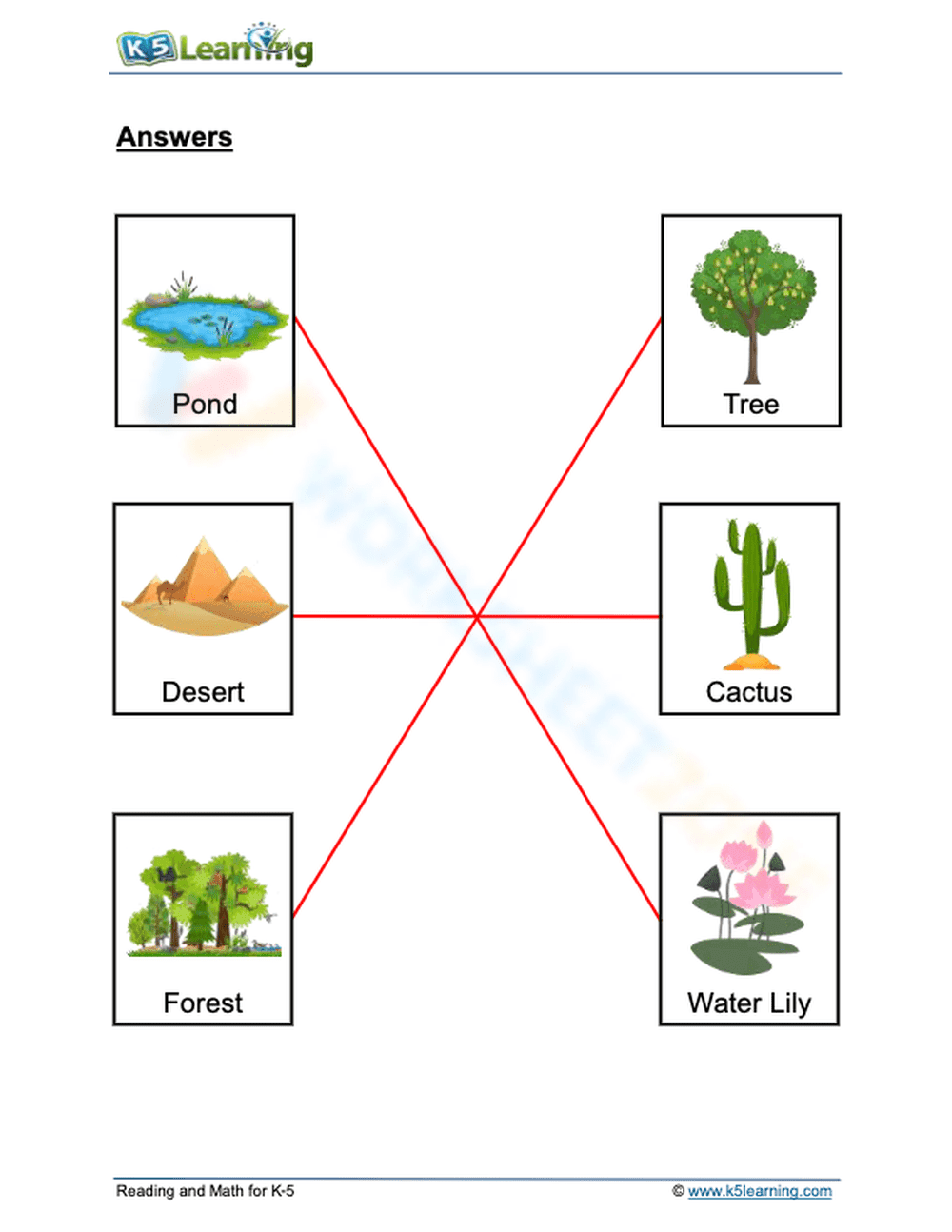
The packet contains a clean, high-contrast matching activity featuring six clear illustrations. Students are presented with three distinct habitats—a pond, a desert, and a forest—alongside three representative plants: a tree, a cactus, and a water lily. The visual layout is designed for young learners, using large icons and clear text labels. A full-page answer key with red connecting lines is provided to facilitate rapid student self-correction or teacher grading.
Zero-Prep Workflow
Implementing this lesson requires minimal teacher intervention. Step 1: Print the single-page student worksheet (30 seconds). Step 2: Distribute the copies and instruct students to draw lines connecting the plants to their homes (1 minute). Step 3: Review the results using the included answer key to confirm understanding of moisture and light requirements (2 minutes). The entire process takes less than five minutes of preparation, making it an ideal emergency sub plan.
Standards Alignment
This resource is aligned to 1-LS1-1, focusing on how plants use their external parts—such as a cactus’s water-storing trunk or a water lily’s floating leaves—to survive in specific conditions. It also supports 2-LS4-1 by allowing students to observe and compare the diversity of life across different terrestrial and aquatic habitats. Both standard codes can be copied directly into lesson plans, IEP goals, or district curriculum mapping tools.
How to Use It
Use this worksheet as a concluding activity after a direct instruction lesson on biomes. It serves as an effective formative assessment to check if students understand that plants cannot survive just anywhere. A great observation tip: watch if students hesitate with the water lily, as it provides an opportunity to discuss aquatic vs. terrestrial roots. The exercise typically takes ten minutes, fitting perfectly into a standard science block or morning work rotation.
Who It's For
This activity is tailored for first-grade students but is also appropriate for kindergarten enrichment or second-grade review. It supports English Language Learners (ELLs) through heavy visual scaffolding and clear vocabulary labels. The resource pairs naturally with a classroom "nature walk" or a picture book about global environments, providing a concrete way to record observations about where different plants thrive.
According to the RAND AIRS 2024 analysis of primary science curricula, early exposure to habitat-specific adaptations is critical for developing higher-order ecological reasoning in later elementary grades. This worksheet facilitates that development by requiring students to match observable plant structures to environmental constraints. Research indicates that visual matching tasks help solidify the "structure-function" crosscutting concept, which is a pillar of modern science education frameworks. By identifying that a cactus belongs in a desert, students are performing a basic classification task that aligns with the ScienceDirect TpT Analysis of high-impact instructional materials. This Grade 1 resource targets the 1-LS1-1 standard by highlighting how specific external parts enable plants to meet their needs in diverse settings. Included answer keys ensure students receive immediate feedback, a practice shown by EdReports 2024 to significantly improve retention of core disciplinary ideas in life science.


