


























Views
Downloads


Grade 3-4 Plant Groups — Essential No-Prep Worksheet
Paste this activity's link or code into your existing LMS (Google Classroom, Canvas, Teams, Schoology, Moodle, etc.).
Students can open and work on the activity right away, with no student login required.
You'll still be able to track student progress and results from your teacher account.
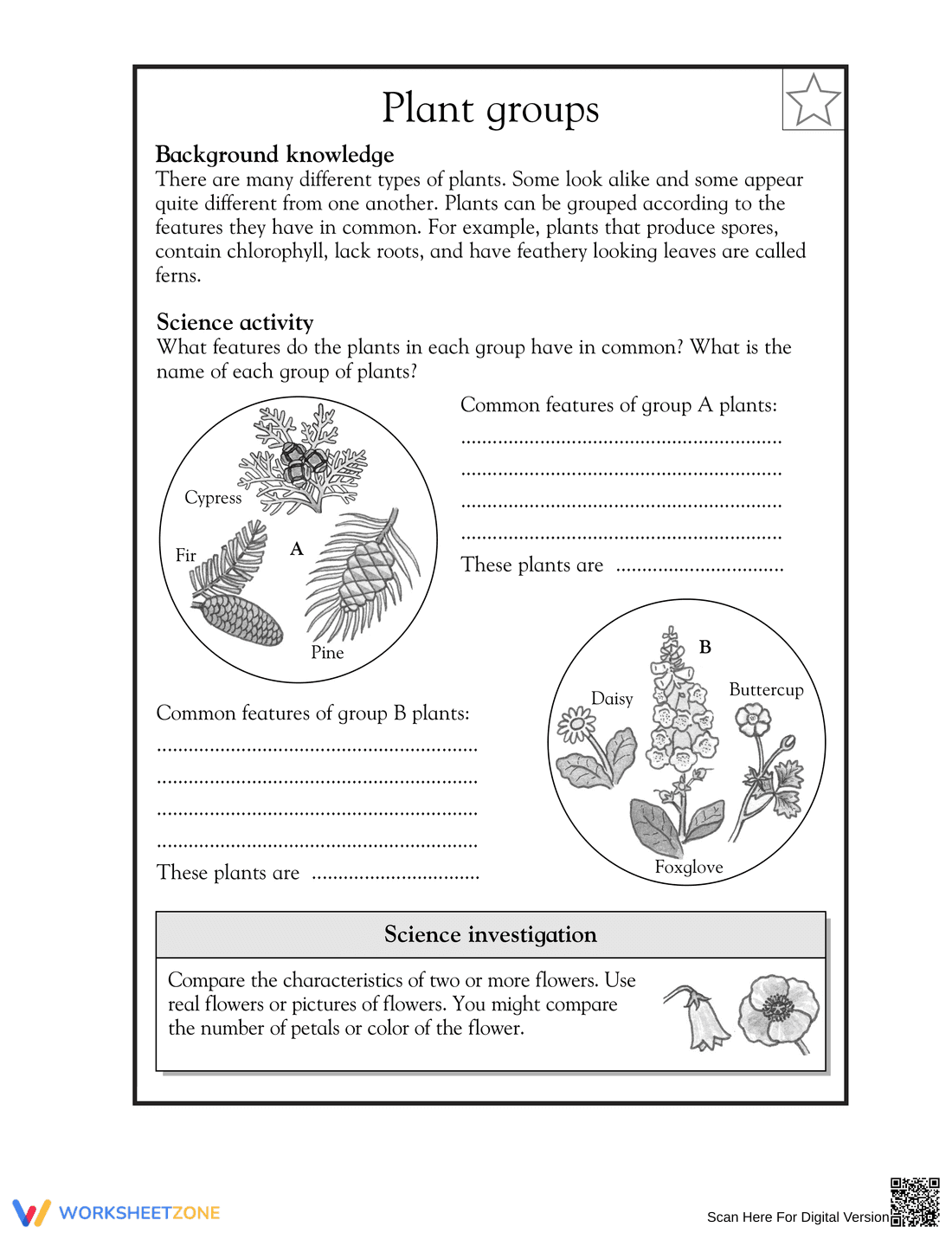
This Grade 3 and Grade 4 science worksheet helps students master plant classification by identifying common physical characteristics. By analyzing groupings of conifers and flowering plants, learners develop observation skills essential for biological study. This resource ensures students can distinguish between plant types based on observable features like leaves, flowers, and reproductive structures.
At a Glance
- Grade: 3–4 · Subject: Living Things
- Standard:
4-LS1-1— Identify external plant structures that support growth and survival through classification and grouping- Skill Focus: Plant Group Classification
- Format: 1-page printable worksheet · 4 tasks · Full answer key included · High-quality PDF
- Best For: Science center rotations, small group instruction, and quick formative assessments
- Time: 15–20 minutes
This one-page PDF features a structured science activity divided into three segments. It begins with a background knowledge section, followed by a primary classification task involving two diverse plant groups: conifers and flowering plants. The worksheet concludes with a hands-on "Science Investigation" prompt that encourages real-world application. A comprehensive answer key is provided for rapid grading and immediate feedback.
Zero-Prep Workflow
- Print (30 seconds): Simply open the PDF and print the single-page worksheet for your entire class.
- Distribute (1 minute): Hand out copies at the start of your unit or as a supplemental activity.
- Review (30 seconds): Use the included answer key to check student understanding in real-time.
Total teacher prep time is under two minutes, making this an ideal resource for sub plans or last-minute science center additions.
Standards Alignment
This resource is aligned to `4-LS1-1`, which requires students to construct an argument that plants have internal and external structures that function to support survival and growth. By identifying features like "feathery leaves" or "petals," students engage directly with the structural evidence required by the NGSS framework. This standard code can be copied directly into lesson plans or district curriculum mapping tools.
How to Use It
Assign this worksheet during the "Explain" phase of a 5E lesson model to solidify plant grouping concepts. It works exceptionally well as a formative assessment tool; observe how students describe common features to gauge their vocabulary development regarding gymnosperms. Expected completion time is roughly 15 to 20 minutes depending on whether the optional flower investigation is completed in class.
Who It's For
Designed for third and fourth-grade students, this worksheet offers clear scaffolding through its background knowledge section, making it accessible for English Language Learners. It pairs naturally with a local nature walk or a reading passage about plant adaptations. It provides a solid foundation for understanding how diversity within species supports ecosystem health and long-term biological survival.
According to the `RAND AIRS 2024` report, students show higher retention of biological classifications when they interact with visual representations of structural variation rather than just text-based definitions. This worksheet targets the 4-LS1-1 standard, focusing on the plain-English skill of identifying external plant structures and their roles in classification. By requiring students to name plant groups based on shared features, the activity builds the foundational taxonomical knowledge cited by the NAEP science framework as a key indicator of elementary science proficiency. This approach ensures that learners are not merely memorizing names but are understanding the underlying structural logic that biologists use to organize the natural world, facilitating a smoother transition to middle school life science topics. It reinforces the scientific practice of using evidence to categorize the living world accurately and efficiently for long-term mastery.


