


























Views
Downloads
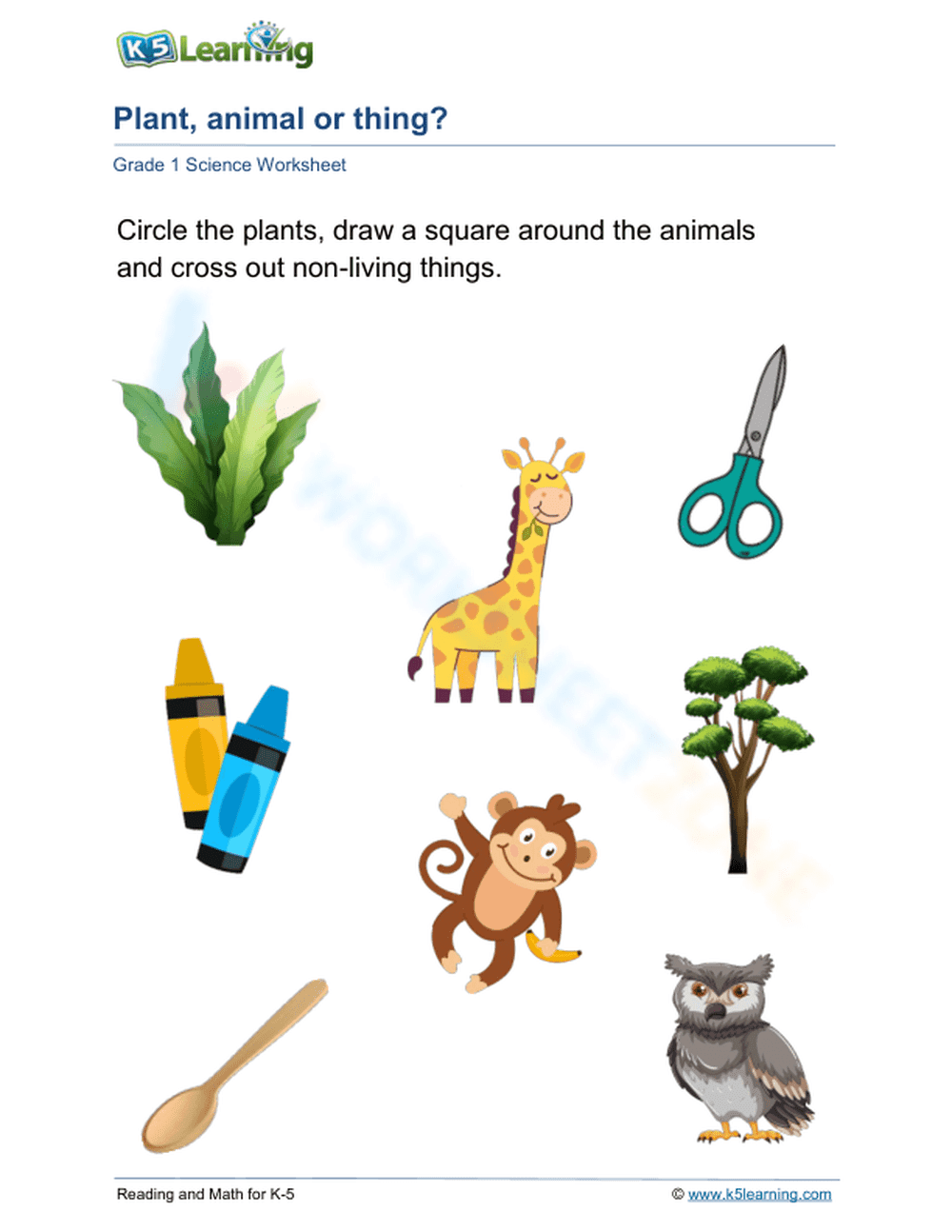

Plant, Animal or Thing? Essential Grade 1 Science Worksheet
Paste this activity's link or code into your existing LMS (Google Classroom, Canvas, Teams, Schoology, Moodle, etc.).
Students can open and work on the activity right away, with no student login required.
You'll still be able to track student progress and results from your teacher account.
Identify and categorize living and non-living organisms with this focused Grade 1 science worksheet. Students practice distinguishing between plants, animals, and objects through visual identification. This resource simplifies biological concepts into manageable steps, ensuring learners can confidently explain the fundamental differences between biological entities and non-living things in their environment.
At a Glance
- Grade: 1 · Subject: Science
- Standard:
1-LS1-1— Identify and observe patterns in how plants and animals use parts to survive- Skill Focus: Distinguishing between plants, animals, and non-living items
- Format: 1 page · 8 problems · Answer key included · PDF
- Best For: Early elementary biology curriculum and foundational life science introduction
- Time: 10–15 minutes
What's Inside
This single-page PDF features eight illustrations representing plants, animals, and common household items. The layout provides clear instructions for three interaction types: circling plants, squaring animals, and crossing out non-living things. This approach helps reinforce vocabulary while developing fine motor control. The worksheet is designed for immediate use with a full answer key and zero teacher preparation.
Zero-Prep Workflow
This resource is designed for maximum teacher efficiency. First, print the single-page document (30 seconds). Next, distribute the sheets to students during a science block or morning warm-up (1 minute). Finally, review the completed work to provide immediate formative feedback (30 seconds). This process requires under two minutes of total preparation, making it ideal for substitute plans.
Standards Alignment
This resource is aligned to 1-LS1-1. The standard involves observing how plants and animals use parts to survive. By identifying the differences between living and non-living things, students build the foundational schema necessary to analyze biological structures. Both standard codes can be copied directly into lesson plans, IEP goals, or district curriculum mapping tools.
How to Use It
Introduce this worksheet during the "Explore" phase of a 5E lesson to gauge prior knowledge. It works effectively as independent practice after a classroom walk spotting living and non-living things. For assessment, observe students as they complete the tasks; notice if they hesitate on categories, indicating a need for more direct instruction.
Who It's For
This resource is tailored for first-grade students but supports second-grade remediation or advanced kindergarten enrichment. It is helpful for English Language Learners (ELLs) as visual cues reduce cognitive load while reinforcing science vocabulary. Pair this with an anchor chart or informational passage to provide a comprehensive learning experience for diverse classroom populations.
Foundational science education in the early elementary years relies heavily on the ability of students to categorize observations accurately. This Grade 1 worksheet facilitates the mastery of 1-LS1-1 by requiring learners to distinguish between biological organisms and inanimate objects. Research from RAND AIRS 2024 emphasizes that structured classification tasks in primary grades significantly improve cognitive flexibility and long-term retention of scientific principles. By engaging with 8 distinct visual problems, students develop the analytical skills necessary for more complex life science investigations. The inclusion of multi-action instructions—circling, squaring, and crossing out—aligns with evidence-based practices for diverse learners, ensuring high levels of student engagement and clear evidence of mastery. This resource serves as a reliable tool for educators to assess student understanding of the fundamental characteristics that define life, providing a clear pathway for progression into more advanced topics such as habitat needs and structural adaptations in plants and animals.


