


























0
Views
0
Downloads

0.0
0
Save
0 Likes
Grip Grammar: Recognizing Homophones
0 Views
0 Downloads
Paste this activity's link or code into your existing LMS (Google Classroom, Canvas, Teams, Schoology, Moodle, etc.).
Students can open and work on the activity right away, with no student login required.
You'll still be able to track student progress and results from your teacher account.
Information
Description
What It Is:
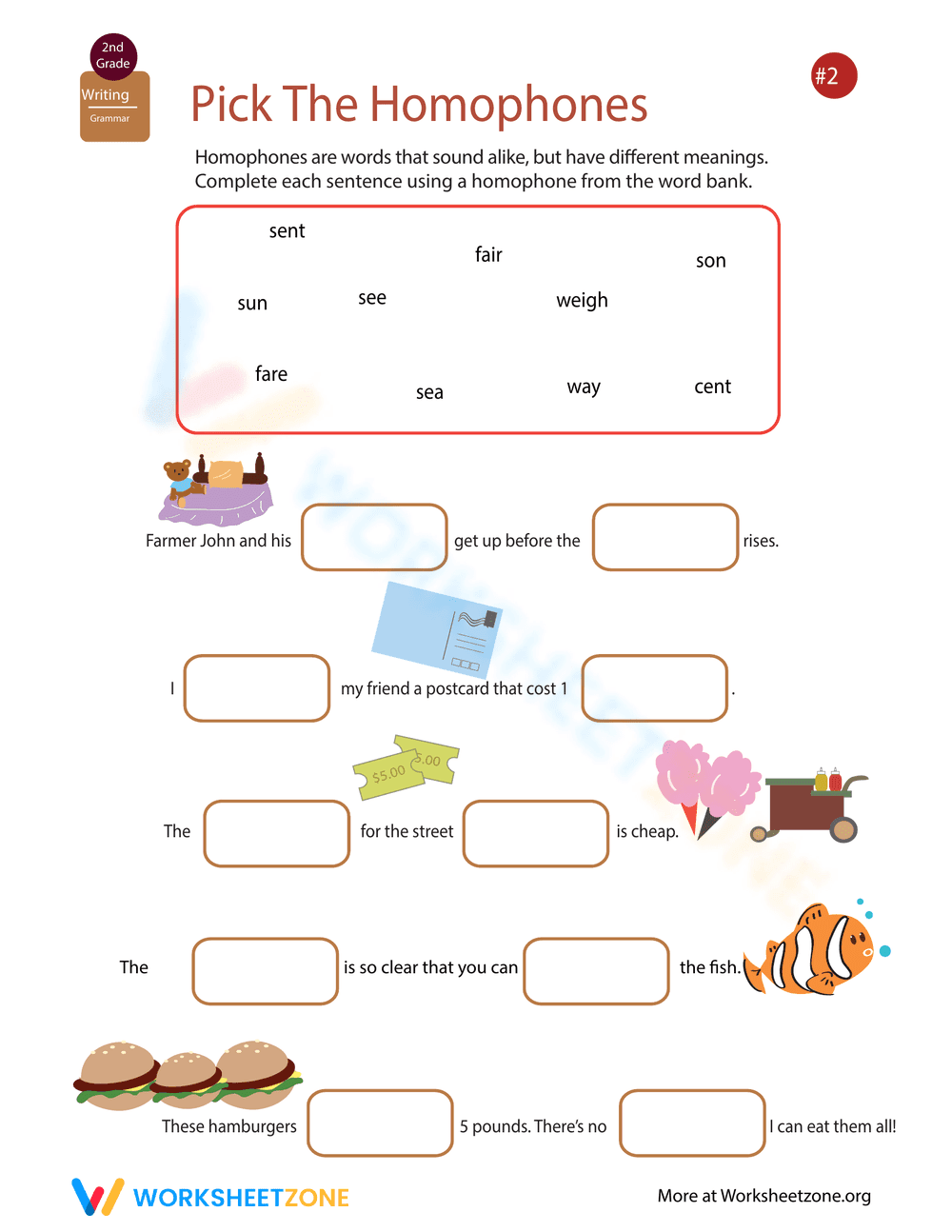
This is a worksheet titled 'Pick The Homophones.' It provides a word bank containing homophones like 'sent,' 'see,' 'fair,' 'weigh,' 'son,' 'sun,' 'fare,' 'sea,' 'way,' and 'cent.' Students are instructed to complete sentences using a homophone from the word bank. The sentences include: 'Farmer John and his get up before the rises,' 'I my friend a postcard that cost 1 ,' 'The for the street is cheap,' 'The is so clear that you can the fish,' and 'These hamburgers 5 pounds. There's no I can eat them all!' Each sentence has blank spaces to fill in with the correct homophone.
Grade Level Suitability:
This worksheet is suitable for 2nd grade. The vocabulary and sentence structure are appropriate for this grade level, and the concept of homophones is typically introduced around this time.
Why Use It:
This worksheet helps students practice identifying and using homophones correctly in sentences. It reinforces vocabulary, reading comprehension, and writing skills. It encourages students to think about the different meanings of words that sound the same.
How to Use It:
Students should read each sentence carefully. Then, they should select the appropriate homophone from the word bank to complete the sentence, ensuring that the chosen word makes sense in the context of the sentence. Finally, they write the chosen word in the blank space provided.
Target Users:
This worksheet is designed for 2nd grade students who are learning about homophones. It can be used in the classroom or at home as a supplemental learning activity. It can also be helpful for students who need extra practice with vocabulary and sentence construction.
This is a worksheet titled 'Pick The Homophones.' It provides a word bank containing homophones like 'sent,' 'see,' 'fair,' 'weigh,' 'son,' 'sun,' 'fare,' 'sea,' 'way,' and 'cent.' Students are instructed to complete sentences using a homophone from the word bank. The sentences include: 'Farmer John and his get up before the rises,' 'I my friend a postcard that cost 1 ,' 'The for the street is cheap,' 'The is so clear that you can the fish,' and 'These hamburgers 5 pounds. There's no I can eat them all!' Each sentence has blank spaces to fill in with the correct homophone.
Grade Level Suitability:
This worksheet is suitable for 2nd grade. The vocabulary and sentence structure are appropriate for this grade level, and the concept of homophones is typically introduced around this time.
Why Use It:
This worksheet helps students practice identifying and using homophones correctly in sentences. It reinforces vocabulary, reading comprehension, and writing skills. It encourages students to think about the different meanings of words that sound the same.
How to Use It:
Students should read each sentence carefully. Then, they should select the appropriate homophone from the word bank to complete the sentence, ensuring that the chosen word makes sense in the context of the sentence. Finally, they write the chosen word in the blank space provided.
Target Users:
This worksheet is designed for 2nd grade students who are learning about homophones. It can be used in the classroom or at home as a supplemental learning activity. It can also be helpful for students who need extra practice with vocabulary and sentence construction.


