


























0
Views
0
Downloads

0.0
0
Save
0 Likes
Share
Fundamentals of Physics
0 Views
0 Downloads
Paste this activity's link or code into your existing LMS (Google Classroom, Canvas, Teams, Schoology, Moodle, etc.).
Students can open and work on the activity right away, with no student login required.
You'll still be able to track student progress and results from your teacher account.
Information
Description
What It Is:
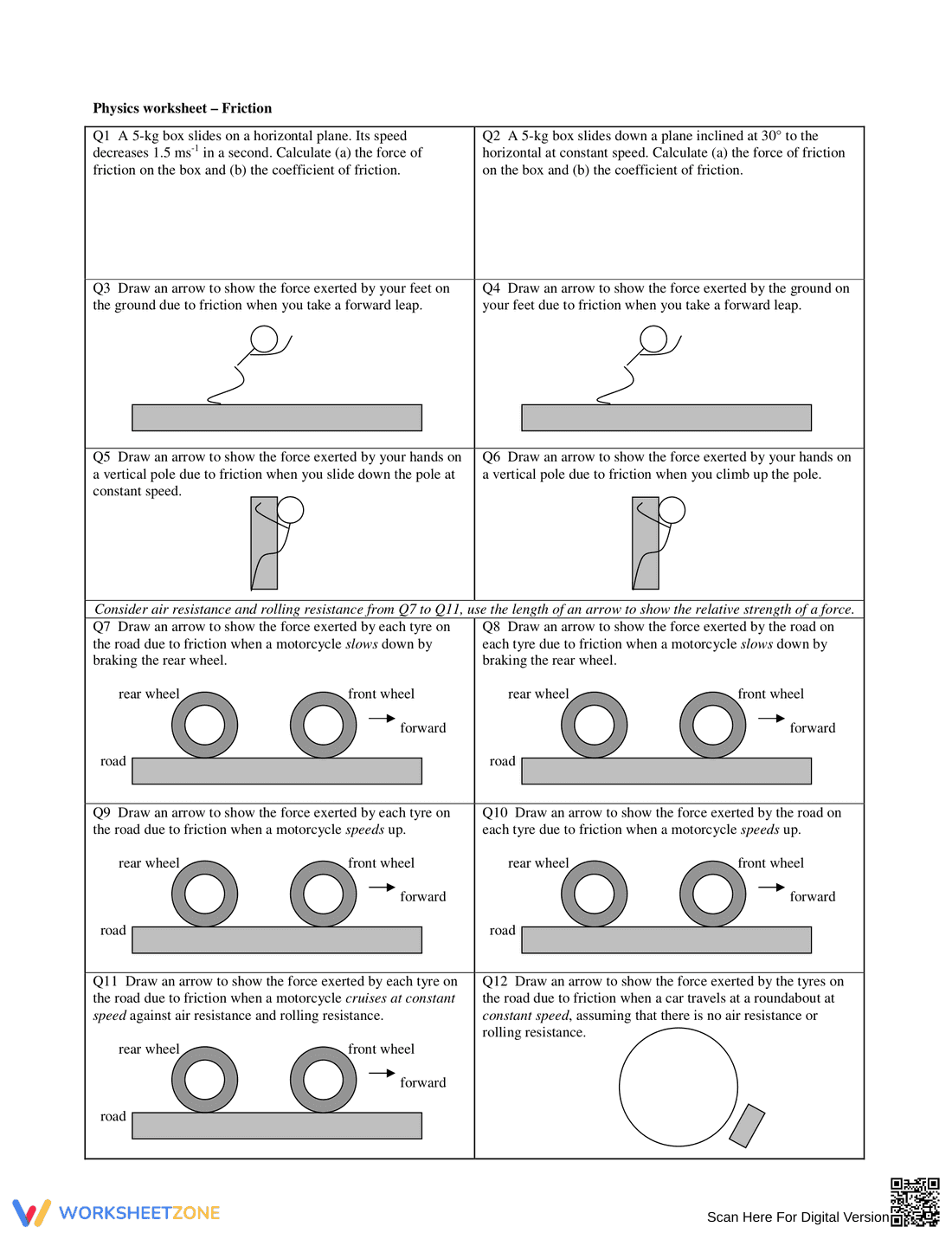
This is a physics worksheet focusing on the concept of friction. It includes problems involving calculating the force of friction and the coefficient of friction for a box sliding on a horizontal plane and an inclined plane. Several questions require students to draw arrows representing the force exerted due to friction in various scenarios, such as a person taking a step, sliding down or climbing a pole, and motorcycle tires braking or accelerating.
Grade Level Suitability:
This worksheet is suitable for high school physics, specifically grades 11-12. The concepts of force, friction, and coefficient of friction are typically covered in these grades. The drawing of force vectors and the application of these concepts to real-world scenarios suggest a level of understanding appropriate for older students.
Why Use It:
This worksheet helps students understand and apply the concept of friction in different contexts. It reinforces the understanding of force vectors and their application in real-world scenarios. It also provides practice in calculating the force of friction and the coefficient of friction.
How to Use It:
Students should read each problem carefully and apply their knowledge of friction to solve it. For calculation problems, they should use the appropriate formulas. For drawing problems, they should draw arrows representing the direction and magnitude of the force of friction. The worksheet can be used for in-class practice, homework, or as a review activity.
Target Users:
The target users are high school physics students learning about friction. It is also suitable for teachers looking for practice problems and activities to reinforce the concept of friction.
This is a physics worksheet focusing on the concept of friction. It includes problems involving calculating the force of friction and the coefficient of friction for a box sliding on a horizontal plane and an inclined plane. Several questions require students to draw arrows representing the force exerted due to friction in various scenarios, such as a person taking a step, sliding down or climbing a pole, and motorcycle tires braking or accelerating.
Grade Level Suitability:
This worksheet is suitable for high school physics, specifically grades 11-12. The concepts of force, friction, and coefficient of friction are typically covered in these grades. The drawing of force vectors and the application of these concepts to real-world scenarios suggest a level of understanding appropriate for older students.
Why Use It:
This worksheet helps students understand and apply the concept of friction in different contexts. It reinforces the understanding of force vectors and their application in real-world scenarios. It also provides practice in calculating the force of friction and the coefficient of friction.
How to Use It:
Students should read each problem carefully and apply their knowledge of friction to solve it. For calculation problems, they should use the appropriate formulas. For drawing problems, they should draw arrows representing the direction and magnitude of the force of friction. The worksheet can be used for in-class practice, homework, or as a review activity.
Target Users:
The target users are high school physics students learning about friction. It is also suitable for teachers looking for practice problems and activities to reinforce the concept of friction.


