


























Views
Downloads

Printable Physical Properties Worksheet | Grade 7
Paste this activity's link or code into your existing LMS (Google Classroom, Canvas, Teams, Schoology, Moodle, etc.).
Students can open and work on the activity right away, with no student login required.
You'll still be able to track student progress and results from your teacher account.
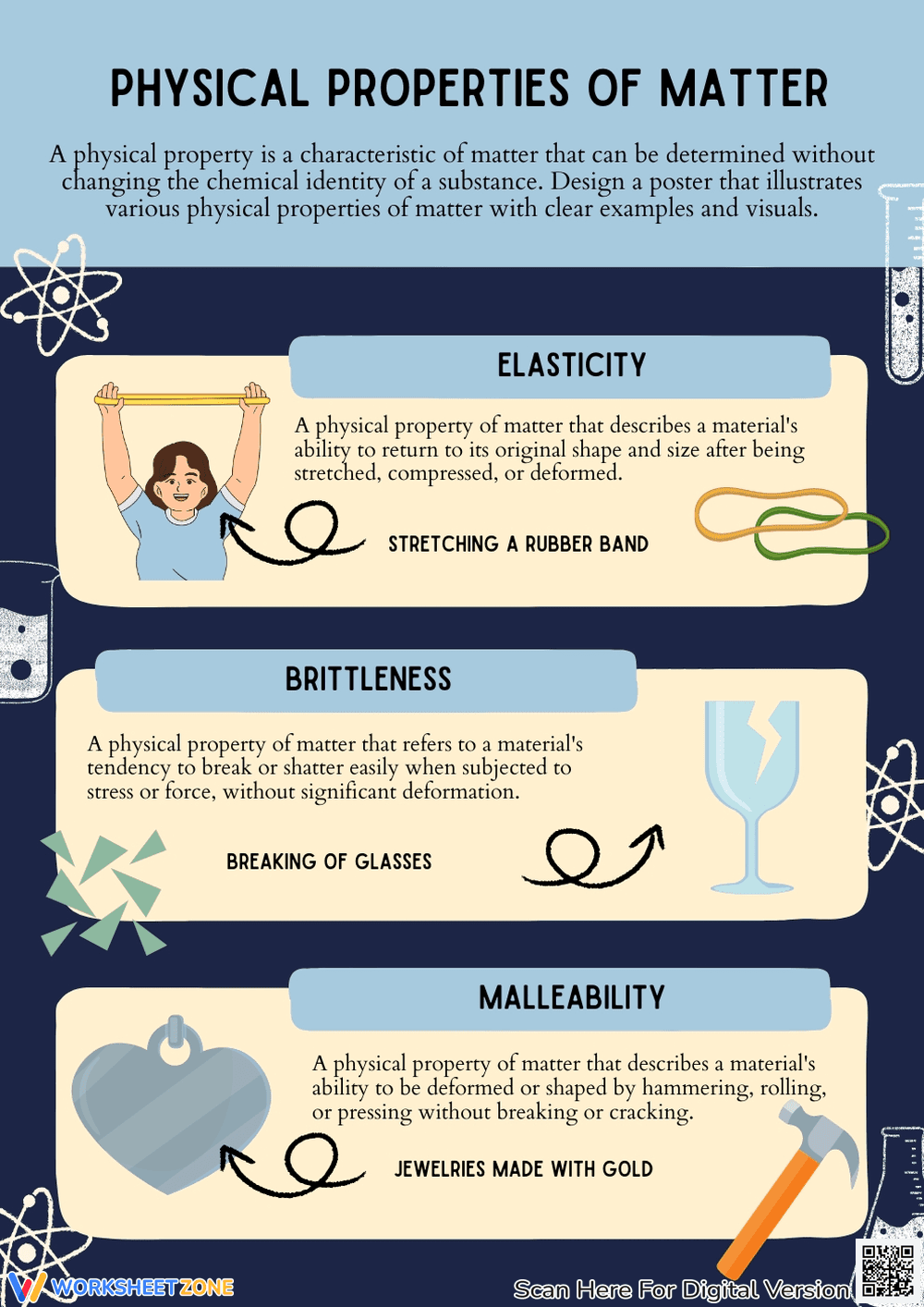
This Grade 7 physical science resource introduces students to the physical properties of matter, focusing on elasticity, brittleness, and malleability. Students review clear definitions and visual examples before completing a creative poster design task to demonstrate their understanding of how materials behave under various physical forces.
At a Glance
- Grade: 7 · Subject: Science
- Standard:
MS-PS1-2— Analyze properties of substances to identify materials- Skill Focus: Identifying physical properties
- Format: 1 page · 1 problem · No answer key · PDF
- Best For: Independent project or reference
- Time: 30–45 minutes
This single-page PDF serves as an instructional reference guide and project prompt. It features a visual layout defining physical properties with real-world examples of elasticity, brittleness, and malleability. The top includes an open-ended task requiring students to design a poster illustrating additional properties. No answer key is required.
This resource requires minimal preparation, making it an ideal zero-prep solution.
- Print (1 min): Download the PDF and print a class set.
- Distribute (1 min): Hand out the sheet with blank paper for the poster assignment.
- Review (2 mins): Read the definitions together and clarify expectations.
With under five minutes of total teacher prep time, this activity is perfect for emergency sub plans.
This resource aligns with NGSS, focusing on concepts needed for MS-PS1-2: Analyze and interpret data on the properties of substances. Understanding physical properties is a crucial prerequisite for distinguishing them from chemical properties. Both standard codes can be copied directly into lesson plans, IEP goals, or district curriculum mapping tools.
Use this resource during the initial phases of a matter unit. Introduce it before direct instruction as a hook, asking students to brainstorm materials sharing these traits. As a formative assessment observation tip, circulate while students design posters to ensure they accurately match physical properties with real-world examples. Expected completion time ranges from 30 to 45 minutes.
Designed for Grade 7 science students, this highly visual reference sheet provides excellent differentiation for English Language Learners who benefit from concrete examples like a stretched rubber band. It pairs naturally with hands-on laboratory stations where students physically test the malleability of aluminum foil.
Mastering the distinction between different material characteristics is a fundamental component of middle school physical science instruction. Aligned with MS-PS1-2, this resource helps students analyze properties of substances to identify materials through visual representation and creative application. According to EdReports 2024, science instructional materials that integrate visual models with vocabulary acquisition significantly improve student retention of abstract physical science concepts. By requiring students to synthesize definitions of elasticity, brittleness, and malleability into their own independent poster designs, this worksheet moves beyond rote memorization into active conceptual application. The combination of clear reference material and an open-ended design task ensures that learners can effectively anchor new vocabulary to familiar, real-world phenomena. This targeted approach not only reinforces the specific standard but also builds the essential scientific literacy required for more advanced chemistry and physics coursework in high school.


