


























Views
Downloads

Photosynthesis Review Worksheet | Grade 9-12 Printable
Paste this activity's link or code into your existing LMS (Google Classroom, Canvas, Teams, Schoology, Moodle, etc.).
Students can open and work on the activity right away, with no student login required.
You'll still be able to track student progress and results from your teacher account.
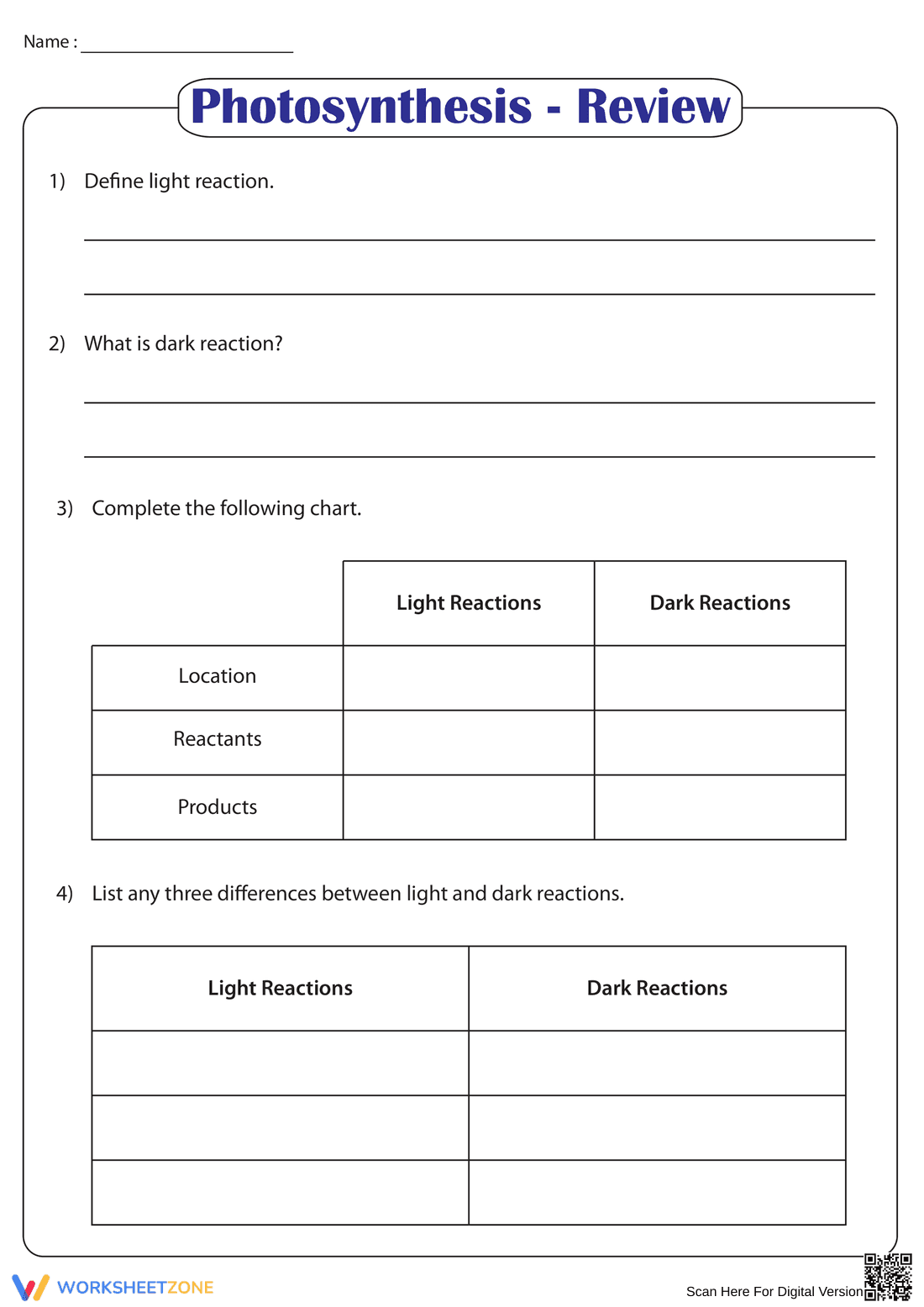
This high school biology worksheet provides a focused review of photosynthesis, specifically targeting the differences between light-dependent and light-independent (dark) reactions. Students will define key terms, identify locations and reactants, and compare the two stages to solidify their understanding of how plants convert light energy into chemical energy.
At a Glance
- Grade: 9-12 · Subject: Biology
- Standard:
HS-LS1-5— Illustrate how photosynthesis transforms light energy into stored chemical energy.- Skill Focus: Comparing light and dark reactions
- Format: 2 pages · 4 problems · Answer key included · PDF
- Best For: End-of-unit review or sub plan
- Time: 15–20 minutes
Inside this resource, educators will find a streamlined, one-page student worksheet featuring four distinct review tasks. The activities include writing definitions for light and dark reactions, completing a comparison chart detailing locations, reactants, and products, and listing three major differences between the phases. A complete answer key is provided on the second page to ensure efficient grading.
Designed for maximum efficiency, this resource follows a simple zero-prep workflow. First, print the single-page student handout (under 1 minute). Next, distribute the copies to your class as a warm-up or review activity (1 minute). Finally, review the answers together using the provided key (5 minutes). The total teacher preparation time is under two minutes, making this an ideal option for busy days or substitute teacher plans.
This worksheet is aligned to the Next Generation Science Standards, specifically focusing on HS-LS1-5: Use a model to illustrate how photosynthesis transforms light energy into stored chemical energy. By breaking down the specific inputs and outputs of the thylakoid and stroma reactions, students build the foundational knowledge required to master this standard. Both standard codes can be copied directly into lesson plans, IEP goals, or district curriculum mapping tools.
This review sheet is highly versatile. Use it as a formative assessment after direct instruction on the Calvin cycle and light-dependent reactions to gauge student comprehension before moving on to cellular respiration. Alternatively, assign it as focused homework or a quick bell-ringer. As an observation tip, check whether students correctly identify the stroma and thylakoid as the locations for each reaction, as this reveals their spatial understanding of chloroplast anatomy. Expected completion time is 15 to 20 minutes.
This resource is primarily designed for high school biology students in grades 9 through 12. It serves as an excellent tool for general education classrooms, but the structured chart format also provides helpful visual organization for students who benefit from clear, compartmentalized data entry. Pair this worksheet with a detailed diagram of a chloroplast or a hands-on modeling activity to reinforce the concepts visually and kinesthetically.
Mastering the specific mechanisms of energy transfer in plants is a critical component of high school life sciences. This resource directly supports HS-LS1-5 by requiring students to illustrate how photosynthesis transforms light energy into stored chemical energy through the detailed comparison of light and dark reactions. According to a ScienceDirect TpT Analysis, providing students with structured comparison charts significantly enhances their ability to retain complex biological processes and differentiate between interconnected cellular mechanisms. By isolating the reactants, products, and locations of these two distinct phases, educators can effectively reduce cognitive overload and promote deeper conceptual understanding. This targeted practice ensures that students are not just memorizing terms, but actively analyzing the flow of energy and matter within the chloroplast, laying a strong foundation for advanced biological studies.


