




























Views
Downloads
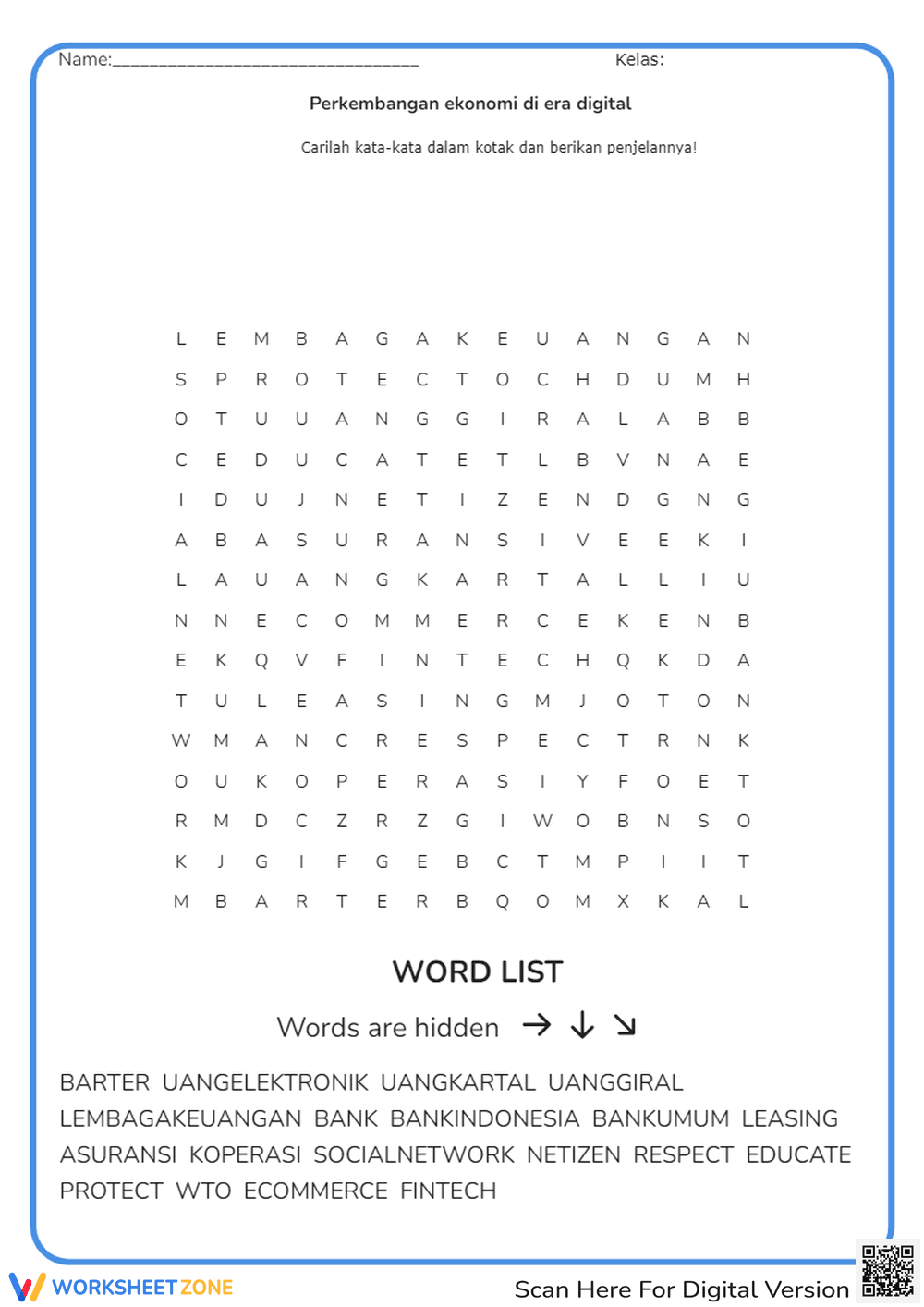

Digital Economy Vocabulary Worksheet | Grade 9 Essential

Paste this activity's link or code into your existing LMS (Google Classroom, Canvas, Teams, Schoology, Moodle, etc.).
Students can open and work on the activity right away, with no student login required.
You'll still be able to track student progress and results from your teacher account.
This Grade 9 economics worksheet helps students master key terminology related to the digital financial environment. By identifying and defining 20 essential terms, learners bridge the gap between traditional banking and modern fintech concepts. It provides a structured way to reinforce domain-specific vocabulary while encouraging critical thinking through written explanations of each discovered term.
At a Glance
- Grade: 9 · Subject: Economics
- Standard:
CCSS.ELA-LITERACY.L.9-10.6— Acquire and use accurately general academic and domain-specific words and phrases- Skill Focus: Digital Economy Vocabulary
- Format: 1 page · 20 problems · Answer key not included · PDF
- Best For: Vocabulary reinforcement and introductory lessons
- Time: 25–35 minutes
The worksheet features a comprehensive word search grid containing 20 high-frequency economic terms, ranging from "Barter" to "Fintech." Below the grid, a word list provides the targets for the search. The layout includes a dedicated space for students to write out definitions, transforming a simple search activity into a rigorous academic exercise. This single-page PDF is designed for immediate use without additional teacher preparation.
Zero-Prep Workflow
- Print: Generate the required number of copies for your class in under one minute.
- Distribute: Hand out the sheets as a bell-ringer or warm-up activity to settle the class quickly.
- Review: Spend ten minutes at the end of the session discussing the definitions to ensure conceptual clarity.
Its self-contained nature makes it an ideal choice for emergency sub plans or quiet independent work sessions during testing blocks.
Standards Alignment
This resource aligns with `CCSS.ELA-LITERACY.L.9-10.6`, which requires students to acquire and use accurately general academic and domain-specific words and phrases. By requiring students to not only find but also explain terms like "Ecommerce" and "Lembaga Keuangan," the worksheet ensures students can demonstrate mastery of technical language. This standard code can be copied directly into lesson plans, IEP goals, or district curriculum mapping tools.
How to Use It
Use this worksheet during the introductory phase of a unit on modern financial systems. It serves as an excellent formative assessment tool; as students work, circulate to observe which terms (such as "Uang Giral" or "Leasing") require further direct instruction. Expected completion time is approximately 30 minutes, making it a perfect fit for the middle of a standard class period.
Who It's For
This activity is designed for Grade 9 Social Studies or Economics students, including English Language Learners who benefit from the visual support of a word search. It pairs naturally with an introductory lecture on the evolution of money or a digital presentation on the role of central banks in the modern era.
According to the RAND AIRS 2024 report, the integration of domain-specific vocabulary through active retrieval practices significantly improves long-term retention in secondary social studies. This worksheet utilizes the CCSS.ELA-LITERACY.L.9-10.6 standard to facilitate this retrieval, requiring students to identify 20 distinct economic terms and provide context-rich explanations. Research by Fisher & Frey (2014) emphasizes that word-solving strategies, when combined with writing tasks, help students internalize complex concepts like "Fintech" and "Ecommerce" more effectively than rote memorization. By engaging in this dual-task activity, Grade 9 students develop the linguistic precision necessary for high school academic success. This resource provides a structured pathway for students to demonstrate their understanding of the digital economy, ensuring they are prepared for more advanced economic analysis and real-world financial literacy challenges.


