


























Views
Downloads

Periodic Table Worksheet | Essential Grade 8 Science
Paste this activity's link or code into your existing LMS (Google Classroom, Canvas, Teams, Schoology, Moodle, etc.).
Students can open and work on the activity right away, with no student login required.
You'll still be able to track student progress and results from your teacher account.
This periodic table classification review worksheet strengthens Grade 8 science students' ability to categorize chemical elements by their properties. Learners examine groups, periods, metals, nonmetals, and metalloids across 25 focused questions. By completing these prompts, students build foundational physical science literacy needed to analyze atomic structures and periodic trends.
At a Glance
- Grade: 8 · Subject: Science
- Standard:
MS-PS1-1— Classify elements by observable properties to understand atomic structure and organization- Skill Focus: Periodic table classification, metal and nonmetal groups, and period identification
- Format: 3 student pages · 25 total problems · Full answer key included · Printable PDF
- Best For: Mid-unit chemistry review and formative skills assessment
- Time: 30–45 minutes
What's Inside
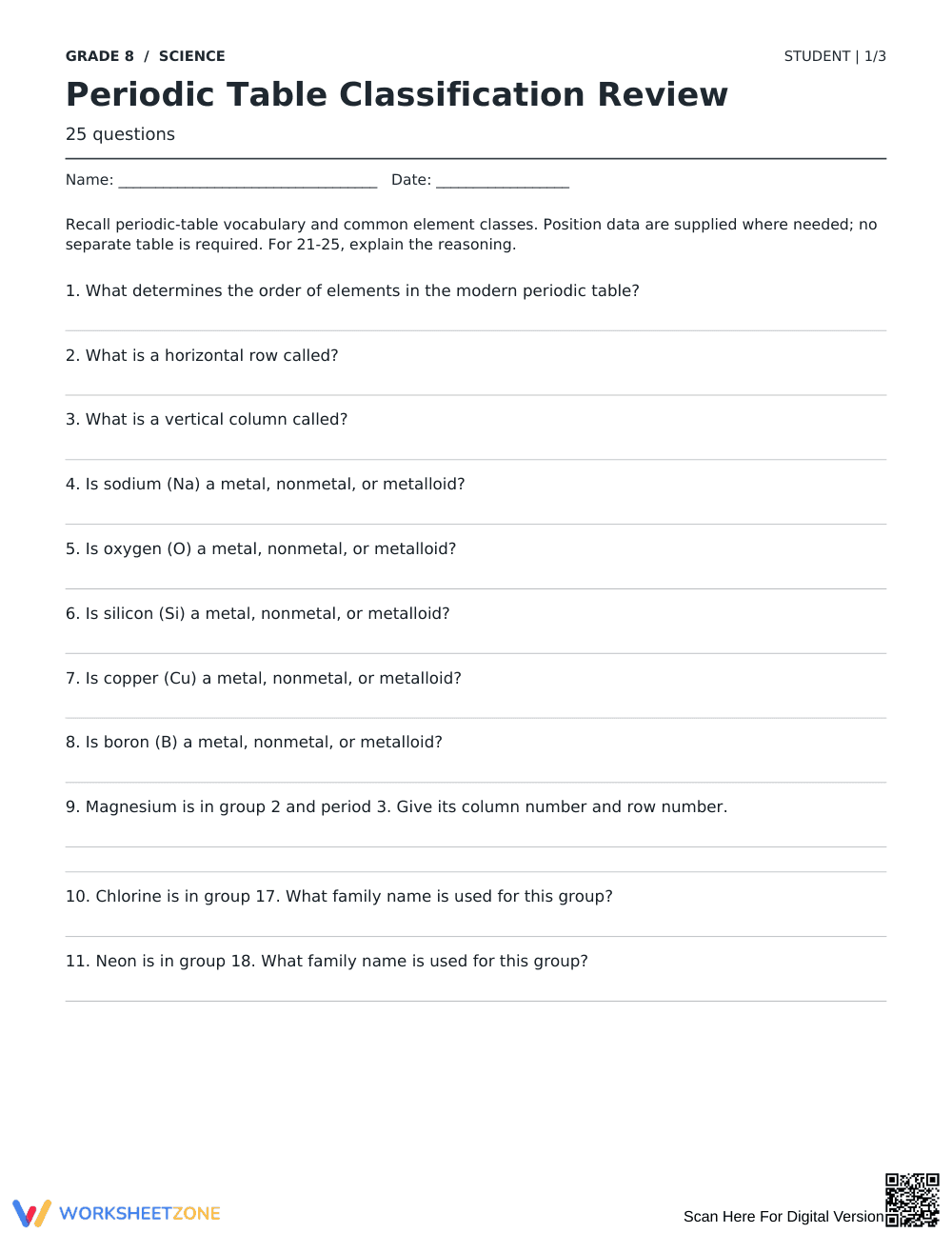
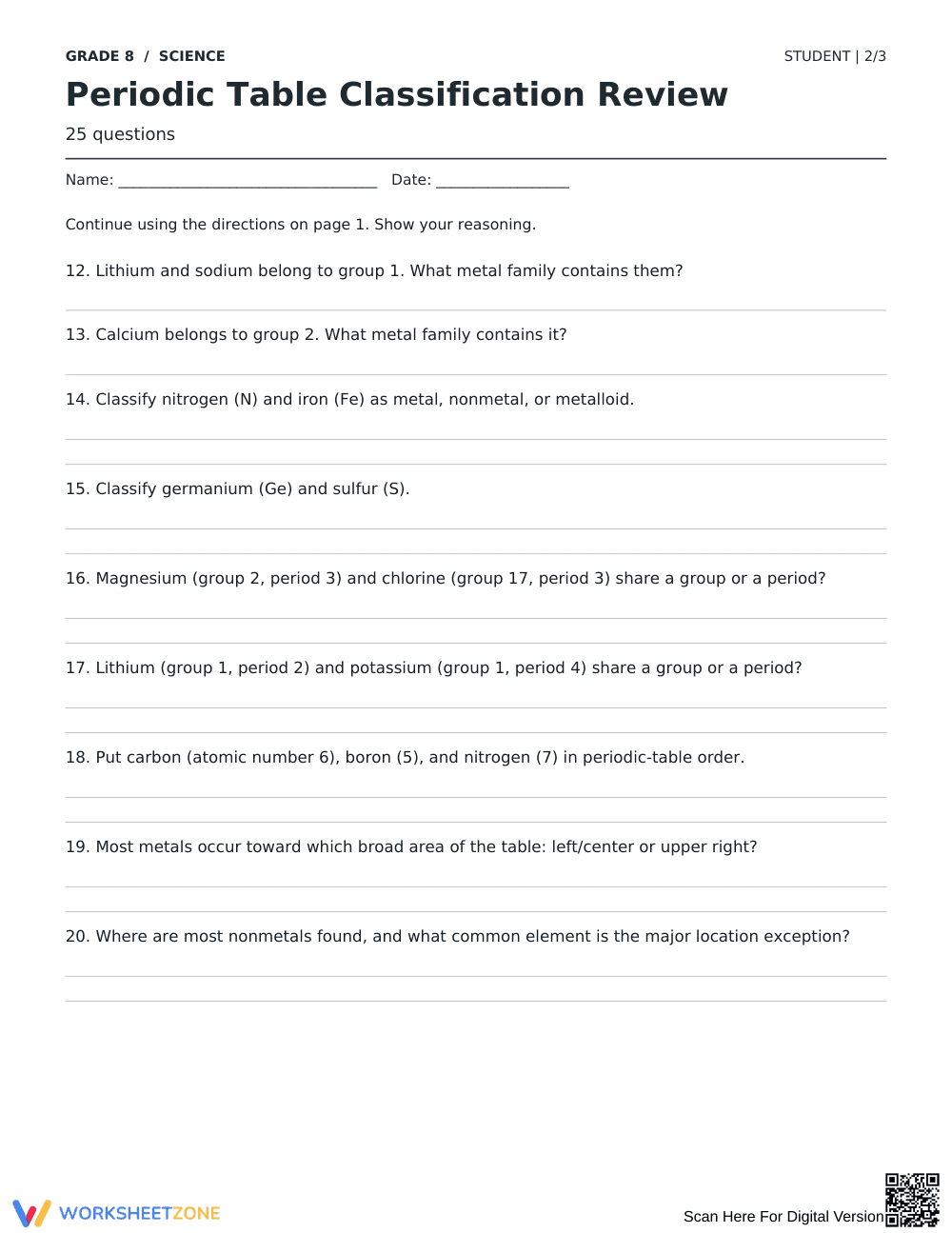
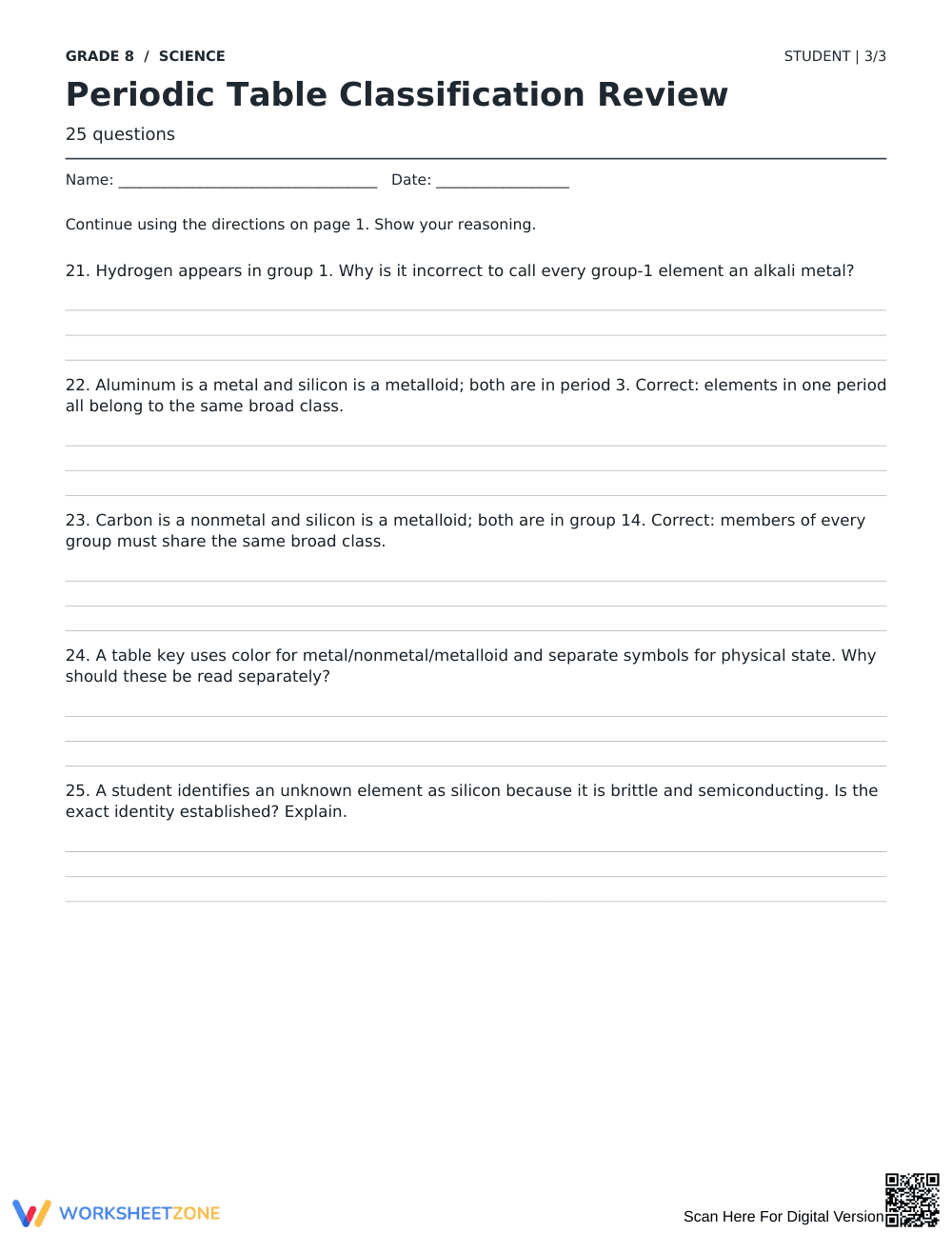
This 3-page printable science resource contains 25 open-response questions with structured writing lines. Position coordinates like atomic numbers, groups, and periods are integrated into the prompts so students do not need an external reference sheet. A complete 2-page answer key provides solutions, reasoning, and a 2-point grading guide.
Skill Progression
- Guided practice (Questions 1–8): Direct recall questions define periods and groups while classifying sodium, silicon, and oxygen into broad element classes.
- Supported practice (Questions 9–20): Applied prompts guide students through coordinate navigation, chemical families like halogens, and atomic number ordering.
- Independent practice (Questions 21–25): Higher-order analysis challenges learners to explain hydrogen exceptions, evaluate period consistency, and justify chemical identification limits.
This structured progression reflects an I Do, We Do, You Do gradual-release model, securing fundamentals before requiring written reasoning.
Standards Alignment
The primary standard addressed is `MS-PS1-1`, requiring students to model the atomic composition of simple molecules and extended structures through element patterns. Supporting standard `MS-PS1-2` focuses on analyzing property changes in substances. Both standard codes can be copied directly into lesson plans, IEP goals, or district curriculum mapping tools.
How to Use It
Administer this worksheet after direct instruction on table architecture as a 30- to 45-minute independent review. Alternatively, assign single pages across rotating lab stations. While circulating, check whether students confuse period rows with group columns in Questions 9 and 16 to target misconceptions promptly.
Who It's For
This resource supports Grade 8 science classes, physical science units, and introductory chemistry review. Differentiate by highlighting coordinate cues for struggling learners or requiring electron shells for advanced students. Pair this worksheet directly with a classroom periodic table anchor chart.
Mastering element taxonomy under NGSS standard MS-PS1-1 requires students to classify chemical elements by properties, coordinate positions, and family behaviors before modeling molecular interactions. Research highlighted in Fisher & Frey (2014) demonstrates that structured gradual-release frameworks significantly enhance student retention of complex domain-specific vocabulary and spatial scientific concepts. By shifting learners from basic element recall to analytical justification across 25 targeted questions, this worksheet provides the cognitive scaffolding necessary for durable scientific understanding. Middle school science students must routinely reconcile periodic table patterns, distinguish periods from groups, and evaluate classification boundaries to succeed in subsequent chemical reaction coursework. Educational data confirm that explicit practice with organizational systems in physical science builds academic vocabulary while directly preventing persistent misconceptions regarding atomic relationships. Consequently, systematic classification review directly reinforces core disciplinary ideas while supporting measurable standards mastery across middle school science learning environments.


