


























Views
Downloads


Printable Perimeter Worksheet | Grade 3 Math Guide
Paste this activity's link or code into your existing LMS (Google Classroom, Canvas, Teams, Schoology, Moodle, etc.).
Students can open and work on the activity right away, with no student login required.
You'll still be able to track student progress and results from your teacher account.
Mastering Measurement with a Focus on Perimeter
This worksheet offers targeted practice for Grade 3 students in calculating the perimeter of various polygons. It guides students from basic shapes to more complex figures and word problems, fostering a strong understanding of how to measure and combine side lengths. The activities reinforce procedural fluency and conceptual understanding in a clear, structured format, building student confidence.
At a Glance
- Grade: 3 · Subject: Math
- Standard:
CCSS.MATH.CONTENT.3.MD.D.8— Solve real world and mathematical problems involving perimeters of polygons.- Skill Focus: Calculating Perimeter
- Format: 5 pages · 22 problems · Answer key included · PDF
- Best For: Independent practice, homework, or formative assessment
- Time: 25–40 minutes
What's Inside
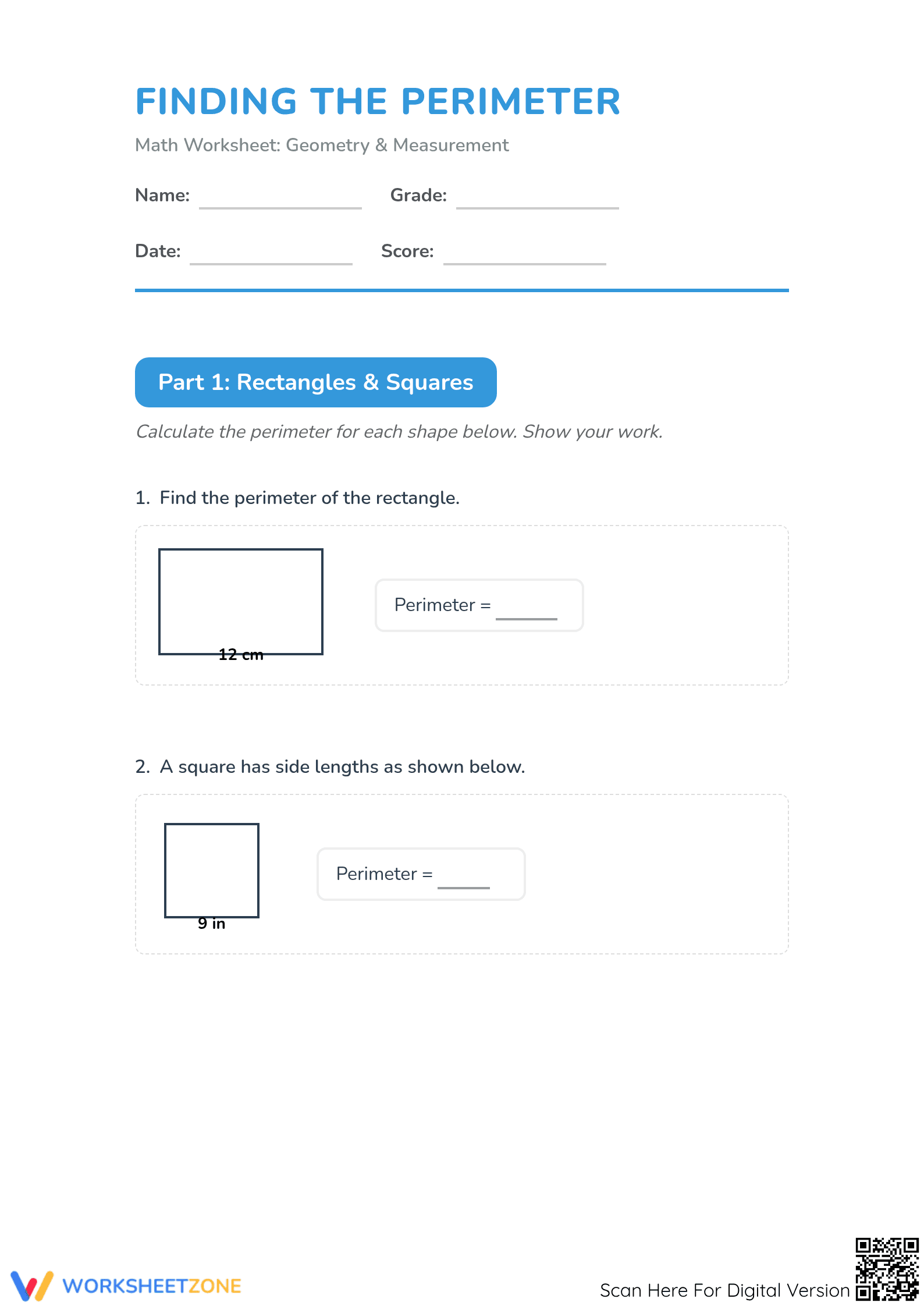
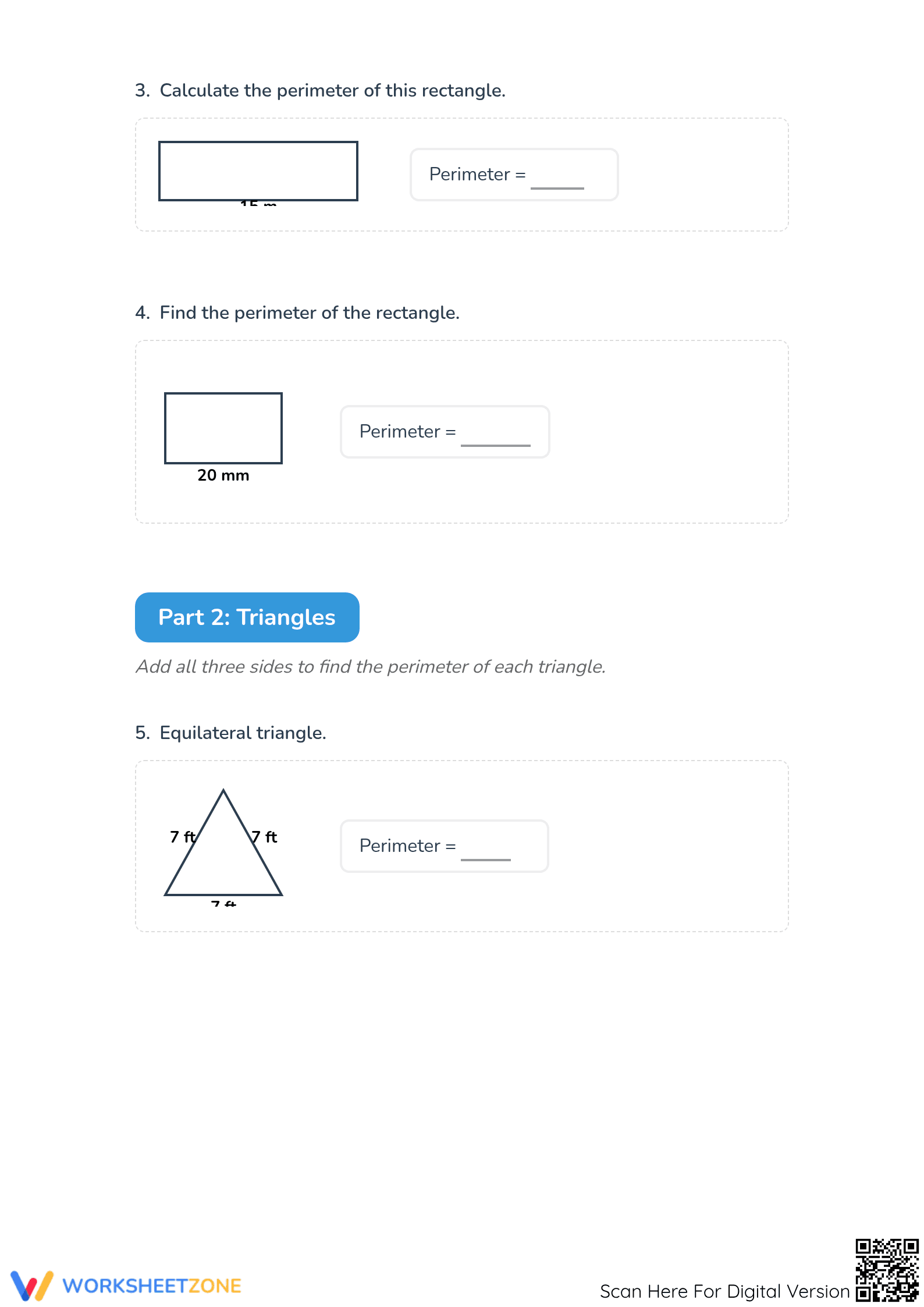
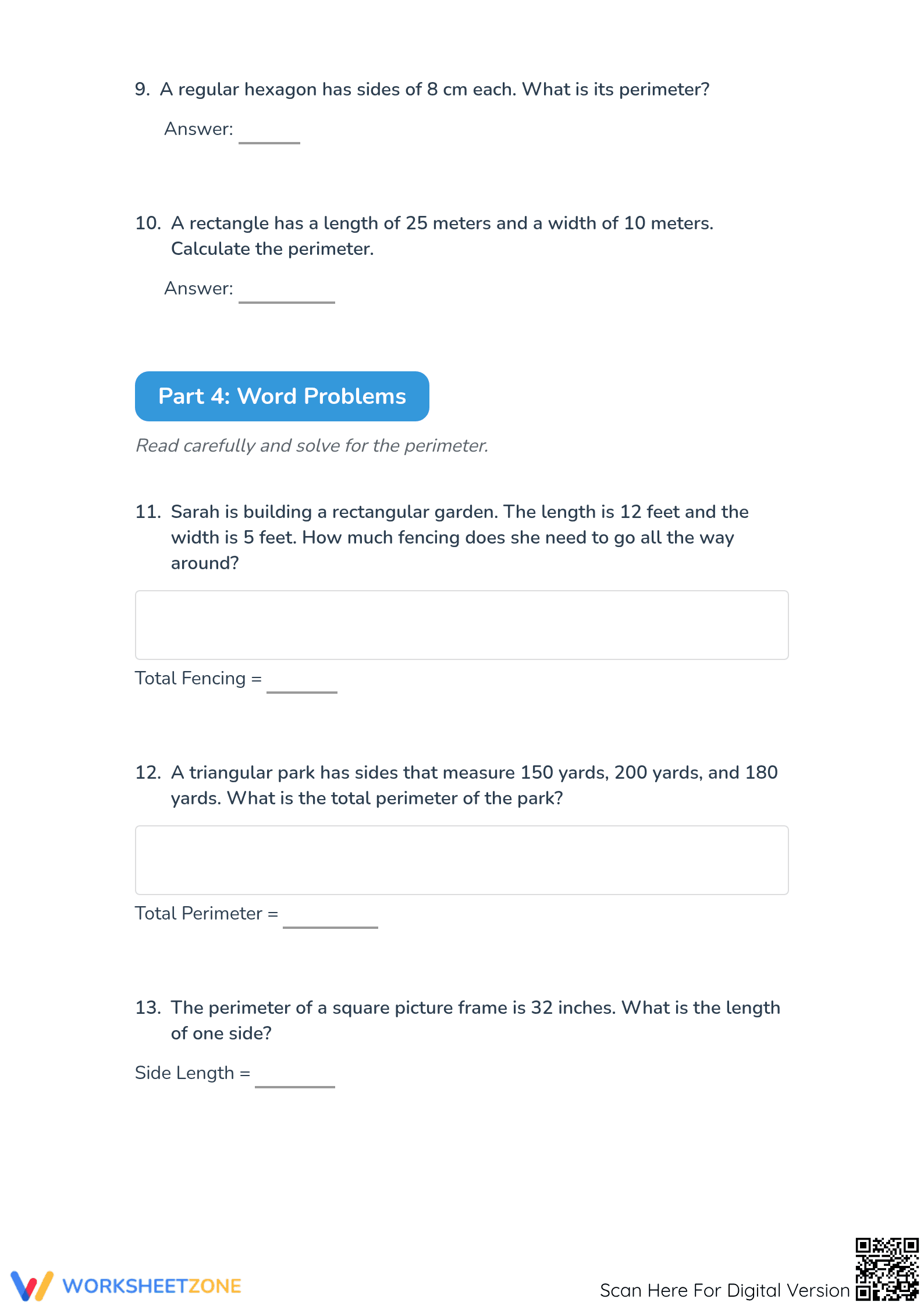
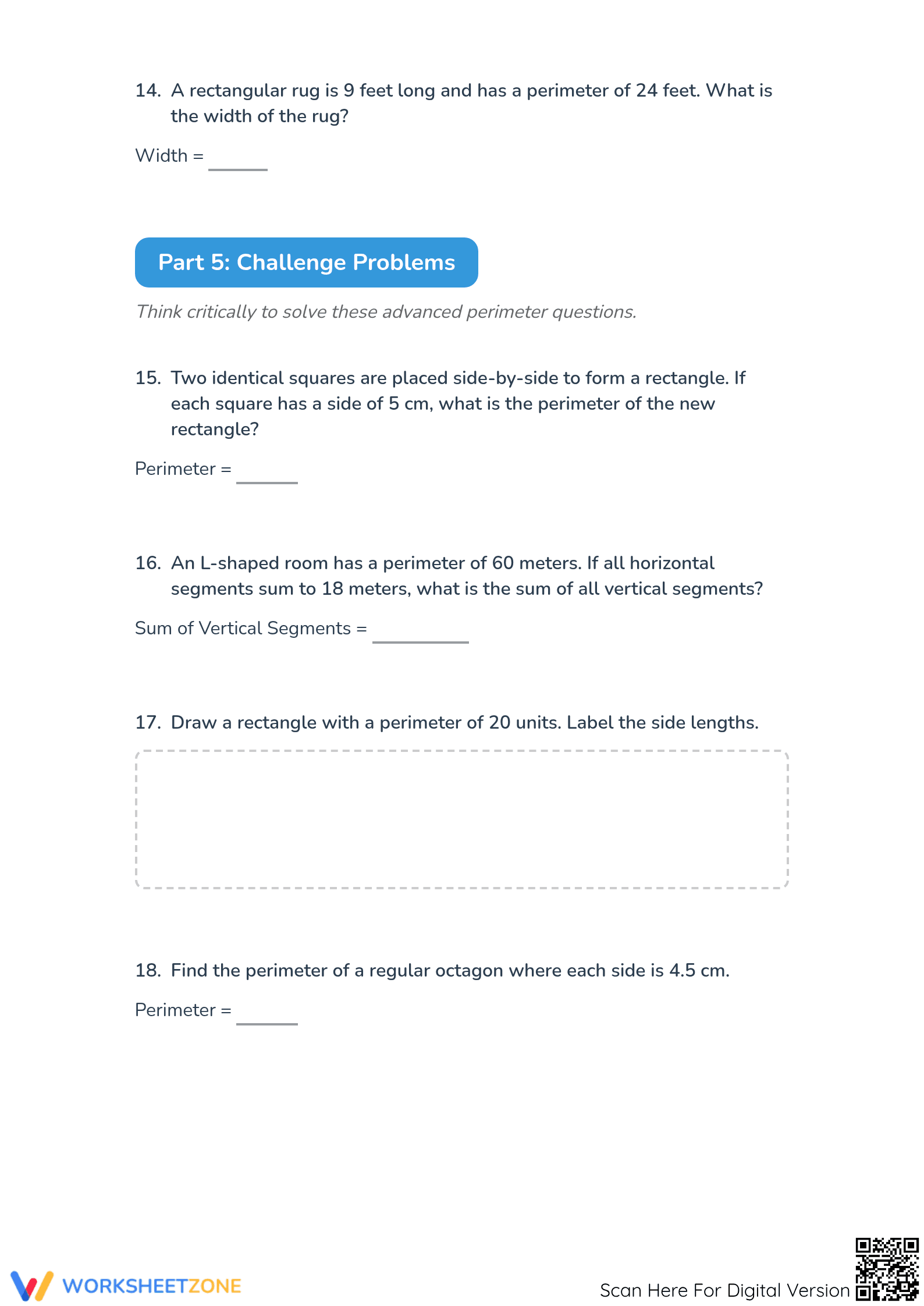
This five-page resource offers varied tasks to build perimeter calculation proficiency. Pages one to three contain 20 problems for shapes with labeled side lengths. Page four presents a multi-step word problem and a creative task to draw shapes with a specific perimeter. A short quiz on the final page assesses mastery, and a complete page-by-page answer key is included for efficient review.
Skill Progression
Designed with a gradual-release model, this worksheet supports student learning from introduction to independence, with problems carefully sequenced to build confidence. Guided Practice: The first page focuses on simple polygons like squares and rectangles, serving as a warm-up and review of core perimeter concepts. Supported Practice: Subsequent pages introduce irregular and composite shapes, requiring students to add up all side lengths. Clear diagrams provide support for applying the perimeter formula to more complex figures. Independent Practice: Final activities, including the word problem and quiz, challenge students to apply their knowledge independently, offering a reliable measure of mastery.
Standards Alignment
This resource aligns directly with Common Core State Standard CCSS.MATH.CONTENT.3.MD.D.8 for Grade 3 Measurement and Data. This standard requires solving real-world and mathematical problems involving polygon perimeters, covering finding perimeter from side lengths, unknown side lengths, and exhibiting rectangles with specific area/perimeter relations. This worksheet specifically targets finding perimeter given side lengths, and the standard code can be easily integrated into lesson plans.
How to Use It
This versatile worksheet suits various instructional settings. Assign it for independent practice after a direct instruction lesson to solidify perimeter skills, or as a homework assignment for reinforcement. For formative assessment, have students complete the final quiz individually; observing their process yields insight into their understanding and helps identify any misconceptions about adding side lengths.
Who It's For
Designed for third-grade students first learning perimeter, this worksheet also serves as an excellent review tool for fourth and fifth graders. Its clean layout and clear tasks ensure accessibility for all learners, including those in inclusion settings. It complements hands-on activities, connecting abstract perimeter concepts to physical experiences.
This resource delivers focused, standards-based practice on a critical measurement skill. Aligned with Fisher & Frey (2014) on structured progression, its design moves students from guided to independent work. Solving 22 problems aligned to CCSS.MATH.CONTENT.3.MD.D.8 builds the foundational ability to find polygon perimeters, crucial for future geometric reasoning. The worksheet's structure, with varied problem types and a final assessment, fosters both procedural fluency and conceptual understanding, preparing students for advanced measurement and geometry challenges.


