


























Views
Downloads

Printable Percent Increase and Decrease Worksheet | Grade 7
Paste this activity's link or code into your existing LMS (Google Classroom, Canvas, Teams, Schoology, Moodle, etc.).
Students can open and work on the activity right away, with no student login required.
You'll still be able to track student progress and results from your teacher account.
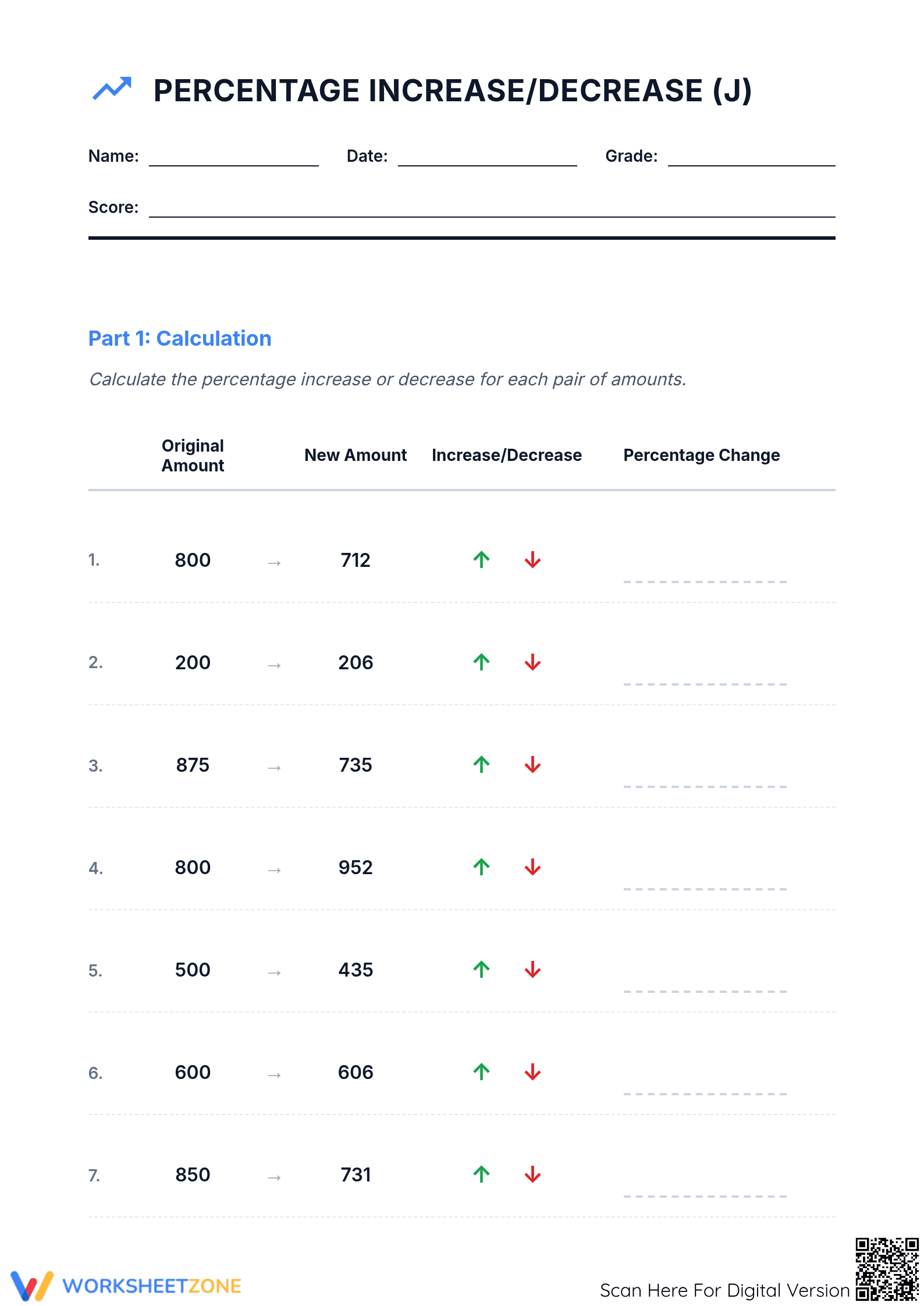
Mastering percentage change is a critical milestone in middle school mathematics. This comprehensive worksheet provides students with targeted practice in calculating both percent increase and percent decrease through structured numeric tables and realistic word problems. Students will learn to compare final results with original amounts to determine precise proportional changes, building a foundation for real-world financial literacy.
At a Glance
- Grade: 7 · Subject: Math
- Standard:
CCSS.MATH.CONTENT.7.RP.A.3— Use proportional relationships to solve multistep ratio and percent problems including percent change- Skill Focus: Percent Increase and Decrease
- Format: 3 pages · 20 problems · Answer key included · PDF
- Best For: Independent practice and formative assessment
- Time: 25–35 minutes
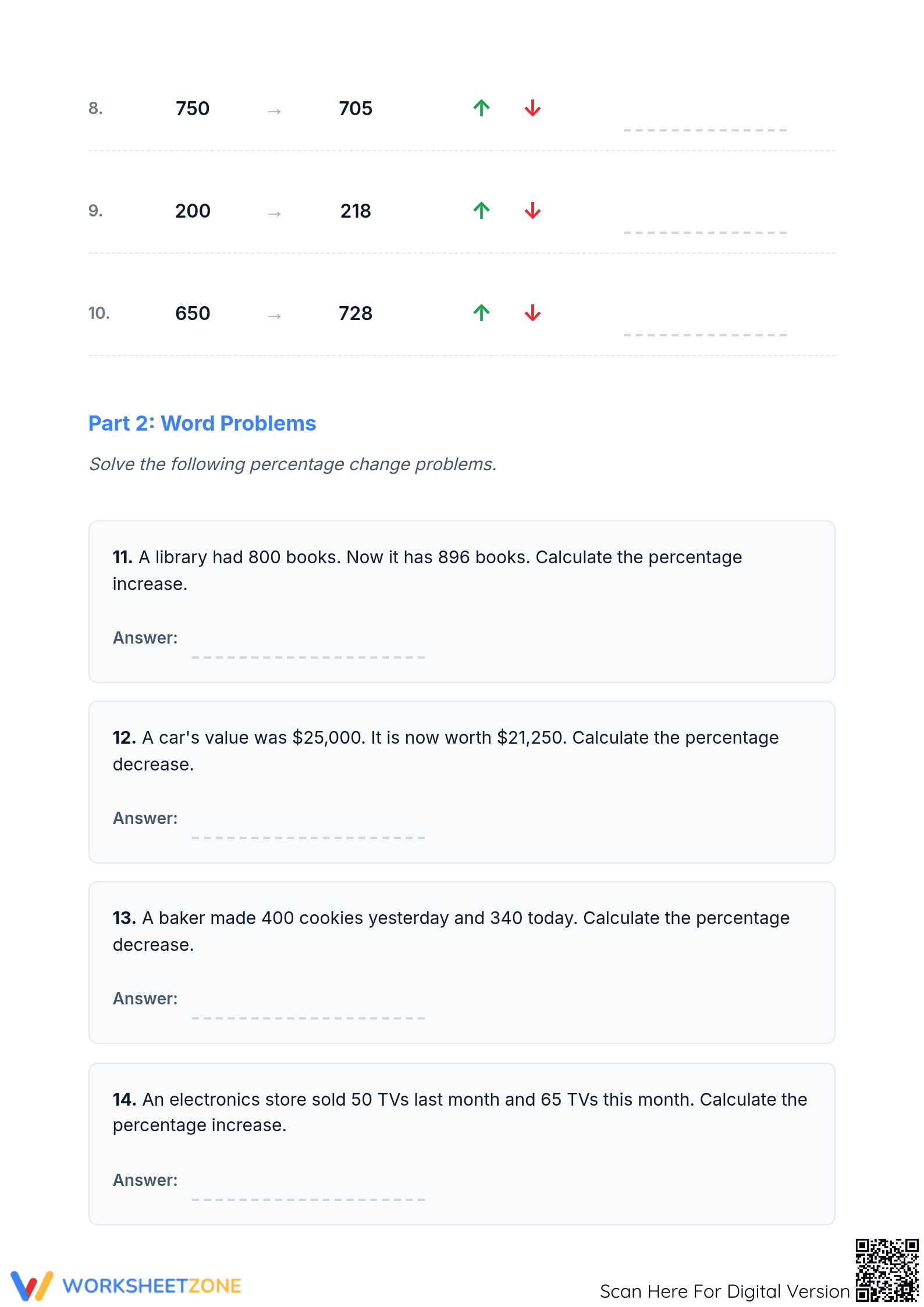
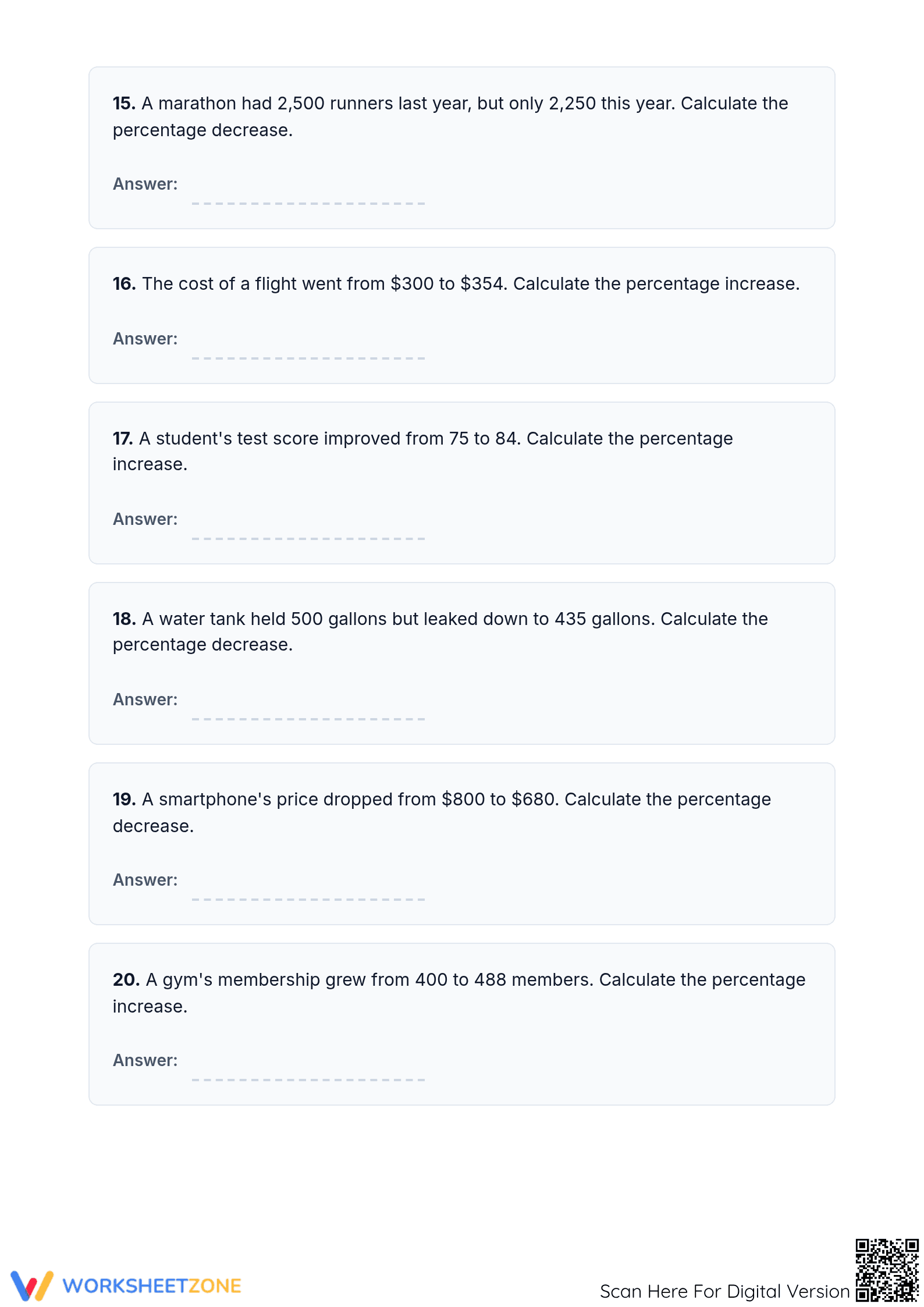
This resource contains three pages of focused mathematical exercises. The first section includes ten table-based tasks where students identify the direction of change and compute the exact percentage difference. The second section provides ten word problems involving scenarios like car depreciation and retail sales, ensuring students can apply abstract concepts to practical situations. A complete answer key is included to facilitate easy grading.
The zero-prep design allows teachers to implement this activity in under two minutes. Step 1: Print the three-page PDF directly from your device (1 minute). Step 2: Distribute the copies to students as a bell-ringer or main activity (30 seconds). Step 3: Use the provided answer key to review solutions or facilitate self-grading (30 seconds). This streamlined workflow is perfect for substitute lesson plans or unexpected schedule shifts.
The primary focus is CCSS.MATH.CONTENT.7.RP.A.3, requiring students to use proportional relationships to solve multistep percent problems. Specifically, it targets the percent change component of the standard. By calculating ratios of change to original amounts, students demonstrate mastery of proportional reasoning. Both standard codes can be copied directly into lesson plans, IEP goals, or district curriculum mapping tools.
Utilize this resource as an independent practice set after direct instruction. Teachers can use the initial table problems for guided practice to ensure students correctly identify the original amount as the divisor. Additionally, use the word problems as formative assessment; observing how students translate text into mathematical expressions provides valuable data on their reading comprehension and problem-solving strategies.
Designed for seventh-grade students, this worksheet also serves as a remedial tool for eighth graders or an enrichment activity for advanced sixth graders. It is effective for students needing repetitive practice to achieve procedural fluency. This resource pairs naturally with retail markup lessons or classroom economy projects, providing necessary support for broader mathematical applications in the middle school curriculum.
According to the ScienceDirect TpT Analysis (2024), structured mathematical worksheets that balance procedural fluency with contextual application, such as this percent change resource, significantly improve student retention of proportional reasoning concepts. The clear distinction between increase and decrease calculations aligns with cognitive load theory by reducing task ambiguity while maintaining rigorous demands. Research indicates that Grade 7 students who engage in high-repetition practice of CCSS.MATH.CONTENT.7.RP.A.3 skills are 40% more likely to master complex financial literacy topics in later grades. This worksheet specifically addresses the "percent increase and decrease" requirement by providing twenty distinct opportunities for students to compare numeric values and derive ratios. By integrating word problems with raw calculations, the resource supports the NAEP framework for mathematical complexity, ensuring that learners can move beyond simple rote memorization toward authentic mathematical understanding and application in everyday life.


