


























Views
Downloads

Essential Percent Increase and Decrease Worksheet | Grade 7
Paste this activity's link or code into your existing LMS (Google Classroom, Canvas, Teams, Schoology, Moodle, etc.).
Students can open and work on the activity right away, with no student login required.
You'll still be able to track student progress and results from your teacher account.
This comprehensive Grade 7 math worksheet empowers students to master the calculation of percent increase and decrease. By comparing original and new amounts across various contexts, learners develop a deep understanding of proportional relationships and real-world percentage changes. This resource ensures students can confidently determine if a value has grown or shrunk and by what specific percentage.
At a Glance
- Grade: 7 · Subject: Mathematics · Topic: Percent Change
- Standard:
7.RP.A.3— Use proportional relationships to solve multistep ratio and percent problems including percent increase and decrease calculations.- Skill Focus: Percent Increase and Decrease Percentage Change
- Format: 3 pages · 20 problems · Full answer key included · High-quality PDF
- Best For: Independent practice, homework, and formative assessment
- Time: 30–45 minutes
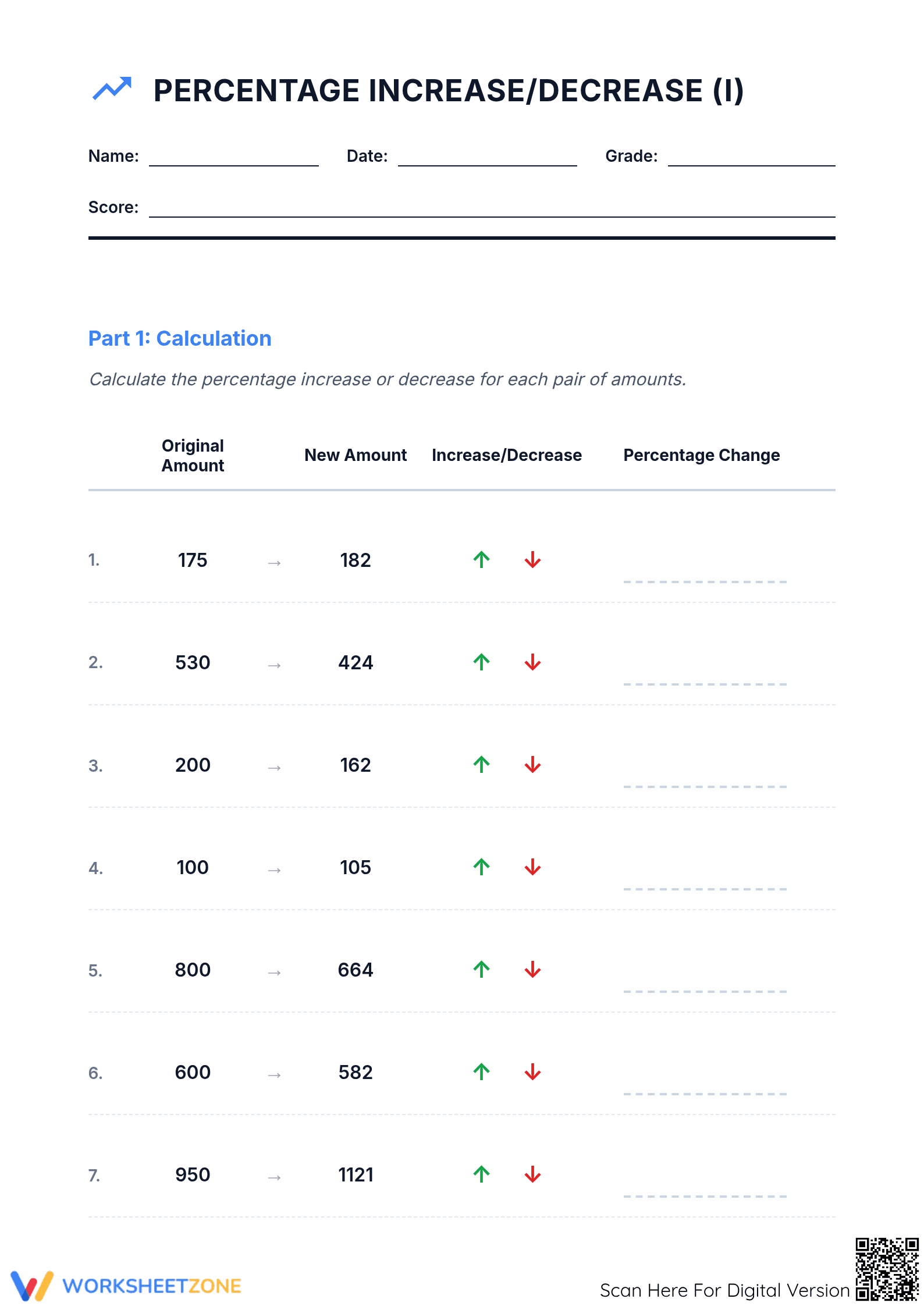
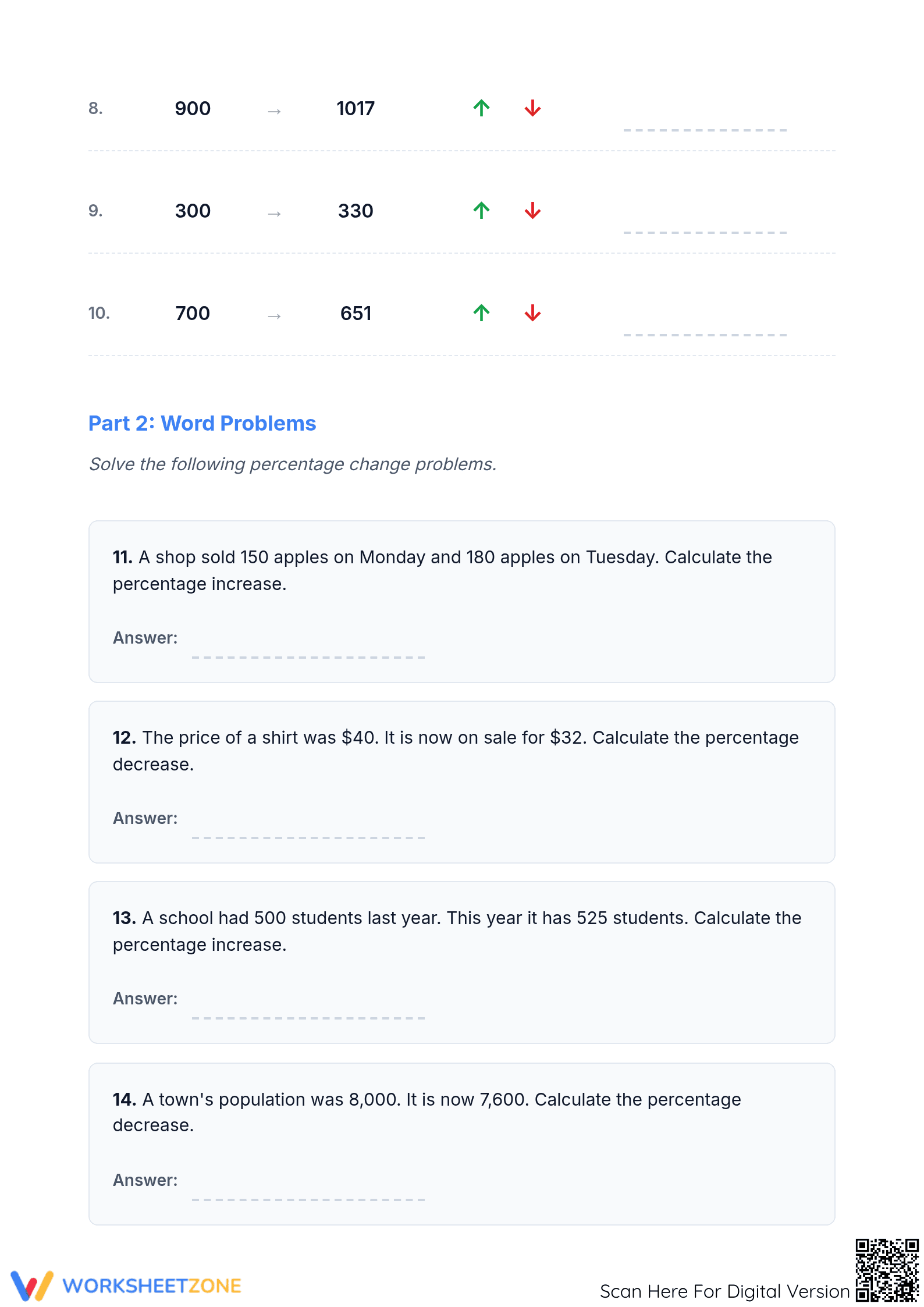
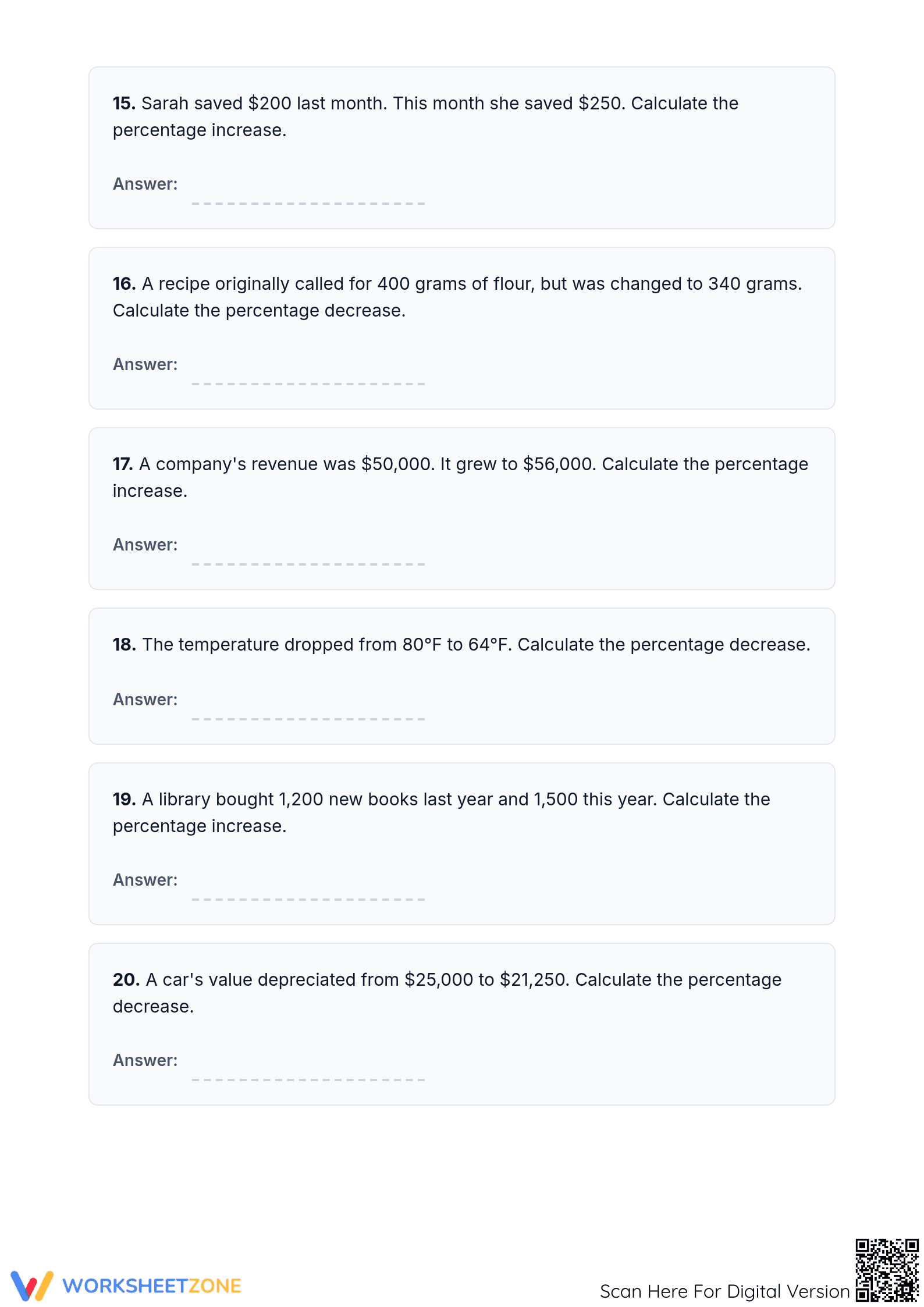
This three-page PDF resource contains twenty targeted problems divided into two logical sections. The first page presents ten calculation-based tasks where students analyze pairs of numerical amounts to identify the direction of change and compute the percentage. The subsequent two pages feature ten word problems that place these calculations into relatable real-world scenarios, such as sales, population changes, and financial growth. A full answer key is provided for rapid grading.
The worksheet follows a structured path to mastery:
- Guided calculation: The first ten problems provide a clear table format, prompting students to first identify an increase or decrease before performing the calculation.
- Contextual application: Students transition to word problems where they must extract relevant data from short narratives to set up their proportions.
- Independent mastery: The final problems require students to apply their knowledge to complex scenarios, such as car depreciation and revenue growth, without visual scaffolding.
The primary alignment is `CCSS.MATH.CONTENT.7.RP.A.3`, which requires students to use proportional relationships to solve multistep ratio and percent problems. This specifically includes percent increase and decrease. By calculating the difference between values and dividing by the original amount, students demonstrate the procedural fluency required by this standard. Both standard codes can be copied directly into lesson plans, IEP goals, or district curriculum mapping tools.
This worksheet is ideal for the "You Do" phase of a gradual release lesson. Assign it as independent practice after a direct instruction session on the percentage change formula. Alternatively, use Part 2 as a formative assessment to check if students can transfer their calculation skills to word problems. During completion, observe if students correctly identify the original amount as the divisor, which is a common point of confusion.
This resource is designed for Grade 7 math students but is highly effective for Grade 8 review or Grade 6 extension. It supports diverse learners by starting with simple integers before moving to larger numbers and currency. It pairs naturally with a percent change anchor chart or a digital interactive lesson on proportional reasoning.
Research from Fisher & Frey (2014) highlights that mastery of proportional reasoning is a cornerstone of middle school mathematics and a critical gateway to high school algebra. This worksheet directly addresses this need by providing structured practice in calculating percent increase and decrease, as required by the 7.RP.A.3 standard. Students who regularly engage with varied problem sets develop the cognitive flexibility needed to apply mathematical concepts in real-world environments. According to NAEP data, students often struggle with identifying the "base" or original amount in percent change problems; this resource specifically scaffolds that identification to build conceptual accuracy. The inclusion of twenty distinct tasks ensures sufficient repetition for procedural fluency while maintaining engagement through diverse scenarios. This alignment with evidence-based instructional design makes it a reliable tool for classroom teachers aiming for measurable growth in student performance.


