


























Views
Downloads

Essential Percent Increase and Decrease Worksheet | Grade 7
Paste this activity's link or code into your existing LMS (Google Classroom, Canvas, Teams, Schoology, Moodle, etc.).
Students can open and work on the activity right away, with no student login required.
You'll still be able to track student progress and results from your teacher account.
Calculating percentage change is a vital middle school math skill for financial literacy. This Grade 7 worksheet provides comprehensive practice in determining both percent increase and percent decrease. Students will learn to compare original and new amounts to calculate precise percentage shifts, building a strong foundation for advanced algebraic reasoning and consumer math applications.
At a Glance
- Grade: 7 · Subject: Math
- Standard:
CCSS.MATH.CONTENT.7.RP.A.3— Use proportional relationships to solve multistep ratio and percent problems like increase and decrease- Skill Focus: Percent Increase and Decrease Calculation
- Format: 4 Printable pages · 20 Structured problems · Full answer key included · PDF
- Best For: Classroom practice, homework assignments, or formative assessment
- Time: 30–45 minutes
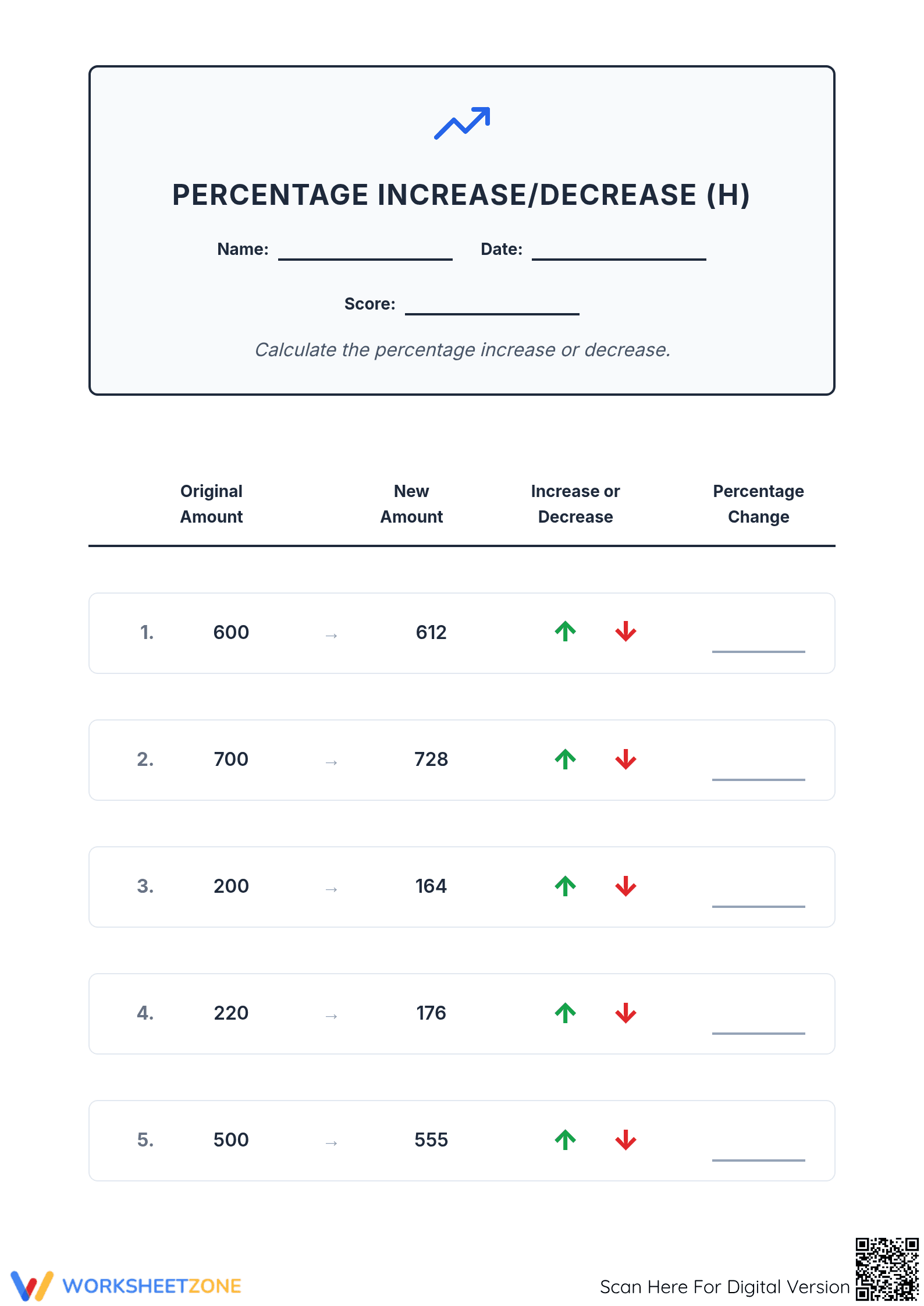
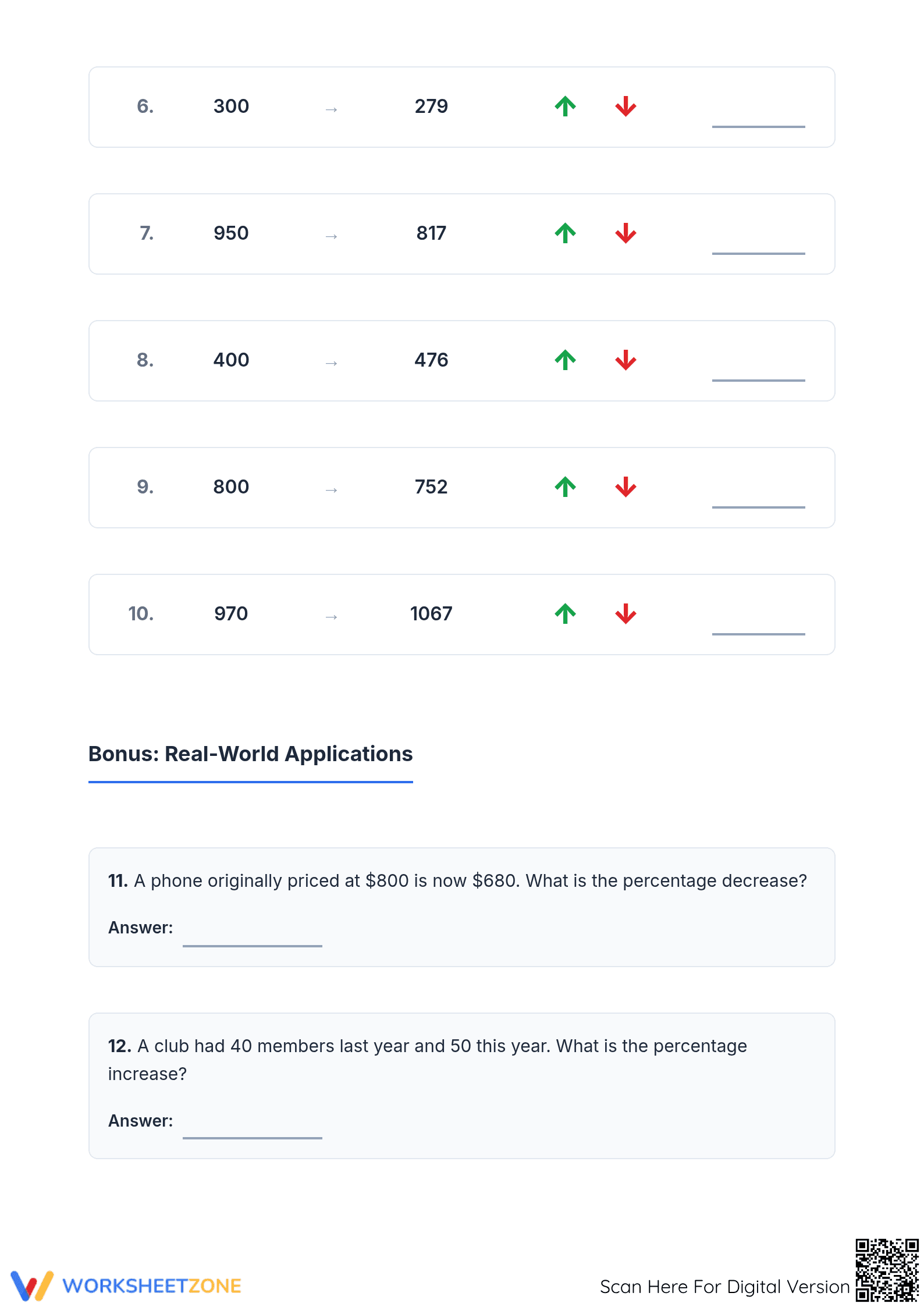
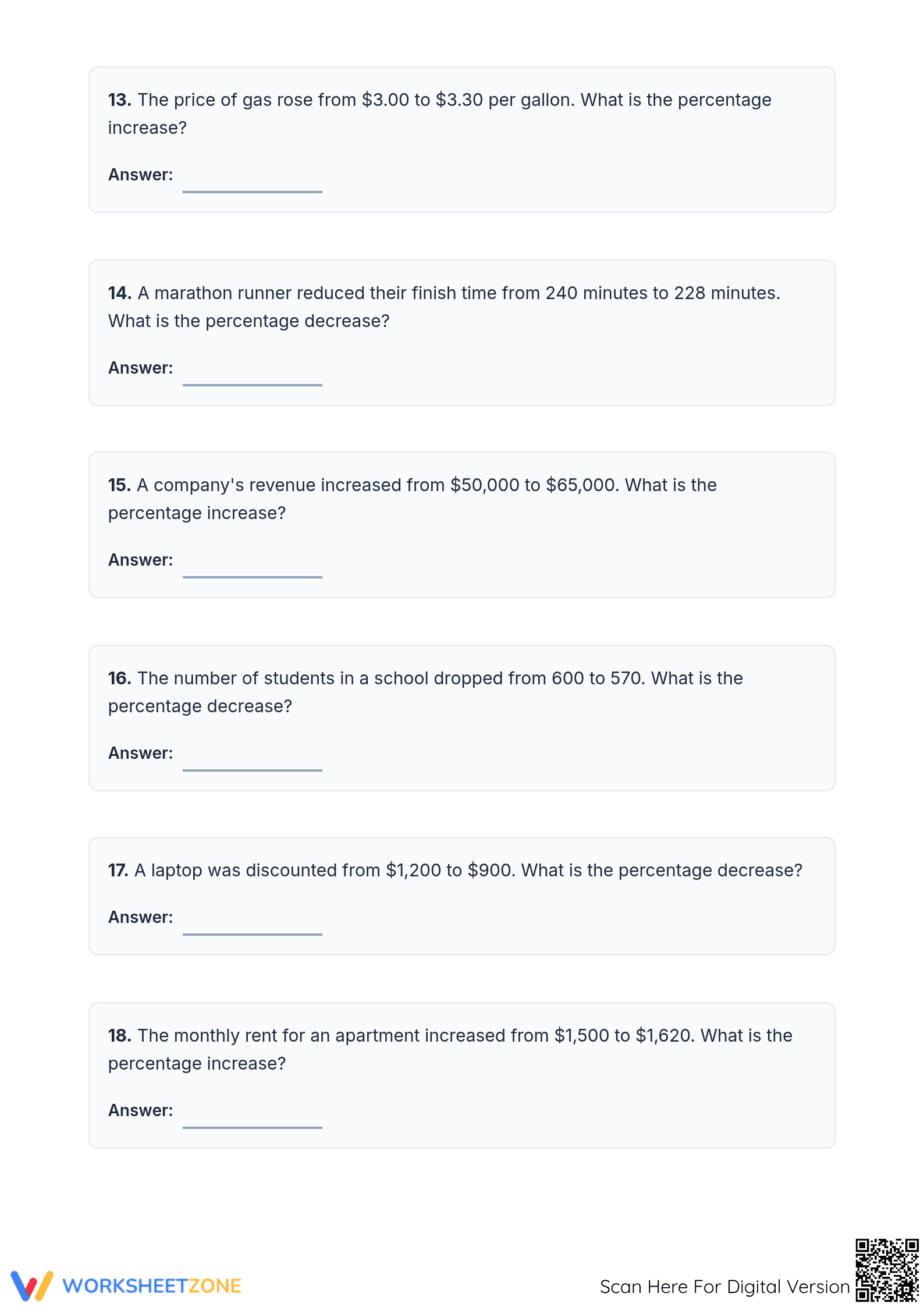
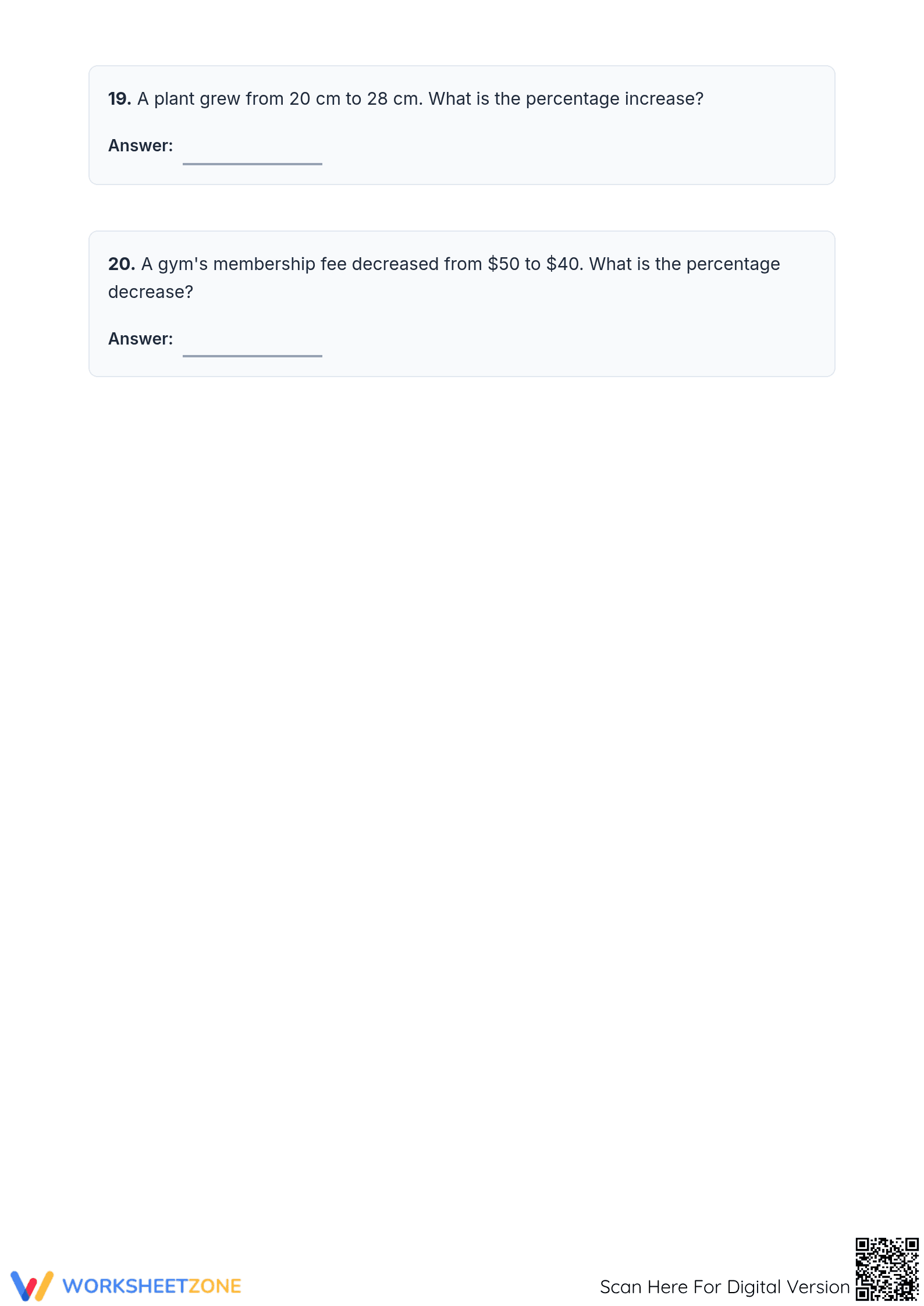
This four-page resource contains a balanced mix of abstract calculation and applied reasoning. The first two pages feature a structured table where students identify if a change is an increase or decrease before calculating. The final pages present ten real-world word problems covering retail discounts, population growth, and business revenue. A complete answer key is provided for immediate feedback.
The worksheet follows a logical instructional sequence. Items 1-10 offer guided table-based practice with visual cues to help students distinguish between upward and downward shifts. This is followed by supported practice through short-sentence word problems. Finally, students engage in independent practice with multi-sentence real-world applications requiring data extraction. This gradual-release model ensures student confidence and mastery of percentage shifts.
This resource is directly aligned to CCSS.MATH.CONTENT.7.RP.A.3, which requires students to use proportional relationships to solve multistep ratio and percent problems. It also supports the Mathematical Practice of modeling as students apply percentage concepts to real-world scenarios. Both standard codes can be copied directly into lesson plans, IEP goals, or district curriculum mapping tools.
Use this worksheet during the "We Do" or "You Do" phase of a lesson. It serves as an excellent formative assessment tool; teachers should observe if students correctly identify the original amount as the divisor, which is a common point of confusion. The 35-minute completion time makes it suitable for a standard class period or a comprehensive homework assignment for middle schoolers.
This material is designed for 7th-grade students mastering proportional relationships, though it remains highly effective for 8th-grade review. It is particularly useful for students who benefit from structured layouts and clear transitions from abstract numbers to contextual problems. Pair this with a percentage change anchor chart for maximum classroom instructional impact.
According to the RAND AIRS 2024 report, structured mathematical drills combined with contextual word problems significantly improve retention of proportional reasoning skills among middle school students. This worksheet implements these findings by bridging the gap between raw calculation and practical application of CCSS.MATH.CONTENT.7.RP.A.3. By requiring students to first identify the direction of change before performing calculations, the resource reinforces the conceptual understanding of ratios as described in Fisher & Frey (2014) research on gradual release. This methodology ensures that learners do not just memorize formulas but understand the underlying relationships between values. National assessment data from NAEP indicates that mastery of percent change is a critical predictor of success in high school algebra. This printable resource provides the essential repetition needed for that mastery, making it a reliable addition to any Grade 7 mathematics curriculum or intervention program.


