


























Views
Downloads

Printable Percent Increase and Decrease Worksheet | Grade 7
Paste this activity's link or code into your existing LMS (Google Classroom, Canvas, Teams, Schoology, Moodle, etc.).
Students can open and work on the activity right away, with no student login required.
You'll still be able to track student progress and results from your teacher account.
This printable Grade 7 math worksheet empowers students to master the essential skill of calculating percent change. By navigating through 20 structured problems, learners develop the fluency required to compare original and new amounts accurately. This comprehensive resource ensures students can distinguish between growth and reduction while applying mathematical reasoning to real-world financial scenarios and data sets.
At a Glance
- Grade: 7 · Subject: Math
- Standard:
7.RP.A.3— Use proportional relationships to solve multistep ratio and percent problems like percent increase.- Skill Focus: Percent Increase and Decrease
- Format: 4 pages · 20 problems · Answer key included · PDF
- Best For: Independent practice and formative assessment
- Time: 30–45 minutes
What's Inside
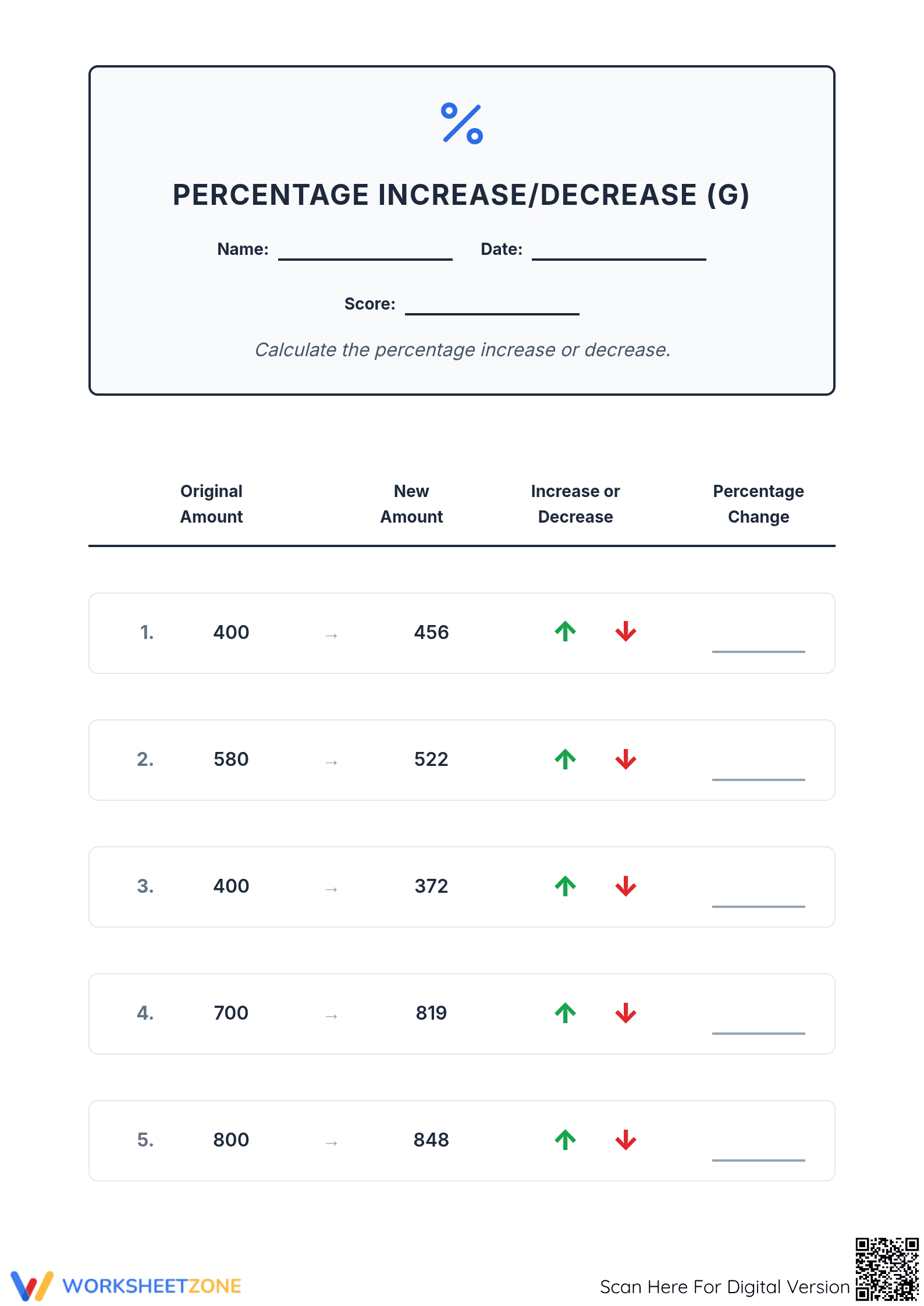
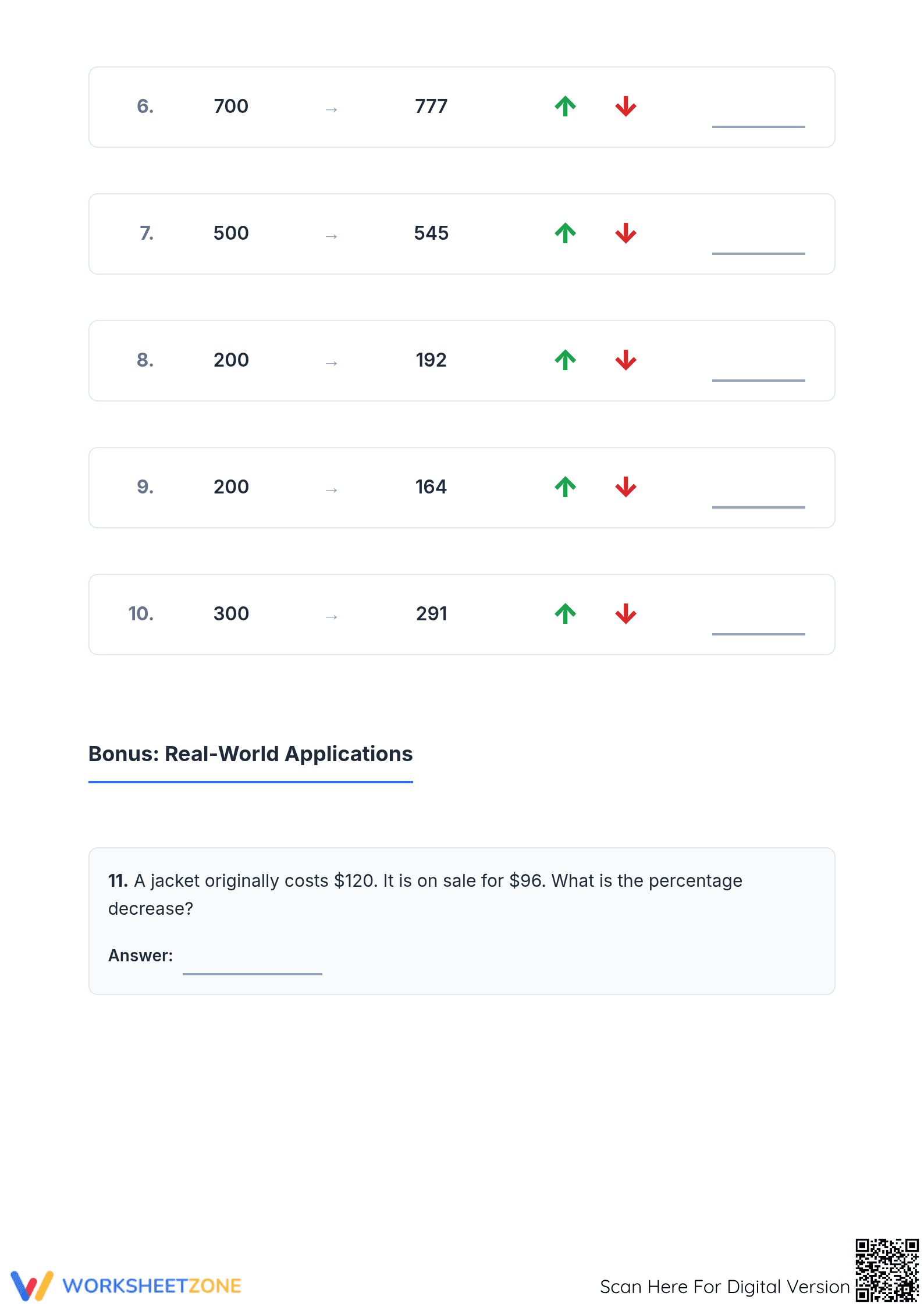
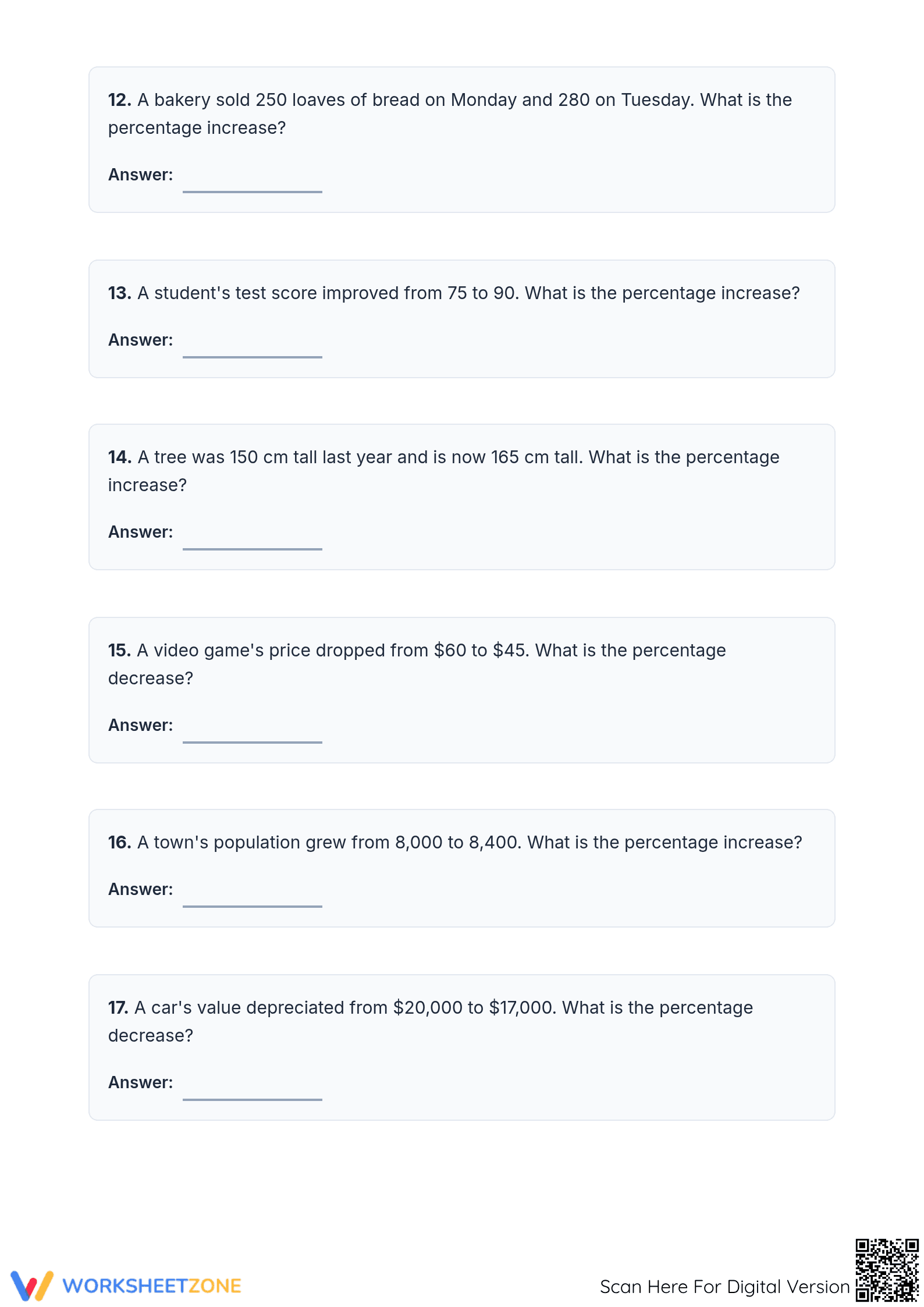
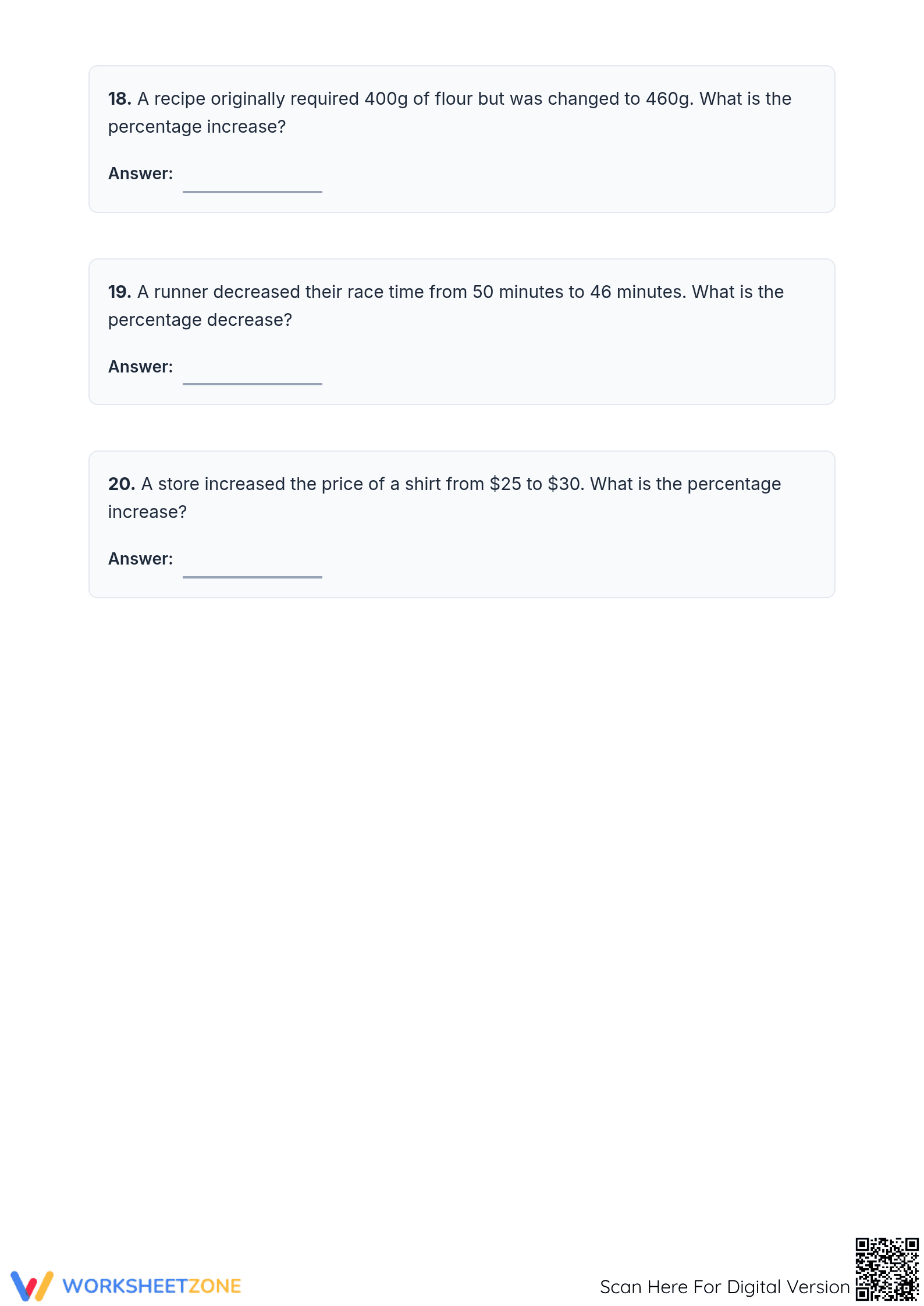
This four-page PDF includes a diverse range of 20 problems designed to build confidence. The first two pages feature ten table-based calculations where students identify the direction of change and compute the exact percentage. The subsequent pages present ten real-world word problems, ranging from retail discounts to population growth. A full answer key is provided for immediate feedback and grading efficiency.
Skill Progression
- Guided practice: The initial 5 problems use simplified integers to help students internalize the formula: (Change / Original) × 100.
- Supported practice: Problems 6 through 10 introduce larger values and various directions of change, requiring more precise division and selection.
- Independent practice: The final 10 word problems strip away the table structure, forcing students to identify the "original" vs. "new" amount within a narrative context.
This progression follows the gradual-release model, moving from scaffolded identification to independent application.
Standards Alignment
The worksheet is strictly aligned to 7.RP.A.3: "Use proportional relationships to solve multistep ratio and percent problems. Examples: simple interest, tax, markups and markdowns, gratuities and commissions, fees, percent increase and decrease, percent error." It specifically targets the foundational understanding of percent change as a ratio. This standard code can be copied directly into lesson plans, IEP goals, or district curriculum mapping tools.
How to Use It
Use this worksheet during the "You Do" phase of a lesson after students have mastered basic percentage calculations. It serves as an excellent tool for a mid-unit formative assessment to identify students who struggle with identifying the correct base (original) value. Expected completion time is 35 minutes for most Grade 7 students.
Who It's For
This resource is designed for Grade 7 middle schoolers, though it provides valuable remediation for Grade 8 students or an accelerated challenge for Grade 6 learners. It pairs naturally with a lesson on proportional relationships or a financial literacy unit involving markups and discounts.
The ability to calculate percent increase and decrease is a cornerstone of middle school mathematics, bridging the gap between basic arithmetic and algebraic reasoning. According to the RAND AIRS 2024 report, students who master proportional reasoning in Grade 7 show significantly higher proficiency in high school functions and data analysis. This worksheet targets the 7.RP.A.3 standard by requiring students to synthesize their understanding of ratios and multi-step operations. By transitioning from table-based identification to contextual word problems, the resource reinforces the conceptual shift from additive to multiplicative change. Research by Fisher & Frey (2014) highlights that structured practice with real-world scenarios, such as the depreciation and growth cases included here, enhances long-term retention of mathematical concepts. This self-contained 20-problem set provides the necessary repetition to ensure students can accurately determine percent change in varied professional and personal contexts.


